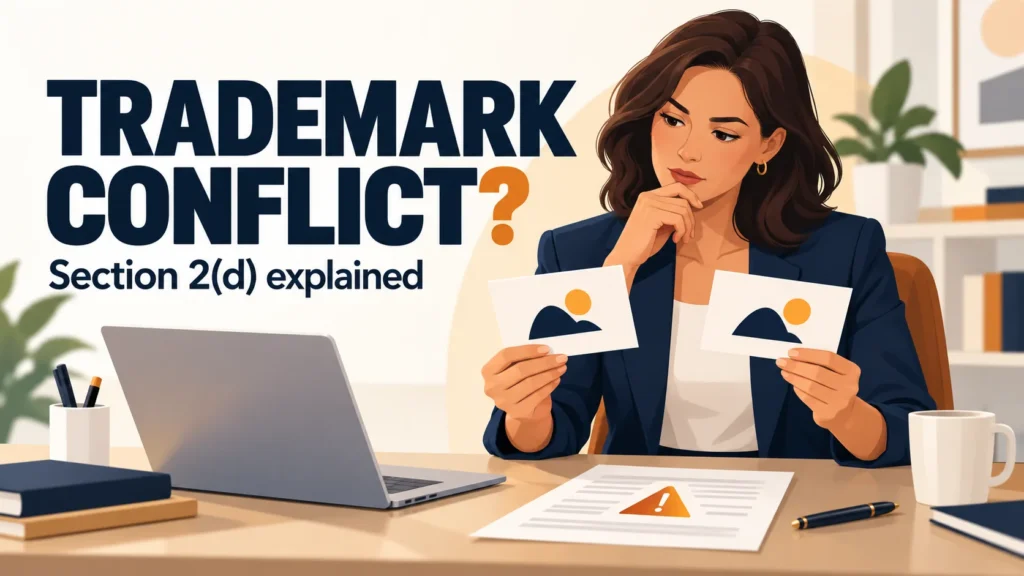
You filed an application to register a trademark, and the USPTO says it is likely to be confused with someone else’s mark. That is a refusal under Section 2(d) on the ground of likelihood of confusion. This means the examining attorney has determined the marks are close enough — and the (related) goods or services are sufficiently related, that consumers might assume a common source, sponsorship, or affiliation.
There must be no same marks or corresponding products. Conflict can arise between a clothing brand and a similarly-themed clothing retail service; likewise, two differently spelled names can phonetically sound almost identical. But to refuse is not read as ruling out every conceivable use of your brand. It has to do with your specific application, the registration cited, and the record 28
This guide walks through the two comparisons central to a USPTO likelihood-of-confusion review, the DuPont factors, real-world examples, and options for response. If you were hit by an Office Action, start with the date of issue and response deadline, cited registration, and each reason for refusal (with detailed information on why).
What Is USPTO Trademark Likelihood of Confusion?
USPTO trademark likelihood of confusion asks whether consumers encountering two marks on the relevant goods or services are likely to believe those offerings come from the same business, or that the businesses are connected. The examining attorney considers the marks, the identified goods or services, and relevant evidence under the Section 2(d) framework. A mere possibility of confusion is not the standard; the inquiry is case-specific. See the USPTO’s grounds for refusal and TMEP §1207.01.
What Does a Section 2(d) Trademark Refusal Mean?
Under the Act, Section 2(d) provides that registration must be refused where a proposed mark so resembles a qualifying prior mark as to be likely, when used on or in connection with the goods or services of the applicant, to confuse. The mark that is the subject of all but ordinary examination is almost invariably an existing federal registration. The office action must specify the registration and detail how the examiner compared your application.
Existing Registered Mark
A registration, in itself, can lead to a direct refusal. Consider its imprint, and the goods or services attributed to it in relation to your own; noting the fact that what appears on its present-day website does not reflect the potentially much broader class of registration.
Earlier-Filed Pending Application
There can be a conflict with an application that has been filed earlier. This can even lead the USPTO to inform you of it — and suspend your application—all while that prior case is ongoing. To be clear, a pending application is not the equivalent of a registered mark cited in a final Section 2(d) determination, and cannot, therefore, support a rejection unless it registers. If you are looking for a better answer workflow, check out Trademark Office action response.
Two Most Important Likelihood-of-Confusion Questions

1. Are the Marks Similar?
When buyers see, hear, and understand, take the marks as a whole — words and design elements — while knowing that a unique common element can be especially powerful.
2. Are the Goods or Services Related?
Ask whether consumers might reasonably expect the offerings to come from one source. Their being in different classes does not settle that question.
Similar marks + related goods or services generally mean greater Section 2(d) risk. This is a useful starting point, not a formula or a prediction of your result.
How Does USPTO Compare the Trademarks?

The USPTO compares marks in their entirety for appearance, sound, meaning, and overall commercial impression. It does not require a side-by-side photographic match. Nor should one shared syllable be pulled out of context and treated as the entire mark. TMEP §1207.01(b) explains these comparisons.
Disclaimed wording also remains part of the mark in this comparison. Our Trademark Disclaimer guide explains what a disclaimer does and does not change.
Similar Appearance
How marks appear may be affected by spelling, length, and placement in a specific piece of art as well as design features. A word mark for a standard character is not limited to the font displayed on the company web page.
Similar Sound or Pronunciation
However, different spellings might be pronounced the same. This allows examiners to take into account how people would pronounce something (particularly if they are requesting the product in person or hearing a recommendation).
Similar Meaning or Connotation
Equivalent words can be equivalent in meaning even with their letters being different. Context is key: a term could imply one thing for software and another for food.
Similar Commercial Impression
This is the big idea that a given buyer remembers from examining the mark. It could be as simple as adding a generic product word, or redesigning, which reflects much the same main impression and may not signify — else it signifies the other way round. You still need to take into account the entire mark.
Do Trademarks Have to Be Identical to Conflict?
No. Not a degree, different word order, a new spelling, or a logo solves a conflict. I will be using fictional names such as ZAYNO and ZAINO for the same apparel type. A buyer might remember them and say them almost the same way, even though they have different letters. But as the old saying goes, “more than just a pickle; pickles are a delicious complement to your meal.” In contrast, such a small visual difference would be important only when it significantly alters the significance of the marks themselves or their overall impression. The analysis is also based on the specific goods and services.
How Does USPTO Determine If Goods or Services Are Related?

It is not necessary to have the same products and services or compete directly. Examiners take into account the descriptions in the application and cited registration alongside facts that speak to whether consumers would expect those offerings came from the same source. They can be complementary, available through the same sets of outlets, or typically offered under a single mark. An example of this is clothing and online retail services for clothing — the former is a good, while the latter is a service. Not every store, however, is at odds with any manufacturer.
Broad identifications can matter. An application that is merely identified as “shirts” cannot typically defeat a conflict with another applicant simply by stating it currently only sells premium shirts through its own website if that restriction does not appear in the identification. Similarly, actual adverts of that cited registration do not necessarily limit an unqualified identification. Different trademark classes do not automatically prevent a Section 2(d) refusal. See the USPTO’s examples of related offerings.
Similar Marks Can Result in Unrelated Goods
These two comparisons interact. Where marks are sufficiently alike, evidence of a lower degree of goods or services relatedness may be enough to support confusion than when those marks are less similar. Identical names do not conflict across the board for every product, nor does a weakly related offering always result in an automatic refusal.
Imagine, in theory, the precise same made-up language on backpacks and with one reverse-knowing providing custom complete entirely unadorned packs. The link between the products may be more convincing than if the names also suggest ideas that differ significantly. A supported, case-specific analysis is still necessary for the examiner. See TMEP §1207.01(a).
What Are the DuPont Factors?
DuPont and the Federal Analysis of Likely Confusion. The factors are derived from In re E. I. du Pont de Nemours & Co. There were several factors in the original list, including similarity of marks, relatedness of goods or services, channels of trade/proof relating to buyer conditions, number and nature of similar marks in use (or actual confusion), consent agreements (and other circumstances).
They are not a mechanical series of tick boxes. Not all the factors are evidenced in each application, and to different degrees. In a typical exam, the examiner begins with the application and extrinsic evidence that can properly be incorporated into the record, including cited registration. TMEP §1207.01 describes the framework.
Which DuPont Factors Matter Most?

Similarity of the Marks
This is often integral, as the mark serves as a source identifier for consumers. Your answer should comment on the actual comparison made by the examiner, built for comparing looks and sound, and meaning, and take an impression, not just to say that their spelling is different.
How Well The Goods or Service Relates
This is often equally central. But the next question is perhaps whether buyers may associate the tentpole offerings they spot with a single source. Data on marketplace practice likely will help; unsupported claims that “our businesses are different” rarely tell the whole story.
When the record supports other factors, the evaluation may shift. It should focus on what really matters in this case, rather than parroting out all thirteen DuPont factors without supporting data.
Other DuPont Factors That May Matter
Trade Channels
This can depend on where and how these identified goods or services usually reach buyers. It may be a broader identification, however — one that includes regular channels even when an organization is battling all the time.
Purchaser Sophistication and Purchase Conditions
The same ambiguity may be influenced by the care that accompanies a purchase. A contract with an enterprise may undergo more scrutiny than an inexpensive impulse purchase, but careful buyers can still confuse source or affiliation.
Cited Mark Strength or Weakness
A very unique mark, for example, may be one situation as opposed to a term that many more individuals use to convey equivalent products. The evidence needs to be of the right kind; weakness does not license someone free and clear to register a confusingly similar mark.
Contextual and Similarity Related Marks
Relevant third-party use that can illuminate what consumers actually see; and registrations could also be probative of a term’s conceptual weakness. Market uses are seldomly established by a bare list of search hits.
Actual Confusion
Actual confusion is important evidence, but such an incident is not needed. If the marks have not been in use side by side for a sufficient time or on a meaningful scale, an absence may be of little moment.
Consent Agreements
In particular, an agreement with the cited registrant can serve a useful purpose by explaining how the parties will mitigate any potential confusion. And the contents and other evidence still make a difference.
Other Relevant Circumstances
The framework permits relevant facts supported in the record; it does not invite speculation about changes to businesses in the future. See TMEP §1207.01(d).
Likelihood of confusion in trade channels;
Trade channels refer to the paths by which offerings travel to get to customers—online stores, brick-and-mortar shops, wholesale distributors or through direct sales to professional buyers. Strengthening a refusal-related (Questionable) offering sold to overlapping buyers via ordinary (ordinary) channels, capable of generating more than one refusal.
For example, let’s say you have one business that is selling clothes online and the other that sells in boutiques. Just that marketing difference may not fix the issue, especially if there are no channel limitations in their identifications. Sometimes, properly supported, permissible disadvantageous limitation of the applicant’s identification counts; an assertion in a reply “we will sell exclusively online” is not an assessment. TMEP §1207.01(a).
Does Buyer Sophistication Matter?
So yes, when the record supports it but it’s not a get out of jail free card. The shopper who has started a buying journey for an accessory worth less money may conclude the purchase quickly. Buyers of enterprise software or specific industrial gear might scrutinize vendors. Even an expert purchaser can assume that affiliates in product categories with a shared parent company, or licensed rights. Think about who actually purchases the identified products or services(eg, a consumer is not limited to spatial professionals).
Are Weak or Generic Trademarks Afforded Narrower Protection?
In certain circumstances, evidence that a shared word or idea is in widespread use to describe similar services may instead lend support for a narrow segment of protection for an element. This may be evident in each context of third-party registrations as well as actual marketplace uses.
Screenshots of search results will not be enough to show how a third party uses the mark, and/or whether it is using the mark in the course of trade and how consumers may encounter it. But where the marks and goods/services are otherwise close, even a barely more than nominal shared term will not defeat a refusal. See TMEP §1207.01(a).
Is There Such a Thing As Real Confusion?
No. Section 2(d) relates to confusion likelihood; the USPTO need not wait for someone to actually purchase from the wrong source. This is specifically applicable to an Intent-to-Use Trademark application, whereby the proposed mark may not be in use yet. If the two marks have coexisted for a substantial period of time, evidence relating to that experience can be informative, but “we have never heard a complaint” is not prima facie proof that there is no likely confusion.
Both Trademarks Cannot be Registered If they are Similar.
Sometimes. The goods/services may be sufficiently dissimilar, the marks may create different commercial impressions, the common element may be relatively weak, or a strong showing of consent (or lack thereof) could tip the scales. Just because someone else has a registration history doesn’t decide a new case, and just because an earlier approval set precedent does not necessitate an examiner approving yours. It, however, remains to be discussed in what context the relevant evidence weighs on this application and cited mark.
Trademark Likelihood-of-Confusion Examples
All five examples below are hypothetical. They illustrate questions to investigate, not predictions of USPTO outcomes.
| Situation | What deserves attention |
|---|---|
| 1. Similar sound, same goods: ZAYNO vs ZAINO for clothing | Similar pronunciation and overlapping goods could increase risk, despite different spelling. |
| 2. Similar name, unrelated goods: a fanciful name for garden hoses versus the same name for specialized medical instruments | The offerings’ relationship may be much harder to establish, though a full search and facts still matter. |
| 3. Shared leading word: LUMERA vs LUMERA ACTIVE for athletic apparel | Added wording may not change the impression of the shared distinctive word enough. |
| 4. Goods and retail services: a mark for jackets versus a similar mark for online retail services featuring jackets | A goods-versus-services distinction alone may not prevent a finding of relatedness. |
| 5. Similar imagery, different words: two logos with a strikingly similar mountain-and-sun device but different names for outdoor gear | Compare each complete composite mark; the common design and different wording both matter. |
Just Keep Adding Words: When Is a Trademark Different Enough?
Not automatically. Including a descriptive product term, company suffix or tagline may leave a distinctive shared word exposed. Additionally, a single altered letter can substantively alter meaning and tone of voice. Do a comparison of the full marks in context, and explain why the addition is or is not important to prospective buyers.
Is Probability of Confusion Avoided by Different Spelling?
Not necessarily. ZAYNO and ZAINO may even sound alike in the fictional clothing case. Spelling matters to how things appear and can matter for the meaning. An example useful response describes both mark comparisons rather than presuming either that sound always wins, or that a morphed letter indicates the inquiry has ended.
Avoiding a Section 2(d) Refusal by Being in Different Trademark Class
No—not by itself. They do not create sealed markets—trademark classes help with administering applications. A relatedness question could arise when comparing clothing goods in Class 25 and retail services featuring clothing in Class 35. Read Trademark Classes Explained: The Complete Guide to ALL 45 USPTO Classes and the Trademark Class Finder for your classification, then review and analyze the actual identifications and proof separately.
Was a Trademark Search Able to Find Likelihood-of-Confusion Issues Before Filing?
The behaviour of an early clearance search can be indicative. Go beyond the literal and exact matches to consider synonyms, homophones, translations, similar meanings (as we discussed above), co-pending applications or registered marks, as well as proximity of goods or services. Because you want to review the entire record, not just a results page. While searches obviously can assist you in selecting or fine-tuning a proposed mark, they in no way will substitute for an express ruling by the USPTO. For now, the USPTO trademark search resources
See our trademark clearance search guide for a step-by-step pre-filing process.
How Do You Respond to a Section 2(d) Likelihood-of-Confusion Refusal?
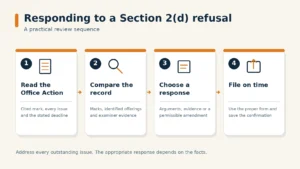
First read the entire Office Action, identify each cited registration and separate requirement, and calendar the stated deadline. For many Section 1 and 44 applications, an examining-attorney Office Action has a three-month response period with one available three-month extension requested for a fee before the deadline; Section 66(a) Madrid applications generally have six months without that extension. Always check the actual notice and current USPTO response rules. A response should address every outstanding issue, not just Section 2(d).
Contend the Marks Are Disparately Different
Identify specific differences in appearance, sound, meaning, and commercial impression, but also address commonality. The overall marks will be considered by the examiner.
Claim that the Goods or Services Are Unrelated
Check out the actual identifications, and study the evidence furnished to link them. When the examiner says that marketplace evidence shows X, and it does not demonstrate what he claims — so explain why with support.
Take Care of Trade Channels or Buyer Conditions
Demonstrate relevance of considerations against the descriptions of record. A narrow business plan that does not make its way into broad identification wording may carry little force.
Demonstrate that a common factor is weak.
Third-party registrations or documented marketplace uses may back up the assertion. Instead of copying and pasting search results or registration numbers, put usable evidence on the record.
Narrow Goods or Services
In those jurisdictions where it is allowed, a plainly narrowing amendment can change the relatedness analysis. After filing, applicants can each narrow or clarify an identification, but they do not: be able to broaden the scope of the original identification. Visit Also: Can You Add a Trademark Class After Filing? And Trademark Classes Explained before choosing what to delete or narrow.
Associates With a Consent or Coexistence Agreement
The mentioned owner will discuss a structured arrangement; negotiations require some caution, and consent does not mean approval.
Address the Examiner’s Art Directly
What do these actual third-party websites have to do with this application, and/or what are their limitations (if any)? Provide your supporting materials where necessary. Unsupported formulas like “the marks look different, and consumers are sophisticated,” rarely respond to a nuanced rejection. Filing the Response: You can read about this process under Trademark Office Action Response.
What is a trademark consent/coexistence agreement?
It is a pact for concurrent use or registration of marks between mark owners. It might indicate separate arenas or channels, the manner of presentation of the parties’ marks, steps to avoid confusion, and remedies for situations in which actual confusion occurs. This agreement is viewed by the USPTO in conjunction with the totality of a DuPont analysis. A simple agreement to consent may be less important than a reasoned agreement with practical safeguards in place, and no arrangement is a guarantee of registration. See TMEP §1207.01(d)(viii)..
Our trademark coexistence agreement guide explains how consent differs from broader coexistence terms and what the USPTO considers.
What Happens if Section 2 (d) Refusal Is Final
Final does not mean all procedural routes have been taken. You will then file a Request for Reconsideration, an appeal with Notice of Appeal to the TTAB, or both, as necessary and in due time. Apply for reconsideration within the time limit. There is no extension of the appeal deadline on its own. Quickly assess what the instructions are for the final action; the correct path and timing will depend on both record and filing basis. See the USPTO’s response guidance and TTAB appeal guidance.
Likelihood of Confusion vs Trademark Infringement
| USPTO Section 2(d) registration review | Trademark infringement dispute |
|---|---|
| An examining attorney evaluates an application; the TTAB can review an appealed refusal. | A court evaluates asserted rights and alleged unlawful use. |
| The immediate issue is whether the applied-for mark can register. | The dispute may concern liability and remedies. |
| The DuPont factors guide federal registration analysis. | Federal courts may use circuit-specific frameworks, such as Sleekcraft, Lapp, or Polaroid. |
| The application’s and cited registration’s identified offerings are central. | Actual marketplace conduct and other litigation evidence can be central. |
This article deals with USPTO registration (not trademark infringement litigation). A refusal does not, anyhow, decide an infringement claim or a right to use every mark. A marketplace dispute may need further legal guidance outside of the scope of this work.
Common Likelihood-of-Confusion Mistakes
Might Pansy, meaning not copying “Out-Going”, may matter. Here, there are 3 indications — no matching criteria; marks must be identical.
- Assuming different classes represent no conflict: Related offers can be in different classes.
- Only reviewing exact matches: Variants and pending apps that predate it get no attention
- Homophony: Distinct letters can represent the identical spoken name or thought.
- By finding a new logo, it is assumed that the problem has already been solved: The common wording may still play a key role.
- Not including the complementary goods or services: An overlapping buyer represents a retailer and product maker.
- When it comes to no actual confusion: the problem is not a documented error; it is a likelihood.
- Generic arguments without evidence: Address the documented record and identifiable indicators.
- Consent is often treated as automatic approval: circumstances — the terms and overall conditions matter still.
- Missing the Office Action deadline: Response after announcement could mean abandonment; confirm date in your notice.
Can You Answer a Section 2(d) Refusal by Yourself?
Yes. Section 2(d) is substantive in nature (although applicants could respond themselves if not otherwise precluded from acting in the application). Multiple registrations, DuPont analysis, proof and recommended amendment choices—and a final Office Action. In certain cases, applicants are able to put together a convincing argument; others require assistance from a U.S.-licensed trademark attorney. If you are foreign domiciled, the USPTO will usually require that an attorney hold a U.S. patent bar license to represent you. This article is educational in nature — not guidance relevant to your own refusal.
See our Merely Descriptive Trademark guide.
When does it make sense to seek professional assistance?
Look for assistance where the marks are very close, the initials can be construed as identical, where the examiner quotes a suite of registrations, you have an important narrowing amendment in hand, consent negotiation is appropriate, or conversely, where the refusal is final and may require appeal. This also holds in case the Office Action incorporates more grounds. Advice allows you to evaluate the record and maintain procedural options; it does not guarantee a specific outcome.
Need Help With a Section 2(d) Trademark Refusal?
Contact EagleMarkUSA Office Action Assistance to discuss the cited registrations, evidence, and possible response paths. For pre-filing planning, see EagleMarkUSA Trademark Registration Services. The business’s actual Trademark Use in Commerce and, when applicable, Intent-to-Use Trademark basis should also be reviewed; neither basis bypasses a Section 2(d) examination. For timing, see How Long Does It Take to Get a Trademark? If another party challenges a published application, Trademark Opposition is a separate process.
Frequently Asked Questions About USPTO Likelihood of Confusion
Likelihood of Confusion – What is it?
The question of whether consumers would be likely to think two marks used with respect to the relevant goods or services signify the same source or an affiliated business. The USPTO evaluates the marks, identifications, and relevant evidence without requiring proof of a real purchase confusion.
Which is a Section 2(d) refusal?
An examiner may refuse the mark filed because it is too similar to a registered earlier qualifying mark covering related goods/services. The Office Action should identify the cited registration and clarify what conflict is being asserted. Alternatively, a pending application filed earlier than the one under scrutiny may lead to an advisory or suspension while its result is checked.
What are the DuPont factors?
They are the elements of federal registration analysis: mark similarity, relatedness of goods or services, trade channels between those goods or services, buyer conditions, third-party marks, actual confusion, and consent. This is an evidence-based analysis; the importance of every factor need not be meaningful or uniformly critical in all applications.
Which DuPont factors matter most?
In typical examinations, similarity of the marks and relatedness of the identified goods or services usually are the key starting points. Relevant evidence can support the result, but other factors may influence it. Good answers should focus only on the disputed points and what each party is arguing about them.
Must trademarks Be Identical?
Not necessarily – simply because there are differences in spelling, additional words or designs does not mean that a refusal will be avoided. The totality of the marks in appearance, sound, meaning, and commercial impression, along with the relatedness of the offerings, is considered by an examiner.
Can similar-sounding trademarks conflict?
Yes. Even if the written marks are quite different, similarity in pronunciation can potentially play a role in a likelihood-of-confusion ruling. That is one part of the whole mark comparison — however, experience, appearance, commercial impression, and also goods or services involved.
Can two similar trademarks coexist?
Sometimes. They may differ in the impression they create overall or serve sufficiently dissimilar products, and evidence of a congested market or a specific consent decree might play. Filing in different classes — that is, keeping two SSSAs separate — does not by itself lead to coexistence for specific goods.
All units of the commodity must be homogeneous, meaning goods and services are identical?
No. The focus is on whether they are related in a manner that consumers would assume a common source for the identified offerings. And again, depending on the marks and evidence relating to such goods and retail services featuring the goods, this can become an issue.
Does its presence in a different trademark class eliminate the possibility of confusion?
No. Classes are categories for filing, and goods and services associated with these classes can be filed separately. Stop treating class numbers like a safe harbor, compare the actual identifications and evidence.
Is adding a fifth word a dodge around a section 2(d)?
Not automatically. A word element may also be perceived as leaving a similar commercial impression if the shared portion itself remains distinctive and prominent. Additions can make a difference when they alter buyer perceptions of the total mark; outcomes are contingent on marks and terms.
Different Spelling Avoids Likelihood of Confusion
Not necessarily. You can have two spellings that sound the same or mean the same thing. You can also make a meaningful distinction when letters have been coarse-grained into a graph or some concept based on it. Marks are viewed as a whole, not captured under a spelling-only regulation.
But must there be actual confusion?
No. The issue is likely confusion. Confusion among buyers is relevant, but a company does not have to document an erroneous transaction to invoke Section 2(d) from the USPTO.
Is there a consent agreement that can overcome a refusal?
This can be helpful, particularly when it provides an indication of how the parties have assessed their relationship as well as concrete measures to minimise ambiguities. The USPTO weighs the terms against other evidence. I am sure you would agree that simply a bare consent or even a granular agreement does not guarantee approval automatically.
Responding to Office Action Section 2(d)
Verify the date of issuance and due dates, look for every single cited registration and both the examiner’s evidence, and then respond to refusals and requirements comprehensively in the response. You cannot really argue differentiations of marks or offerings, provide evidence that relates to the pleadings and can be made based on an allowed narrowing amendment, or consent. See Trademark Office Action Response
Yes, in certain instances.
Most often, a Notice of Appeal can be filed with the TTAB against a final refusal during the statutory time period. A Request for Reconsideration may also be offered, but that will not automatically extend the appeal window. Proceed with any specific final Office Action and current USPTO procedure; seek legal assistance before an impending deadline.
Conclusion
Whether consumers would be likely to confuse the source of the relevant goods or services is dealt with under a Section 2(d) refusal. Marks can be different, and the offerings do not have to be alike. Similarity of the total marks and position of the seen shops tend to be the ideal taking off positions while trade channels, buyer care, pressure, and other DuPont factors can also make a difference in light of the confirmation. The question cannot be resolved by different numbers of classes or a generic response.
Look at the specific Office Action just like a lawyer would, calendaring the deadline for response and responding to each of the registrations and rationale cited by the examiner. Without a proper record, no response strategy will secure your place.
Need Help Responding to a Likelihood-of-Confusion Refusal?
Contact EagleMarkUSA for assistance reviewing the cited registrations, mark comparisons, related goods or services, Office Action evidence, and possible response options.

Pingback: Trademark Office Action Response: How to Respond to the USPTO
Pingback: Same Trademark in Different Classes and USPTO Rules - EagleMark USA
Pingback: Trademark Class 25 Explained: Clothing, Apparel & Footwear
Pingback: Trademark Clearance Search: How to Search Before Filing
Pingback: Supplemental Register vs Principal Register: Key Differences
Pingback: Published for Opposition Trademark: Meaning & What Happens Next
Pingback: Trademark Opposition: Process, Grounds, Deadlines & Response
Pingback: Trademark Cancellation: TTAB Process, Grounds & Petition
Pingback: Incontestable Trademark: Section 15 Requirements & Benefits