

Sometimes—but only for goods or services within the scope of what your application already identified. In a U.S. application filed under Section 1 or Section 44, the USPTO may permit you to correct a classification or add a class for an item included in the original identification. You generally cannot use an amendment to introduce a new product or service that the original wording did not cover. Applications filed through the Madrid Protocol under Section 66(a) follow a stricter rule: the USPTO cannot add classes to them.
That distinction matters when your business grows after filing, or you notice an error in the application. A missing class number and a missing product are different problems, with different solutions. This guide explains what changes the USPTO may accept, what typically requires a new application, how fees work, and what to check before you respond to an Office action. For a broader introduction, see our guides to trademark classes and registering the same trademark in different classes.
Can You Add a Trademark Class After Filing? The Short Answer
The USPTO looks first at the identification of goods and services—the actual wording describing what the mark covers. The class number alone does not determine whether an amendment expands that wording in a Section 1 or 44 application. The following table is a practical starting point, not a ruling on a particular filing. USPTO TMEP §§1402.07, 1403.02
| Proposed change | Usually allowed? | Key condition |
|---|---|---|
| Add an entirely new product or service | No | A new item outside the original identification requires a new application. |
| Broaden the identification | No | Amendments may clarify or limit its scope, not expand it. |
| Delete an existing item | Generally yes | Once deleted, an item generally cannot be put back into that application. |
| Narrow or clarify an existing item | Often | The revised wording must stay within the current identification’s scope. |
| Correct a class for goods or services already identified | Sometimes | Section 1/44 applications can correct classification, subject to the circumstances. |
| Add a class for an originally identified item | Sometimes | In a Section 1/44 application, the item must genuinely belong in the added class; fees and other requirements apply. |
| Add a class to a Section 66(a) Madrid application through the USPTO | No | The international classification is controlled by WIPO’s International Bureau. |
Filing basis, application stage, fees, and any use requirements also matter.
Adding a Class Is Different From Adding New Goods or Services
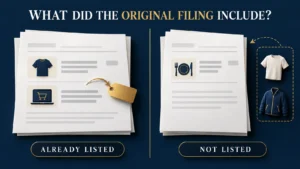
The question “Can I add another class?” can mean two different things. Perhaps the application already lists a product but assigns it to the wrong class. Or perhaps it never mentions the product at all. Read the filed identification before deciding which problem you have.
When the original application already identifies the offering
Suppose a Section 1 application describes both “shirts” and “online retail store services featuring clothing” but lists or pays for only one class. Shirts are clothing goods in Class 25; the separately identified retail service is generally in Class 35. Subject to the precise wording and application record, the USPTO may require an additional class and fee or an amendment restricting the application to the paid classes. The retail service was already stated; adding its appropriate class does not insert a newly invented service. USPTO TMEP §1403.01
When the offering was never identified
Now suppose the application lists only “restaurant services.” The restaurant later begins selling branded shirts and jackets. Clothing is not covered merely because customers can buy it at the restaurant. Adding clothing goods would expand the original identification; the owner would generally need a separate application for the clothing.
Even if the business sold the omitted product at filing, the filed wording controls the amendment.
Why Can’t You Broaden the Goods or Services After Filing?
Other businesses rely on the public application record when evaluating marks. USPTO rules allow applicants to clarify or limit, but not broaden, the identification. The original wording—and any later accepted narrowing—sets the boundary for subsequent amendments. USPTO TMEP §§1402.06–1402.07
For example, “shirts” may potentially be narrowed to a particular type of shirt. Changing “T-shirts” to “clothing” would move from a specific item to a much broader category and would not be an ordinary permissible amendment. The precise result depends on the wording and its ordinary meaning. An applicant also cannot claim everything in a class simply by naming that class or copying its heading.
Can You Change the Goods or Services in an Existing Application?
Yes, within the amendment limits:
- Delete: Remove an item you no longer wish to pursue. An item expressly deleted generally cannot later be reinserted into the same application.
- Narrow: Add a genuine limitation, such as specifying a subset of goods already identified.
- Clarify: Replace unclear wording with a definite description that remains within its original meaning. The USPTO Trademark ID Manual can help identify acceptable terms.
- Do not add: An unrelated product or service cannot be appended just because the business now offers it.
Even a seemingly small change from a product to a service, or downloadable to hosted software, can alter scope. For example, broad initial wording such as “computer anti-virus software” may be clarified into either format within its scope; wording already limited to one format cannot simply change to the other. USPTO TMEP §1402.07(b)–(c)
Can You Add a Class While Responding to a USPTO Office Action?
Potentially. An examining attorney may flag a misclassified item or explain that your listed goods or services fall in more classes than you paid for. In a Section 1 or 44 application, a response can correct the classification or, where the originally listed items support it, add a class and pay the required fee. The applicant may instead narrow the identification to the classes already paid for when appropriate. USPTO TMEP §§1403.01, 1403.02
Follow the Office action’s instructions. A request to clarify wording does not authorize new products. Before an Office action, eligible corrections can be submitted by voluntary amendment. USPTO guidance on correcting errors
Can You Add a Class After Publication?
Changes become more constrained once an application is approved for publication. The USPTO provides a post-approval/publication amendment process for certain changes, including restricting, limiting, or deleting goods and services. It expressly says you cannot use that process to add goods or services or expand their scope. A proposed reclassification or additional class for already identified items requires review of the specific record, filing basis, and procedural stage; do not assume a class can simply be attached after publication. USPTO post-publication guidance
If publication has occurred, inspect the current application status and seek qualified guidance before submitting a change. A separate application is generally the route for an omitted product or service.
What If You Forgot a Product, Service, or Class?
Start with the document actually filed, not a draft or the description on your website:
- Read the identification. Is the offering already included in the ordinary meaning of its wording?
- Check the filing basis and stage. Section 1/44 and Section 66(a) have different class rules; publication and registration change the available procedures.
- Research the identification and class. Use the USPTO ID Manual and, if necessary, get advice about whether the proposed wording fits the existing scope.
- Choose the proper path. Seek an eligible correction or added class for an originally identified item; consider a new application for an omitted item.
Do not abandon a valid pending application merely because you need another for omitted items. Track each filing’s requirements and deadlines. Our Trademark Class Finder, multiple trademark classes guide, and USPTO trademark fees guide can support the review.
Example: Downloadable Software and SaaS
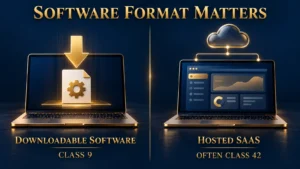
Imagine a company files for “downloadable software for project management” in Class 9. It later launches a hosted, non-downloadable software service. Providing temporary use of online non-downloadable software may fall in Class 42, but the initial identification expressly said downloadable. The new SaaS offering cannot simply be added to that application by paying for Class 42. The company should assess a new application with a properly described service. USPTO TMEP §1402.07
If the initial wording were broad enough to encompass either format, clarification might be possible. Software classification follows the offering and delivery model. See our Class 9 and Class 42 guides for more examples.
Does It Cost Money to Add a Trademark Class?
Usually, yes. As of 2026, the USPTO’s base electronic application filing fee for Section 1 and Section 44 applications is $350 per class. When a class is properly added later, its filing fee is due; other applicable fees or use-related filings may also be required. The USPTO says that classes added later to applications filed through its current system also incur the $200 per-class free-form text identification fee. Older applications and particular procedural situations can differ, so check the current fee schedule and the requirements for your filing before paying. USPTO trademark fee information · USPTO additional fees · USPTO TMEP §1403.02(c)
An additional-class fee cannot cure an omitted offering. A new application has its own per-class costs; intent-to-use filings can also have later use-related fees.
Special Rule for Section 66(a) Madrid Applications
A Section 66(a) U.S. application arises from an international registration under the Madrid Protocol. Its class assignments come from WIPO’s International Bureau. The USPTO cannot add a class, reclassify an item, or move goods or services between classes in that application. A correction by the International Bureau is a distinct matter. The identification may still need permissible clarification within the assigned class. USPTO TMEP §§1401.03(d), 1403.02
For an offering outside the Madrid application’s coverage, discuss a new filing route with a qualified trademark professional.
Can You Add a Class After the Trademark Registers?
Registration does not open a routine way to add newly developed products, services, or classes. A Section 7 amendment can address certain permitted corrections or narrowing, but it is not a way to expand a registration’s coverage. A new application is generally needed for a genuinely new offering. USPTO guidance on correcting registrations
There is a limited technology evolution petition for some existing registrations when the owner offers the same fundamental goods or services in an updated format and meets the USPTO’s conditions. It is not a general expansion tool. In certain eligible cases, the resulting amended identification can even be in a different class; Madrid-based registrations have additional limits, including no change in classification. USPTO technology evolution guidance
Common Mistakes When Trying to Add a Class
- Looking only at the class number. The original identification’s meaning controls whether a proposed Section 1/44 amendment stays within scope.
- Assuming a fee buys new coverage. Payment does not authorize goods or services that were never identified.
- Treating all software alike. Downloadable goods and hosted services can require different descriptions and classes.
- Deleting an item too quickly. An expressly deleted item generally cannot be reinserted later in the same application.
- Ignoring the filing basis. Section 66(a) does not permit the USPTO to add classes or reclassify items.
- Waiting until after publication or registration. The available forms and review process change as the application advances; check the status before acting.
Frequently Asked Questions About Adding Trademark Classes
Can I add a trademark class after I submit my application?
Sometimes. In a Section 1 or 44 application, a class may be added when goods or services originally identified are properly classified there, subject to fees and application requirements. You cannot use the additional class to bring in a newly identified offering outside the existing scope. Section 66(a) applications cannot add classes through the USPTO.
Can I add goods or services to a pending trademark application?
You can clarify or narrow existing wording when the amendment is otherwise proper. You generally cannot append a product or service beyond the scope of the original identification, even if you offered it before filing. For that omitted offering, evaluate a separate application.
What if I chose the wrong trademark class?
Check whether the goods or services themselves were accurately identified. In a Section 1 or 44 application, the USPTO may allow correction of an incorrect class designation, with an added-class fee if the correction increases the number of classes. Section 66(a) classification is controlled by WIPO’s International Bureau and cannot ordinarily be changed by the USPTO.
Can I add a class when responding to an Office action?
Yes, in an eligible Section 1 or 44 application when the original wording already identifies an item properly belonging in that additional class. The Office action may request the added fee and other class-specific information. Read its instructions carefully and keep any revised identification within the original scope.
Can I add a class after my trademark is published?
Do not assume so. Post-publication changes are subject to a separate process and may require additional review. Restricting or deleting identified items can be possible; adding new goods or services or broadening the identification is not. Have the exact application record reviewed if an originally identified item appears to need a class correction.
Can I add a class after my trademark is registered?
You generally need a new application for new goods or services. Certain corrections and narrowing amendments may be available for a registration. The USPTO also has a limited petition process for eligible changes caused by technology evolution, but it does not authorize ordinary business expansion.
Is it cheaper to add a class than file a new application?
That depends on whether an added class is legally available and what fees apply. As of 2026, the Section 1/44 base application fee is $350 per class, and a later-added class in the current filing system can trigger an additional $200 free-form identification fee. A new application has its own fees. Compare only the routes that actually fit your identification.
Does adding a class change my original filing date?
An eligible class added for an item already within the original Section 1/44 identification is part of the pending application; however, filing-date and priority consequences depend on the application and filing basis. A separate application for newly identified goods or services receives its own filing date. Seek legal advice if an intervening third-party filing makes timing important.
Can I add Class 42 to a Class 9 software application?
Only if the original identification and application record permit an amendment covering the relevant Class 42 service. An application specifically limited to downloadable software does not automatically cover a later SaaS service. If that service falls outside the filed wording, a new application is generally needed.
Need to Add Goods or Services to Your Trademark Filing?
There is a practical answer to “Can you add a trademark class after filing?”Check the original identification first. A Section 1 or 44 application may allow a new class for an item it already described, while an omitted product or service generally needs its own application. Section 66(a) Madrid applications do not permit classes to be added through the USPTO.
Before submitting an amendment, compare your actual offering with the filed language, confirm the filing basis and status, and review the applicable fees. Choosing a class because it sounds close to your industry does not establish coverage for everything your business does.
EagleMarkUSA can help you navigate the U.S. trademark registration process and review the practical next steps for your application. Contact us to discuss your filing. This article is general educational information, not legal advice for a specific situation; no service can guarantee USPTO approval.

Pingback: Trademark Classes: Complete USPTO Guide to All 45 Classes (2026)
Pingback: Trademark Class 9 Explained: Software, Electronics & Technology Goods
Pingback: Trademark Class 42 Explained: SaaS, Software & Technology Services
Pingback: Trademark Class 25 Explained: Clothing, Apparel & Footwear
Pingback: Trademark Class 35 Explained: Advertising, Business & Retail Services
Pingback: How Much Does It Cost to Trademark a Name in 2026? USPTO Fees Explained
Pingback: Trademark Office Action Response: How to Respond to the USPTO