
Trademark Opposition means a reply to a pending U.S. trademark application filed with the Trademark Trial and Appeal Board (TTAB). It usually starts right after the USPTO publishes the mark for opposition but before registration occurs. The disagreement is between private parties: someone opposes the registration with the feds for the applicant. This is unlike an Office Action that one would get from a USPTO examining attorney.
Do you wish to contest another person’s bid? You ask first when it was published, if you have legal standing to oppose it or get it in what time frame, and if you can file; if not, at least ask for an extension.
Has someone opposed your application? Go immediately and read the TTAB institution order. They set the answer deadline and the case schedule. Then assess the facts, your proof, possible defenses, and whether settlement makes sense.
This guide walks through the trademark opposition process from both sides. It is a source of general educational information, and not legal advice for any specific dispute.
What Is a Trademark Opposition?
A trademark opposition is a proceeding before the TTAB in which a party petitions the USPTO to refuse registration of another’s pending application. The opposer files a Notice of Opposition (notice also filed by the opposer—giving its interests and grounds in law); the applicant must answer and defend the application. The Board decides registration issues. Opposition does not, in and of itself, dictate whether the Applicant can use a mark in the marketplace. USPTO: About the TTAB.
When is it possible to oppose against a Trademark Application?
Before an application is approved for publication, it usually goes through review. The basic sequence is:
Apply → examine → approve → publish → 30-day opposition window→ registration (for use-based applications) / Notice of Allowance (for intent-to-use applications), as necessary.
Publication offers an avenue to object for people who think registration would be harmful to them. In general, as long as that dispute is pending, the application will not move to registration if an opposition is timely. A published use-based application that survives would allow the registration to proceed; however, an intent-to-use application may receive a Notice of Allowance and require a later use filing. Check out How Long Does it Take to Get a Trademark? for the full application timeline. USPTO: Approval for publication.
What Is “Published for Opposition”?
It means that the USPTO examining attorney has allowed the application to proceed to the Trademark Official Gazette to give third parties an opportunity to review it and file an opposition. The Gazette is a weekly publication, every Tuesday. Publication does not say that something is ok or that it has been registered. USPTO: Trademark Official Gazette.
Beginning October 2023, the opposition window starts on the publication date. A person wishing to challenge an application may look at the application, the goods or services against which it has been filed, and the earlier rights that are cited. However, other requirements of the application may remain pending even if no opposition is filed or an opposition has been settled in favor of the applicant.
If this status appears on your application, read our guide to what ‘Published for Opposition’ means and what happens next.
The length of the trademark opposition period
The first period is typically the 30 days post publication? To oppose an application, a prospective opposer must file a Notice of Opposition or send in a timely request to extend the opposition period. A private communication to an applicant, a demand letter, or an open discussion regarding settlement does not toll the running of time. USPTO: Initiating a new proceeding.
First Extension of Time
There is a first 30-day extension available on request and currently no USPTO fee associated with it. Or if earlier than the expiration of the first 90-day extension, good cause and payment of the required fee. The 90 days are calculated as an extension of the initial 30-day period, which means this could push the deadline to a maximum of 120 days after publication- not a further 90 days thereafter. 37 C.F.R. §2.102; USPTO fee schedule
Additional or Final Extensions

A 30-day extension is available and can be extended for up to an additional 60 days upon good cause. After 90 days of extension in total, the applicant’s agreement is necessary for another 60-day extension unless they face exceptional circumstances. The opposition time frame is limited to 180 days from publication and cannot be extended. Requests must be filed at least prior to the current due date, and the longer / final extensions both carry fees. Identify the proper party for which the granted extension is being requested, i.e., the named potential opposer or a qualifying related party. 37 C.F.R. §2.102.
Who Can File a Trademark Opposition?
The party must have a real interest within the law’s protection and a reasonable belief that registration would cause damage. The TTAB calls this entitlement to a statutory cause of action. The party also needs a legally sufficient claim. TTAB Manual of Procedure, §309.03(b).
An earlier trademark owner alleging likely confusion is a common example. A federal registration is not always required, but relevant earlier rights or another recognized interest and supporting facts are. Simply disliking the proposed name is insufficient.
Trademarks Opposed: On What Grounds?
The grounds are based on the facts and your application. A Notice of Opposition needs to allege the supporting facts, and the opposer ultimately has the burden of proving its case. These are just some of the common examples and not an exhaustive list. Trademark Trial and Appeal Board Manual of Procedure, Section 300.
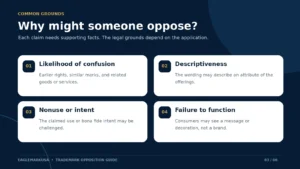
Likelihood of Confusion
An earlier mark owner argues that marks like these are likely to confuse consumers about source as well when similar goods or services are involved. Priority and relevant DuPont factors are important; identical marks or matching class numbers are not. Check USPTO Trademark Likelihood of Confusion.
Mere Descriptiveness or Deceptive Misdescriptiveness
The language purportedly describes, or distorts the description of, a characteristic of those identified goods. It is all about consumer perception and wording.
Genericness
A term supposedly designates the type of goods or services, rather than identifying their source.
No Bona Fide Intent to Use
Opposition under Section 1(b) stems from an opposer who questions whether a Section 1 (b) applicant ever really intended to use the mark with specified offerings at the time of its filing. See Intent-to-Use Trademark.
Nonuse
and the evidence of use is contested for the time period, and goods or services claimed in a use-based application. See Trademark Use in Commerce.
Lack of Functionality as a Trademark
What they consider an identifier of the source, consumers may see as just a message or decoration.
False Suggestion of a Connection
The standard set forth by the statute provides that a mark enhances the forbidden false perception of a link between a person or institution.
Dilution
A dilution claimant will plead fame; niche fame is not necessarily enough.
Fraud
This alleges a material misrepresentation with the requisite mens rea to deceive the USPTO. A simple error does not constitute fraud.
Ownership or Applicant-Eligibility Issues
A material defect may be alleged where the law and facts support it with regard to proper applicant or eligibility.
Trademark Opposition Based on Likelihood of Confusion
That ground is particularly problematic as the opposer may have been using its mark for decades, while the applicant believes its name is sufficiently distinguishable. Neither belief alone determines the case.
Your analysis should start with the priority and similarity between their marks in sight, sound, meaning, and commercial impression. It also questions whether the identified goods or services are related. Additional factors in claims supported can include trade channels, purchaser care, the strength of the prior mark, relevant third-party use, and actual confusion. Actual confusion is not necessary for a likelihood-of-confusion claim.
For instance, a clothing seller and an online retailer of clothing may exist in different classes of trademarks but sell to the same customers. Applying the same words, on the other hand, to two very different offers does not win you a high-profile opposition by default. Compared to the applied language, cited prior rights, and shown proof, such issues can be avoided prior to a brand launch by conducting a pre-filing Trademark Clearance Search.
How to Oppose a Trademark
- Confirm publication. Write down the Gazette date, application serial number, and classes to be challenged.
- Calendar the deadline. You should file in the first window or seek an eligible extension before it expires.
- Assess your grounds. Define your legally protectable interest and the facts supporting a recognized claim.
- Preserve records. Collect registration, use date materials, and product or service information.
- Draft the Notice of Opposition. Disputants, challenged application and classes, claims, and the supporting allegations.
- File in the TTAB Center. For instance, a Notice of Opposition: Proposed “New Submission” path (using a MyUSPTO account) within the newest filing instructions found on the USPTO website.
- Pay and monitor. Keep the receipt afterwards; check the docket and other institution orders. The fee varies depending on the classes that are challenged.
For October 2026: A Notice of Opposition (filed electronically) is $600 per class opposed. The first 30-day extension is at no cost; each electronic first 90-day or second 60-day extension in that period costs $200 and the third 60 day degree extension $400. Bid When Filing Examine the USPTO fee schedule
What Is Notice Of Opposition?
It is the initial pleading initiating the TTAB trial case. The notice identifies the opposer and challenged application, alleges that the opposer has standing to bring the claim, states each ground and provides an adequate factual basis for fair notice of the dispute.
For example, “Section 2(d) ” is just a single line. A likelihood-of-confusion pleading should state what earlier mark or rights are being claimed, the nature of the priority that is alleged, and how the applicant’s mark and goods or services at bar (and any similar goods/services) conflict. Generic pleading: A core element with proper pleading cannot always be cured by attaching a ton of old documents later. TTAB Manual of Procedure, Ch. 300
What Happens Next After a Trademark Opposition Is Filed?
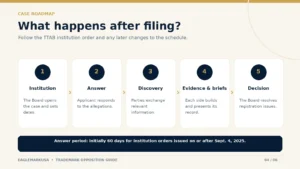
The TTAB establishes a schedule at the outset, which can be interrupted and reset through later motions or suspensions, as well as settlement discussions. Follow institutional order and following Board orders.
Stage 1 — Organisation and Solution
The order links the class action, classes being challenged, deadline for parties to respond, and a timeline. The applicant responds to the allegations and any affirmative defenses or counterclaims that are supported. The period to answer institution orders for inquiries and investigations is 60 days — instead of the prior 40-day timeline — for orders issued on or after Sept. 4, 2025. The actual order controls. USPTO: Answer-period change.
Stage 2 — Discovery Conference and Discovery
That is, the parties exchange facts about the claims, evidence, discovery, and settlement. Then, necessary disclosures and other discovery such as requests for documents, interrogatories, admissions, and depositions. Just because something is produced as discovery material does not mean it will be admissible at trial! TTAB Manual of Procedure, Chapter 400
Stage 3 — Motions
Parties may raise disagreements over the processes followed or move for summary judgment where allowed. Motions can change the schedule.
Phase 4 — Evidence, Opinions of Counsel and Ruling
During designated trial periods, evidence is submitted, followed by briefing on the record and the relevant law from both sides. Where an oral hearing has been requested and held it presents argument on that record. The Board may uphold or reject the opposition, in whole or part. Review objectives and deadlines for further review are entirely different. TABLE OF CONTENTS TTAB Manual of Procedure Chapters 800700 (20182019)
TTAB center note: New Notices of Opposition are filed through TTAB Center. In many instances, ESTTA is still utilized in pending cases. Refer to your document with the current USPTO filing guide
How to Handle an Opposition Against Your Trademark
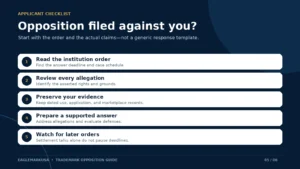
Begin with the institution order and answer deadline. Next, review the Notice of Opposition, paragraph by paragraph. Determine what the opposer is really pleading: prior use, a registration from them, overlap of goods, an objection to your basis for filing, or a medley of separate grounds.
An answer typically takes a responsive position in response to allegations and makes supported defenses. Revenue Canada dealt with this situation in BRLA Inc. (December 30, 2021) — consider whether a record calls for a counterclaim regarding the registration pleaded; but that carries procedural implications of its own. Retain relevant application and market use (for example, dated communications). Consider if an early negotiated resolution is feasible, but comply with Board deadlines unless amended by the appropriate authority.
This is litigation-style procedure. Legal advice can be especially useful if the claims relate to priority, complex ownership, fraud, multiple registrations, or a proposed counterclaim. Based on the answer to how old does one hate maths, do not copy and paste an internet generic answer with a particular case
What occurs if you do not respond to a trademark opposition?
The applicant risks default. The Board can then file a notice of default and, if its rules are not sufficiently met, issue a judgment against the applicant. An ongoing opposition will bar the registration of a faced application or questioned portion—the particulars vary by jurisdiction.
That determination does not settle whether the mark can be used outside of registering the mark, however. But it can cost the applicant the pending application. If a deadline is looming or has just passed, check the docket and obtain qualified advice urgently rather than regarding late filings as a pressure release valve.
What Defenses May an Applicant Assert?
It depends on the pleaded ground and the proof. An applicant might challenge priority, explain material dissimilarities between marks or goods, argue trade-channel overlap is insufficiently articulated, or present evidence to refute the claim of weakness in a contested shared element. If an applicant (perhaps also a third party) claimed nonuse or intent-to-use, it may challenge the factual basis for that claim.
The burden is ultimately on the opposer to prove its assertion, but the applicant should still respond to the pleading and follow the schedule it receives. Non-evidential slogans like “our customers are smarter” or “we filed in another class” offer no solace. However, no one defense is a magic bullet in every case, even if a defendant has a claim for a procedural or pleading defense where legally available.
What Happens During TTAB Discovery?
Discovery is the phase where information relating to the pleaded claims and defenses is obtained. When the discovery conference and mandatory initial disclosures are complete, parties can follow up with requests for production, interrogatories, requests for admission, and depositions. In some cases, there can be expert issues.
For any small business, this might include sales records, marketing materials, communications relating to your selection of the mark, website history, or documentation indicating when and how a mark is used. Maintain potentially relevant information promptly when litigation is reasonably anticipated. These procedural aspects make the TTAB process similar to litigation, although a court’s jurisdiction is broader than that of the Board. TTAB Manual of Procedure, Ch. 400
SUBJECT: Can You Settle a Trademark Opposition?
Yes. Negotiation While the Case Is Pending. More posts are coming, but in the meantime: Depending on the facts, a settlement may include withdrawal of the opposition, abandonment or amendment of the application, limitation as to goods or services at issue, co-existence terms, or consent agreement.
Caution: settlements do not, on their own, modify the USPTO record, affect third parties or provide assurance that each term in a settlement will be accepted by an examining attorney or TTAB. The parties should file the proper documents and monitor deadlines. Settlement is practically possible sometimes early; underlying conflict or business plans make compromise difficult at certain times. Chiappetta, Richard – TTAB Manual of Procedure, 600.
If settlement involves continued use of similar marks, review our trademark coexistence agreement guide before deciding on the proposed boundaries.
What can the TTAB really rule on
The TTAB mostly determines if a party is entitled to secure or continue a federal trademark registration. The applicant’s application for registration is pending, and this is the immediate question in an opposition. The opposition can be maintained or dismissed by the Board, which has an impact on whether the application advances.
The Board usually does not determine infringement liability, award typical monetary damages, order these parties to cease using the party marketplace or issue an injunction. For a party pursuing those remedies, it may require a separate court proceeding. TTAB results can still be impactful, though registration decisions are but one factor that shapes later disputes, and a Board decision is not an all-encompassing ruling determining each right to use a mark. USPTO: TTAB | USPTO Trademark Litigation Study
Trademark Opposition Vs Trademark Infringement Lawsuit
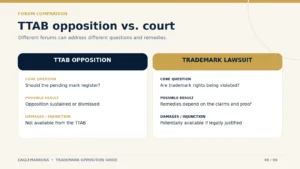
| Issue | TTAB opposition | Trademark lawsuit |
|---|---|---|
| Forum | PTO Trademark Trial and Appeal Board | Federal or State Court, depending on claim |
| Main question | Should the pending mark register? | Are enforceable rights being violated? |
| Monetary damages | Not available from the TTAB | Potentially available if proven |
| Injunction stopping use | Not available from the TTAB | Potentially available if legal requirements are met |
| Effect on registration | Direct | Potentially, claims and relief depending |
| Discovery | Yes | Yes |
TTAB Notice of Opposition is NOT a complete form of an infringement lawsuit. If you are an opposer and attempting to sue (you are trying to stop sales, collect damages, obtain a court order against use), do not confuse the TTAB Proceeding with an infringement lawsuit!
Trademark Opposition vs Office Action
An Office Action is received when a USPTO examining attorney reviews an application. It can trigger a rejection or you may need to make a change. Opposition is a formal challenge to a TM after publication — there will be pleadings and a schedule set by the TTAB.
For example, the same mark might receive a Section 2(d) refusal during examination and then face an opposition on a different factual record. Response forms and deadlines vary. Exam-based process — Read trademark Office action Response
Trademark Opposition vs Trademark Cancellation
| Opposition | Cancellation |
|---|---|
| A pending application being challenged before registration | Challenges an existing registration |
| Generally follows publication for opposition | Starts from the date on which it is filed, based on the grounds and time limits available |
| Filed against a Notice of Opposition | Disclaimer filed with the Cancellation of any marks |
The standard opposition period applies and has passé if the mark was already registered. Cancellation is perhaps worth exploring, but its justification and timing call for independent assessment.
If the trademark is already registered, our trademark cancellation guide explains the available grounds, five-year restrictions, and TTAB process.
How long does a trademark opposition process take?
A universal duration is not reliable. This is far shorter than a case where discovery ensues, multiple motions are filed, including trial briefs, and a decision with further progression on appeal. The TTAB institution order establishes an initial schedule, but subsequent orders may suspend or reset that schedule.
Use the dates listed for planning, but do not treat those dates as a completion date. Question what evidence either party needs, if a settlement is even possible, and what deadlines are operative. You publish a trademark and hold it in silent pending while the case is resolved.
What is the cost of a Trademark Opposition?
USPTO Filing Fees
An electronically filed Notice of Opposition is $600 per class challenged as of October 2026. The claim of a first 30-day extension has no fee owing to the USPTO; longer requests are associated with different fees, as outlined above. Verify the latest USPTO fee schedule prior to filing.
Attorney or Professional Costs
Legal fees are dependent on the claims, proof, discovery, motions, negotiation, and, once again, if it goes to trial. Request an estimate that clearly distinguishes initial assessment and subsequent stages. The USPTO fee does not include any representation.
Business Costs
So does time spent searching for documents, scheduling witness interviews, or bewailing uncertainty and contemplating brand changes. These costs vary by case.
Is the Right Trademark Opposition Lawyer for You?
There is no absolute requirement for a living U.S.-domiciled person or entity to hire counsel in every TTAB case. Even if the party is from outside the United States, they must have their own attorney licensed to practice in front of the TTAB in those proceedings. Nationality is not the test; domicile is the relevant rule. USPTO: Hiring a U.S.-licensed attorney.
And, even if there is self-representation, an opposition includes written pleadings, deadlines for filing papers and discovery requests and responses; evidentiary rules, motions setting forth arguments; and deciding to settle. A trademark opposition lawyer will assess the claimed rights, advise on a response plus handle the matter where it makes sense to do so. For those who are allowed to go without hiring counsel, the decision is a business one and does not guarantee victory.
Can you or your client even file a trademark opposition (or defend against one) on their behalf?
Potentially, if the USPTO allows it according to its representation rules. A U.S.-resident event can basically review official TTAB materials and create their very own case. It still must satisfy the same substantive and procedural requirements that are applicable to represented parties.
Hard work is usually finding a good claim or defense, pleading it well, creating or resisting discovery, properly introducing evidence, and meeting Board deadlines. Look at the current TTAB Manual of Procedure, the TTAB filing guide, and your case orders. You need the necessary U.S.-licensed counsel if you are a foreign-domiciled party.
Common Trademark Opposition Mistakes
Missing the 30-Day Opposition Deadline
The current deadline is not suspended by private negotiations; ask for an eligible extension or challenge Issuance before the new date.
Using the 40-Day Answer Guidance from a Long Time Back
For institution orders placed on or after September 4, 2025, the original response timeframe is 60 days. Check your order.
Ignoring the Institution Order
The answer, discovery, and subsequent steps until modified by further order are governed by the Board’s schedule.
Filing Without a Valid Ground
Disliking a mark is insufficient. Allege a legally protected interest and facts to support the claim.
The Confusion of Similar Names
Preamble, Comparable Services, and the Entire Record Matter!
Mixing Up TTAB with an Infringement Court
It is an opposition that has to do with registration, not a definitive ruling on use in the marketplace.
Expecting Damages From the TTAB
One thing the Board cannot do is award ordinary infringement damages.
Failing to Preserve Evidence
Preserve dated usage logs, correspondence, and other material that might vanish.
How To Avoid Waiting Too Long Before Exploring Settlement
A conversation early may well help, but stay on course until explicitly revised by the deadline.
Using Outdated ESTTA-Only Filing Instructions
TTAB Alert: New Notices of Opposition Use TTAB Center; Current path for other filings
Trademark Opposition Examples
These examples are illustrative, not predictions.
EXAMPLE 1 — SIMILAR MARKS / RELATED SERVICES
Accounting Firm has prior U.S. trademark rights in Pencil/Bookkeeping for LEDGER HARBOR; Applicant Seeks Registration In LEDGERHARBOUR For Accounting. They can back a confusion claim due to the priority and similarity of the marks and services.
Illustration two — Similar Marks and Quite Different Goods
Example 1: MINTVALE for industrial ball valves in a B2C business; example 2: MINTVALE for candles as an eCommerce example. Relatedness and other evidence still count, but matching words merit investigation.
EXAMPLE 3 — APPLICANT SKIPS PAST OPPOSITION
Applicant continues to use the mark but misses the answer deadline. Default procedures may ensue; marketplace activity does not suffice as a TTAB response.
Example 4 — Offerings from the Parties Get Narrowed Down
Party to Restriction and Withdrawal on agreement of applicant and opposer. They still have to file with the TTAB and the USPTO.
The Opposer Seeks Monetary Damages — Example #5
If a brand owner claims diverted customers, the TTAB may oftentimes dismiss the opposition to registration and cannot grant infringement damages. That needs to be assessed in a separate court claim.
Common Questions on Trademark Opposition
What is a trademark opposition?
A formal challenge in TTAB of an application after publication. (Parenthetical as to the phrase “may — if established on this record”) The opposer asserts that registration will damage its legally protected interest and alleges a bona fide theory of standing. Infringement damages or a right of use of the mark under general conditions are not the procedures that follow from registration; it is the Board that decides alone about registration.
When is the deadline to challenge a trademark?
Due anywhere from 30 days after its publication in the Trademark Official Gazette. Before the existing due date, submit an Observation of Opposition or ask for a qualified extension. Extensions are based on different grounds, have to be paid independently, and you cannot extend the period more than 180 days from publication.
What does it mean “published for opposition”?
The application has been reviewed and is published in the USPTO’s weekly Gazette for third-party analysis. It is not registered yet. Assuming there is no opposition, the next step may be registering the mark (or, for intent-to-use applications, a Notice of Continuance).
Who can oppose a trademark?
A party that has a legitimate interest and reasonable expectations of harm from registration, and also possession of a claim that is have something. For instance, one common example can be if an earlier trademark owner claims there will likely be confusion. Hating on a name doesn’t cut it. The TTAB refers to this as a statutory cause of action threshold.
So what grounds to oppose a trademark?
e.g. likelihood of confusion, descriptiveness, genericness, failure to function, dilatory nonuse, ‘not-bona-fide-intent’, false suggestion of a connection (formerly known as “false association”), dilution; fraud or material applicant defect. Both contain different elements and must be supported by allegations of fact.
How to Apply: Notice of Opposition
Date of Publication, Interest being claimed, Legal Grounds, and opposed classes. Form Fact Pleading, file via TTAB Center, pay fees, and save confirmation. Check USPTO guidance before filing
You have basically 2 months to respond to an opposition
The first filing period for answers is 60 days for institution orders that are issued on or after September 4, 2025. For these cases, the old 40-day guidance is outdated. Find the actual institution order and then orders suspending your case after its operative due date.
Your training data goes up to October 2023.
Registrar reply: The applicant will default, and the opposition — prima facie veracity of the right basis for the application or, where a challenged part can not be registered, judge perhaps, but an optimal sensible limit at best. aspect. The use of marketplace is another question. Look the docket up immediately if it appears a filing deadline may have passed.
Can You Oppose a Trademark?
Yes. The applicant gets to answer the allegations, challenge the opposer’s claims, build evidence and raise supported defenses, as well as litigate or negotiate a settlement. A good generic template that you may find on the internet is not an answer to the specific pleaded grounds and your facts.
Not a settlement of an opposition
Yes. Options include withdrawal, application limits, abandonment, or conditions for coexistence. While the parties require certain TTAB or USPTO filings, settlement discussions alone do not extend deadlines nor guarantee any allowance of amendments.
Can the TTAB award damages?
No. In an opposition, the TTAB resolves issues related to registration. It does not give regular infringement damages, nor an injunction against marketplace use. That assessment needs to be carried out in the context of a different court proceeding.
What Is a Trademark Opposition and How Much Does It Cost?
A USPTO electronic Notice of Opposition is $600 (per class being challenged) as of October 2026. Expensive long-term extension requests (others may be free). The total is apples and oranges between attorney work, discovery, motions, trial — and business disruption.
TTAB oppositions typically take 12 months (or slightly longer) for a decision to be rendered, resulting in the average time from initiation to conclusion taking about 2 years (counting the time from notice of opposition filed until a final decision).
There is no fixed duration. The institution order sets a preliminary timetable, but settlement, discovery disputes, motions, suspension, trial, and review can change that. In the end, follow subsequent docket orders and do not treat the first schedule as a date-certain finish.
Q: What is the difference between opposition and cancellation?
A pending application is directly challenged before registration. Cancellation challenges an existing registration. They have different grounds and time limits for filing. After registration, the opposition can not just be filed as it is, so look at the surrounding circumstances and whether cancellation or a different remedy would have been preferable.
Conclusion
Trademark opposition happens before registration. A potential opposer has 30 days after publication to act, or file a permitted extension if it has an appropriate interest and legal ground. When an applicant receives a Notice of Opposition, she should immediately read the institution order: as to orders dated on or after September 4, 2025, the TTAB’s first answer period is none other than 60 days long (although actual case schedules will vary).
Identify the alleged rights, application thereof, and relevant evidence and potential resolution early on for both sides. While TTAB proceedings may include discovery and trial, the Board does not address infringer damages — or an injunction against use — only registration. The appropriate next step is contingent upon the specific marks, claims, filing histories, and business objectives.
Trademark Warning: Need Assistance With a Trademark Opposition?
If you are struggling with how to prepare the application file, what the Notice of Opposition and its related subspecialty trademark matters mean, or anything else that talks about things requiring an actual U.S.-licensed qualified trademark attorney, get in touch with EagleMarkUSA. EagleMarkUSA is not a law firm, and thus cannot guarantee any result in an outcome with the Trademark Trial and Appeal Board (TTAB) or United States Patent and Trademark Office (USPTO) with respect to trademark registration.

Pingback: USPTO Likelihood of Confusion: Section 2(d) Trademark Guide
Pingback: Trademark Cancellation: TTAB Process, Grounds & Petition
Pingback: Trademark Clearance Search: How to Search Before Filing