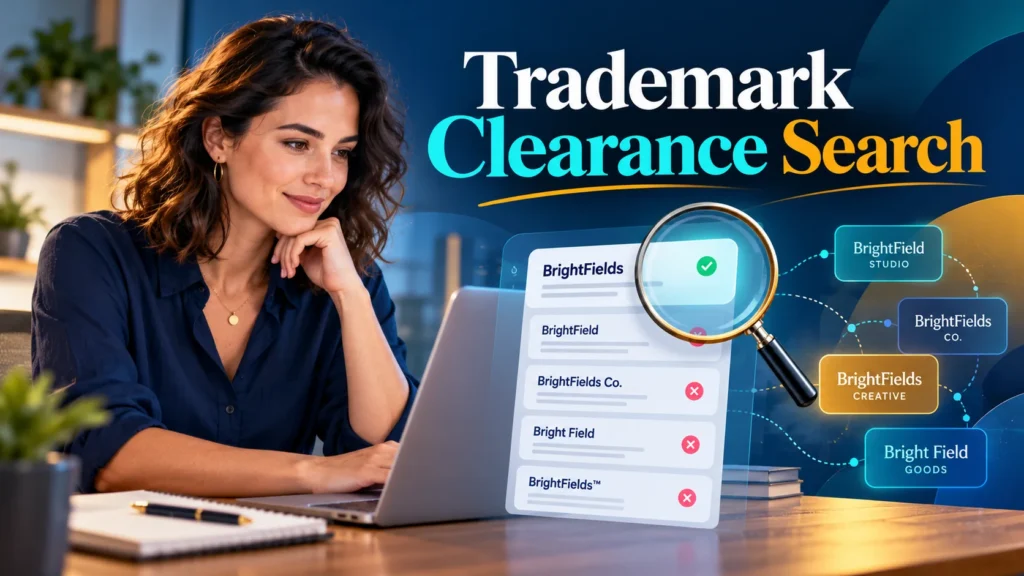
Searching for a trademark before filing is a crucial step in the trademark clearance search process.
If a proposed name registers with the USPTO, but there is no duplicate registrant, it is not a safe bet that the trademark is clear. Another spelling may mean the same; a similar mark may refer to a class of services related to a class of services already registered in the Federal Register; and a business employing a mark may have rights without a federal registration.
A thorough trademark clearance search involves finding the same or similar names, similar sounds, similar meanings, pending applications, registrations, and relevant market usage. It then queries if any result might lead a purchaser to think that the offerings are from the same origin.
The ideal window to explore is prior to filing non-refundable fees or putting cash into a website, packaging, and advertising. This guide outlines how to create a search, evaluate a result, and determine when a proposed mark should be deep-danned. There is no search that can ensure that your mark will be registered with the USPTO and/or that it will be lawfully used.
What is a Trademark Clearance Search?
A pre-filing trademark clearance search is conducted to identify earlier trademarks that may present a risk of infringing on your intended trademark and/or products or services. Records are generated when searching for a name, and when clearing a name, it is necessary to consider the extent to which the marks resemble each other, whether the offerings are similar, whether each record is in good standing, and potential rights outside the federal database. Conclude by assessing the risk, rather than a declaration that the project is available. Comprehensive clearance is checking a range of sources, according to the USPTO.
What is the point in searching before filing a Trademark?
Even if you searched for conflicting federal marks, the USPTO examining attorney will search for competing marks. A Section 2(d) likelihood-of-confusion refusal could arise if a registered mark is filed for related goods, and a pending application that was filed earlier could be a concern if it registers as well. Generally, the U.S.PTO does not refund fees for unsuccessful applications. An opposition, rebrand or dispute over use may also be triggered by a conflict that is revealed later.
If a third party opposes the application after publication, our Trademark Opposition guide explains what happens next.
Clearance can assist you in making a smart choice before these expenses increase. It is not predictive of an examiner’s judgment. If you want to learn more about the legal standard for comparison of a conflict, read USPTO Trademark Likelihood of Confusion or USPTO’s federal searching guidance.
Exact-Match Search vs Trademark Clearance Search

| Exact-Match Search | Trademark Clearance Search | |
|---|---|---|
| Non-exhaustive/retrieval search | Yes | Yes |
| Identical wording? | Usually checked | Checked |
| Spacing, punctuation, spelling, soundalikes? | Typical cases where a document is missed | and is searched on purpose. |
| Overall impressions and similar meanings? | Commonly overlooked | This is taken into account, if applicable |
| Other goods/services of similar type in other classes? | Often missed | Investigated |
| Waiting to be approved applications and registrations? | May spot exact matches | Checks and reviews both and their status |
| State records and common law use? | Normally not included | Included where appropriate |
| Useful before filing? | Good first screen | Good basis for a risk decision |
Absent an exact match ≠ clear trademark. Think of being able to carry out searches with only a single search engine, specifically BRIGHTNESS. If used for related home services, BRITE NEST may avoid that question but might warrant consideration. The search terms and goods or services are more important than the zero-result screen.
Knockout Search vs Comprehensive Trademark Clearance Search.
What is a preliminary search or knockout search and how are they related to each other?
A knockout trademark search is a preliminary search to identify readily apparent issues: the specific trademark text being proposed, similar alternatives, and clearly similar products/services. If there is a strong conflict that shows up on the scene, it can save time. While the USPTO describes exact word searching as a “knock-out search,” it is clear that it encourages searchers to go beyond it. Federal trademark searching by USPTO.
Comprehensive Clearance Search
A more thorough search considers other word spellings, different pronunciations, similar concepts, unique elements, related products, pending but not yet issued marks, state registries, business names, and internet/marketplace use. It can also review design elements and other sources pertinent to an international launch. When the marks and goods are partially similar, more sources do not make it a promise of interpretation: that is the tough part.
What Does a Full Trademark Search Entail?
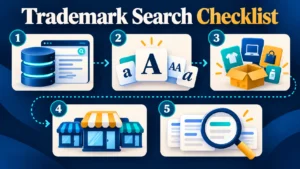
Work: outwards in this order:
- Federal records – conduct a search of the USPTO Trademark Search system for registrations and pending applications and review published marks in the USPTO Trademark Official Gazette.
- Indicate variations: Use exact words, spacing, spelling, phonetic alternatives, strong components, and relevant meanings. If your mark contains search design elements, search for them.
- Offerings: Explore your products or services and categories thereof, including cross-class.
- Other records: Run a search on state trademark and business registries.
- Marketplace use: Do searches on different engines, industry directories, online stores, domain activity, and social profiles (where applicable).
- Risk Review: Open promising records, compare marks and offerings, with record documentation of uncertainty, and determine to proceed, revise, or seek advice.
Additional sources are available in the USPTO’s comprehensive search page, including international databases if applicable. An unmarked search of the U.S. should not assume worldwide clearance.
How to do a Trademark Clearance Search
The following should not be interpreted as an “always” or “every time” research methodology, because not every question will have every conflict. The information provided is illustrative only, and we cannot verify if those names are available.
Step 1 — Identify the Exact Proposed Mark
Record the mark you are going to use, for example, BRIGHTNEST. Pay attention to its spacing, punctuation, pronunciation, and any notable design. Check the actual proposed wording, not assuming that a logo will influence the manner in which the words are perceived by consumers.
Step 2 — Identify the Goods and Services
Record the good(s) that customers will be receiving with the mark, such as downloadable software, online non-downloadable software, furniture, or home-organization consulting. Without that context, it’s hard to determine relevance when searching. Plans that explain the Trademark Classes can help determine which classes to explore, and the actual language used is more important than the class number.
This step involves researching the specific mark.
Step 3 — Search the Exact Mark
Enter the USPTO Trademark Search system with BRIGHTNEST. Document any close pending or registered results along with their goods/services. Don’t search for an exact match, as that is not the last step; rather,, it is a useful first pass.
Step 4 — Search Spacing and Punctuation Variations.
Experiment with bright nest, bright-nest, and other natural presentations. Buyers might not recall a space or hyphen, and the same query might yield different results with varying queries.
Step 5 — look for Spelling Variations.
Try alternative substitutions like BRITENEST, BRYTNEST, singulars, plurals, and common misspellings if appropriate. If you look hard enough, you’ll find marks that are relevant to your search, but you should not assume that any similar string of letters is a “mark”.
Step 6 — Look for Sound Alikes and Phonetic equivalents.
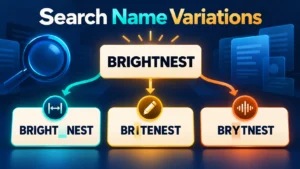
Read aloud the mark and think of some possible alternative pronunciations. A few different written marks could be similar in a recommendation or talk. See USPTO Trademark Likelihood of Confusion for how sound correlates to appearance, meaning, and identified offerings.
Step 7 — Search Similar Meanings and Commercial Impressions
Rewrite the sentence for search, similar meanings, and commercial impressions.
Consider the full name’s implications to a buyer. A synonymous phrase or equivalent concept may merit exploration, but synonyms don’t necessarily contradict. It is important in the context of the full marks and offerings.
Step 8 — Search Strong Components Separately
In Step 8, you’ll be searching for separate components of the word.
Search BRIGHT NEST, and also possibly its individual distinctive words, for BRIGHT NEST HOMES. Interpret results within context. A common word can be used many times without any of the occurrences being meaningful, and an unusual shared component may be worthy of investigation.
Step 9 — Search Related Goods and Services
In the 9th step, look for goods and services that are related.
Don’t focus on direct competitors. Is it realistic for the same company to be capable of offering both? Are they encountered by consumers at the same time, in parallel channels, or complementary to each other? That a different class is not a safe harbor is evidenced by the clothing mark and a similar mark for retail services that include clothing. The USPTO cautions consumers to be careful when filtering by class.
Step 10 — Review Full USPTO Records
After Step 9, examine all the records in the full USPTO record.
Don’t pick from a snippet of the result. Open the following records in TSDR, including mark, owner, serial/registration number, live/dead status, exact goods/services, and relevant records/filling history. The identification in an answer might not only be the company’s current website, but it could be any type of record. TSDR accepts serial number and/or registration number, and offers status and documents. To check the status of your patent application or documents, use USPTO.
The USPTO has a current search guide that describes the combined-mark field, expanded searches, alternative spellings, and design codes. Before using any specific query syntax, make sure to check its live help, because this method doesn’t rely on an old TESS tutorial.
Should you only search your trademark class?
No. Classes are not intended to establish outer boundaries of confusion. Clothing (Class 25) can be related to retail services (Class 35) related to clothing. A mark for related offerings may be concealed in a single-class filter. Begin with a broad search and apply a filter only when there are too many to manage, and then go back and search any category that has been filtered out. Don’t rely on the Trademark Classes Explained and the Trademark Class Finder to say that a mark is safe.
What are Coordinated Classes?
The coordinated classes are groups of USPTO searchable classes that may be useful in locating marks for categories that are frequently found in a selected class. The USPTO cites the following classes for the 25th class of goods for clothing: jewelry (14), handbags (18), and some retail services (35). The current search system is being enhanced with a coordinated-class filter for expert mode and a CC: field tag.
It is an effective approach to managing the results, not an exhaustive list of all the associated products. The USPTO recommends closely reviewing real goods/services and occasionally searching free from class restrictions. USPTO: Classes coordinated.
Live vs Dead Trademarks: Which Ones Matter?
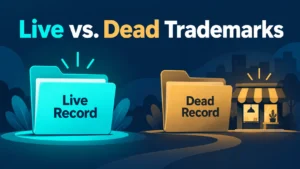
| Federal record status; | What it means for clearance |
|---|---|
| Live pending application | See it. If an earlier-filed application has an impact on your application, then it may register later. |
| Live registration | – read carefully. The similarity of a mark for related goods or services may be a basis for a Section 2(d) refusal. |
| Dead application | May not prevent live federal application from being registered, but explore potential for continued use and revival. |
| Registration cancelled or expiration of registration | Has not continued to enjoy the advantages of federal registration, but may continue to enjoy rights from the marketplace. |
The federal record is “live” or “dead” but not necessarily the status of the business. Some dead records may be revived/reinstated, and some owners may have common law rights, according to the USPTO’s glossary.
What does it mean if there is a dead trademark? Is the name available?
No, not necessarily. If the application or registration is filed dead or rejected by the Federal government, the mark is no longer a live Federal barrier in that record, but it may be commercially used. Another active mark could also pose a problem. See the record’s history, look for the business and what it currently offers, and do not take a “dead” status as permission to take the name. USPTO: Federal trademark search.
Before adopting a name from a dead record, review our trademark abandonment guide to distinguish inactive federal records from abandoned trademark rights.
Pending vs Registered Trademarks
Pending Applications
Search them. If there are any conflicting applications filed earlier than yours, the USPTO may hold your application for a period of time until it is determined. If finally registered, it may provide basis for refusal. A pending record does not mean that it is a completed registration.
Registered Marks
A live registration can directly assist a Section 2(d) refusal in the event that there is likely confusion between the marks and offerings. When comparing, look at the full records and not just the registration number – it does not reveal the scope. Check USPTO Trademark Likelihood of Confusion and USPTO’s explanation of conflicting search results.
So why should Common-Law Trademark Searching be important?
Trademark rights can also exist in the United States as a result of qualifying use, even if the trademark is not federally registered. Not all those uses will be included in the USPTO search system. Use several search engines, websites for businesses, online marketplaces, industry and local directories, relevant records available on the state, and social media platforms. Repeat the test with the same spelling and variants, and determine whether the spelling you have located is for a product or service that is related or not.
A common-law trademark search is not as centralized as federal searching and cannot be carried out in a perfect manner by a few web searches. Close findings may be complex due to geographic reach, earlier use, and the nature of use. The USPTO offers a full search of patents. Those questions could be discussed in detail in a future Common-Law Trademark guide.
Are Business Names, Domain Names and Social Media Searches Trademark Clearance?
They are not a substitute for clearance, but are helpful adjunctive tests. A state can permit an entity name without making a determination as to whether it is in conflict with a trademark. A domain registrar might be able to provide you with an available address, but may not conduct a trademark search. A social platform could provide a handle for the same reason. On the other hand, multiple brands, or domain names and profiles, could lead you to an active marketplace you need to explore. Inquire what the name represents, where, when, and how it is applied, and in connection to your products and services.
How to tell if a search result is really “a problem”?

Employ two essential questions; review the record:
2. How Many Marks?
Make comparisons of complete marks: in appearance, sound, meaning, and commercial impression. There might be a common-but-not-too-common thread, but there also might be differences. It doesn’t have to be spelled the same.
2. How are the Goods or Services Related?
Read the proper descriptions. Think about whether customers might think that one source offers both, complementary offerings, overlapping buyers, and ordinary trade channels. Same class goods may be unrelated; different class goods may be related.
Then, review status, timing, and pertinent marketplace facts. Similarity does not equal a database verdict. A likelihood of confusion analysis is required to determine if there are close calls; see USPTO Trademark Likelihood of Confusion.
Trademark Clearance Search Examples
All examples below are fictional and not to be regarded as being for sale.
| Search finding | What to investigate |
|---|---|
| An identical mark and the same goods give rise to a strong apparent concern | – confirm the older record and status. |
| 2. BRIGHTNEST vs BRITENEST for related home products | – may not eliminate similar pronunciation; note the whole marks and offerings; compare. |
| 3. Weak goods relationship with a substantially different good | – look at the evidence, but consider any other identified goods more broadly. |
| Different classes don’t rule out relatedness: | 4. Class of shirts vs class of online retail services with shirts. |
| 5. Dead federal record, active seller under the name: | Investigate current use and possible common law rights – do not assume federal record alone. |
Is there a free way to do a trademark clearance search?
Yes. The USPTO search system is free, and preliminary information is available from internet searches and many public state records. A general, first-pass examination can be conducted by you. The restriction does not only apply to access to the database: Judgment is needed in trying to find out which variants are worth a try, finding unregistered use, and assessing close results. For all searches, paid assistance is available but not a requirement. The USPTO offers search training and resources.
Will the USPTO Trademark Search Do the Job?
Not for a complete clearance search. It is a vital source for Federal applications and Federal registrations, but it does not record every unregistered use or state records. Include marketplace and relevant state searches. If the big hit is a close call, don’t assume a federal no hit is a no hit; get a qualified legal opinion. USPTO – Complete search of all patents!
What do you do if you see a similar trademark?
Use a logical process: Open full record, consider live/dead status, compare full marks, compare identified offerings, carry out investigation (if any) of relevance to use, evaluate the risk. Write the reasons for the outcome or non-outcome. If it’s near, research more widely, a different proposed mark, a permissible commercially correct narrower marking, or professional review before filing. Don’t take it for granted that all the same situations are bars, and don’t take it for granted that a minor spelling correction will solve a major problem. Check USPTO Trademark Likelihood of Confusion.
If an existing registration presents a potential conflict, our trademark cancellation guide explains when a legal challenge may be available. Finding a similar mark alone is not enough to justify cancellation.
What If You Find No Conflict Trademark?
That is a positive development, but not a certainty. A query might have overlooked a variant or unregistered use, the database might change, or the examiner might interpret a record differently. There are also other matters which may prevent registration, such as descriptiveness, genericness, identification problems, and specimen or use problems. Check the mark and the filing information; read about the USPTO problem if it arises in the Trademark Office Action Response.
Common Mistakes in a Trademark Clearance Search.
- Searching only the exact name: Include likely spelling variations and misspellings.
- Ignore sound-alikes: Read the names out loud and try out various spellings.
- Searching one class: Search for related offerings within one class.
- A match is important in terms of what it is offering: Ignoring goods or services.
- Don’t assume that a deceased record is safe; continuously monitor usage and track record history.
- Failing to respond to pending applications: Filings that have been made earlier may register or postpone your registration.
- Narrowing down search to just federal records: Check for state and common-law use.
- Believing in the use of a domain or business name that is available: It is not a license.
- Other marks or refusal grounds may be retained if they are assumed to be zero.
- Not saving notes: You can get lost in the queries and forget why you set a result aside.
How to Document Your Trademark Search
Finding the time to document your trademark search can be difficult.
Maintain a dated worksheet with terms, spelling and phonetic variants, sources scoured, filters applied, and the results that require attention. On USPTO records, record serial and/or registration numbers, status, and identified goods or services, and any documents in the TSDR. Include brief explanations as to why each close result is important or not. Record or save links that will help you prepare for your review. Documentation does not confer rights nor certify clearance, but simply serves as a means of review.
Is it possible to conduct a Trademark Clearance Search on your own?
Yes. Public tools can be used by a business owner to conduct a knockout search and broad search. The difficult part is usually the interpretation of sound, meaning, crowded fields, and related rights and unregistered rights. The USPTO will make its own federal search during examination and may have a different opinion. But if the stakes or findings are close, a qualified U.S. trademark attorney can help; representation is not necessary just because it’s a search. USPTO: Federal searching.
When to Seek Professional Help?
If there are multiple close marks, a related mark, uncertain common-law use, or national planning of an offering (such as a franchise, multi-class offering or a major packaging investment), then a deeper professional review may be warranted. Part of the reason for a brand switch can be that it was too late to be evaluated. A search provider might provide results, but if it’s a close conflict, then legal analysis requires qualified counsel.
Looking for assistance with a trademark search?
Seek assistance from EagleMarkUSA for organizing search results, for information submission, and for professional review as needed. None of the search services can guarantee that a name is clear or that it will be registered by the USPTO.
Frequently Asked Questions About Trademark Clearance Searches
The following are the answers to some common questions regarding trademark clearance searches.
An overview of a trademark clearance search.
A pre-filing search of federal records and other sources of prior marks that might overlap with a proposed mark. A review should consider similar names and the goods or services — not only an exact spelling match.
Why is it important to search before I file a trademark?
A search can be conducted to identify potential conflicts before filing fees are paid and brand launch commitments. It can also lead to a consideration of investigating, changing, or seeking advice about names. It does not remove all the risks or assure registration.
What is the difference between a Trademark search and a Trademark clearance search?
The results are retrieved from a database search. Clearance performs a suitable search across sources, after which they compare the results with your mark and offerings. This is just one facet of that effort.
What is a “knockout” trademark search?
This is a first-pass filter on obvious conflicts, frequently beginning with duplicative and similar language in offerings that are relevant. It can easily rule out a selection, but a good outcome does not mean full clearance.
What is the method for a trademark clearance search?
Outline the intended mark and products; search for the identical terms, variations, soundalikes, and key elements in the USPTO database. Examine all relevant information and expand to similar products, sources, and applications. Evaluate near hits instead of hits.
Should I look in just my class or broader classes?
No. Other products and services may be included in other Classes. A coordinated-class search is a tool offered by the USPTO to help coordinate searches, but it sometimes fails to find a category of interest, and a wide search may be desirable.
Are there any conflicts between marks in different classes?
Yes. The issue is whether the full marks are close enough and the product/services close enough that consumers might think they were coming from the same source. It isn’t just based on class numbers.
What is meant by live trademark?
A live record is a current federal application or registration in the USPTO search results. A live registered mark can be used to refuse a registration, and a pending earlier-filed live application can impact examination and become a cited registration.
What is a dead trademark?
If a federal application or registration is dead, that application or registration is not active in this record. Even though it cannot be used as a live federal bar, some records may be revived or reinstated, and it may be used in commerce.
Is the name available if it is not in use?
Answer: Does the owner use it anymore, does the owner still have other active marks, and what has occurred in the record? Marketplace rights are not extinguished if the work is in the federal dead.
Would it be advisable to look for pending trademark applications?
Yes. The application that was filed first can cause issues if it registers and could result in the suspension of your application until the USPTO resolves the issue. Search pending applications and/or registrations.
Should common law trademarks be treated as relevant?
Yes. Rights in the USA can be acquired through qualifying use, without the necessity of a federal registration. These uses may not be present in the USPTO database, and therefore state and marketplace research may be helpful in a pre-filing evaluation.
Does it imply that the trademark is available if the domain is available?
No. Domain registration is not the key to trademark rights. A domain that’s available can be used by another party’s confusingly similar domain; similarly, an existing domain may be used for an unrelated use. Investigate the actual use.
Is there a way to do a free trademark clearance search?
Yes. Many public sources are free, as well as the USPTO’s federal search system. Much can be done within the local scope, but identification of all possible variants and interpretation of close findings may be challenging.
Is the USPTO database enough?
It is not exhaustive of all usage of U.S. trademarks. Look for the unregistered marks in the relevant State sources and on the market. A no-hit in the federal database is not “cleared.
If there are no matches, does it mean they are guaranteed to be registered?
No. You could miss a relevant mark during your search, and the USPTO also might discover a conflict or another legal or procedural problem. Look at a clean search as a positive rather than an approval.
Conclusion
Trademark clearance is not about looking to see if your exact name is in a federal database. Look for plausible spellings, sound-alikes, distinctive parts, and similar products and/or services within classes. Check on live registrations and pending applications and don’t take a dead record for granted, unless investigated for use. Issues that may be uncovered by state sources and common law marketplace activity may not be uncovered by a federal search.
The goal is to make a better decision before investing in the mark. Document what you searched, examine close records, and seek qualified help when the findings or launch investment warrant it. Even a thorough search cannot guarantee USPTO registration.
Ready to File After Your Trademark Search?
Contact EagleMarkUSA for help reviewing search results, considering trademark classes and goods or services wording, and preparing a U.S. application. See Trademark Use in Commerce, Intent-to-Use Trademark Application, Trademark Cost, and How Long Does It Take to Get a Trademark? for related filing decisions. EagleMarkUSA Trademark Registration Services can assist with the next steps; no outcome is guaranteed.

Pingback: Same Trademark in Different Classes and USPTO Rules - EagleMark USA
Pingback: How Long Does It Take to Get a Trademark? USPTO Timeline
Pingback: Intent-to-Use Trademark: Section 1(b) Application Guide
Pingback: Trademark Class 25 Explained: Clothing, Apparel & Footwear
Pingback: Trademark Coexistence Agreement: USPTO Rules & Examples
Pingback: Trademark Opposition: Process, Grounds, Deadlines & Response
Pingback: Trademark Scams: Fake USPTO Emails, Notices & Red Flags