

Receiving a USPTO trademark Office Action does not automatically mean your application has failed. It signifies that there is an examining attorney at the Trademark Office who has found problems that need to be sorted out. An issue might be a straightforward request to clarify your services or a legal refusal that requires evidence and a careful argument.
In most cases of applications made under Section 1 or Section 44, the reply must be made within three months of the issuance of the Office Action. There is provision for a three-month extension to be made by a qualified applicant prior to the expiry of the initial period of three months. Other notices may have different deadlines, so read the notice itself. USPTO: Responding to Office Actions
Start by confirming the notice, recording the deadline, and listing every issue it raises. This guide explains how to judge the issues, prepare an office action response, use the appropriate filing path, and understand what happens afterward.
What Is a USPTO Trademark Office Action?
A USPTO trademark Office Action is an official communication from a trademark examining attorney identifying a legal or procedural problem with an application. The notice explains the issue, identifies any required response, and states the deadline. An Office Action may contain one issue or several; applicants should read the entire document before deciding what to file. USPTO: Responding to Office Actions
Requirement vs Refusal
A requirement asks for a correction, clarification, amendment, or information. For example, the examiner might require a more definite description of services or a disclaimer of descriptive wording within an otherwise registrable mark.
A refusal states a legal reason the mark cannot be registered as presented. Examples include a likelihood of confusion with an existing registration under Section 2(d), mere descriptiveness under Section 2(e)(1), or a specimen that does not show qualifying use. A single Office Action can contain both requirements and refusals. Some issues are relatively simple to resolve; others may remain contested.
I Received a Trademark Office Action — What Should I Do First?
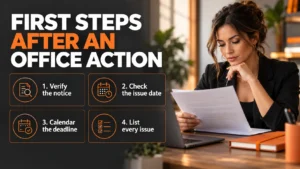
Use this seven-step triage before drafting anything:
- Verify the Office Action. Find the notice under Documents in the USPTO’s Trademark Status and Document Retrieval system (TSDR). Do not rely on an email or invoice alone. USPTO: Recognizing Common Scams
- Find the issue date. The clock generally starts then, not when you read the email.
- Calendar the response deadline. Set an earlier deadline; an extension request also has an initial deadline.
- Determine whether it is non-final or final. This affects the response path and possible appeal.
- List every refusal and requirement. Make a checklist from all headings and attachments.
- Separate procedural from substantive issues. The wording may require revision; a Section 2(d) denial may require legal interpretation; a specimen case may require proof.
- Choose the work needed. Note the amendment, declaration, evidence, argument, or professional review for each issue.
If the deadline is close, seek focused help early.
How Long Do You Have to Answer an Office Action for a Trademark?
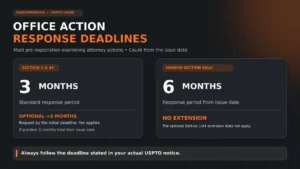
Most Section 1 and Section 44 Applications
The time allowed to address most Section 1 and 44 pre-registration office actions is three months after issuance. However, the eligible applicant is allowed to request one more extension of three months after paying an extra fee. If granted, the total period is six months from the original issue date. USPTO: Response Forms
Madrid Section 66(a) Applications
Applications under Section 66(a) of Madrid usually allow for six months after issuance, with no extension allowed. Foreign-domiciled applicants need a U.S.-licensed attorney before the USPTO. USPTO: Responding to Office Actions
Other Office Actions
Intent to Use Unit, Post Registration Notice, etc. can take various forms and time periods. Check the title, issue date, instructions, and deadline in your notice. USPTO: Response Forms
What Is a Non-Final Office Action?
A non-final Office Action generally raises an issue for the first time. Respond to every point. If all issues are resolved, the application may advance. An unresolved issue may become final; a new issue created by the response may prompt another non-final action. USPTO: Responding to Office Actions
What Is a Final Trademark Office Action?
A final Office Action maintains a previously raised issue. Based on the nature of the problem, you may choose to file a Request for Reconsideration after Final Action, file a Notice of Appeal to the Trademark Trial and Appeal Board (TTAB), or both.
The request for reconsideration is either an amendment, evidence, or an argument that you raise to the examiner, whereas the appeal is an appealable refusal to the TTAB. Reconsideration does not automatically extend or pause the appeal deadline. Track it separately. USPTO: Initiating a New Proceeding
Non-Final vs Final Office Action
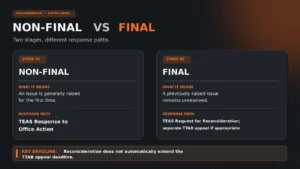
| Issue | Non-Final | Final |
|---|---|---|
| Stage | Issue generally raised for the first time | Previously raised issue maintained |
| Purpose | Opportunity to resolve objections | Examiner’s maintained position |
| Response path | TEAS Response to Office Action | TEAS Request for Reconsideration; separate TTAB appeal where appropriate |
| Appeal relevance | Usually premature | Timely Notice of Appeal may preserve review |
| Stakes | Unresolved issues may become final | Missed deadline may end the application |
Read your specific letter for applicable procedures.
Common Reasons for a Trademark Office Action
Likelihood of Confusion — Section 2(d)
The examiner may find your mark likely to be confused with a registered mark for related goods or services. The analysis considers appearance, sound, meaning, overall commercial impression, the identified offerings, and relevant trade channels. Class numbers alone do not decide the issue. USPTO: Likelihood of Confusion
A response must address the particular marks, identifications, cited registration, and evidence. “Our businesses are different” may fail if the recorded descriptions are broad.
Mere Descriptiveness — Section 2(e)(1)
A Section 2(e)(1) refusal means the examiner believes the mark merely describes an aspect of the identified goods or services. Depending on the evidence and filing history, an applicant might dispute that conclusion or consider an available alternate registration route. A clever explanation alone will not establish registrability. USPTO: Responding to Office Actions
Goods or Services Identification Problems
“Technology solutions” may not say what customers receive. The examiner may request precise wording. Applicants can generally clarify, limit, or delete items, but cannot broaden the original scope. Check proposed wording before accepting it. See Can You Add a Trademark Class After Filing?, Trademark Classes Explained: Complete Guide to All 45 USPTO Classes, and the Trademark Class Finder. USPTO: Correcting Errors
Disclaimer Requirement
A disclaimer disclaims exclusive rights to an unregistrable component apart from the mark as shown. You may accept the requested wording when appropriate or contest it on a sound basis. The wording stays in the mark. USPTO: How to Satisfy a Disclaimer Requirement
Specimen Refusal
A required specimen must show actual use of the mark for the stated goods or services. Problems include the wrong type of evidence, a different mark, a mockup, or no clear connection to the offering. A substitute must meet timing and verification rules; a new image cannot prove earlier use. See Trademark Specimen Explained.. USPTO: Specimen Refusal and How to Overcome It
Ornamental Use or Failure to Function
Wording across a shirt may appear decorative rather than identify its source. Consumer perception, presentation, offerings, and evidence matter. Future changes to packaging do not automatically cure a specimen that must establish use by an earlier date. USPTO: Ornamental Refusal
Procedural vs Substantive Office Actions
| Issue | General Type | Typical Complexity |
|---|---|---|
| Goods/services clarification | Procedural, sometimes strategic | Often lower complexity; narrowing can affect scope |
| Disclaimer | Requirement with legal implications | Often lower complexity, but may be disputed |
| Domicile or entity information | Procedural and fact-specific | Often lower complexity; representation rules may apply |
| Specimen refusal | Evidence and use issue | Fact dependent |
| Ornamental use/failure to function | Substantive use issue | Potentially higher complexity |
| Descriptiveness | Substantive refusal | Potentially higher complexity |
| Likelihood of confusion | Substantive refusal | Potentially higher complexity |
| Final refusal | Procedural stage of a maintained issue | Complexity depends on the underlying issue and appeal options |
One Office Action may mix several types; complexity is case-specific.
How to Respond to a Trademark Office Action
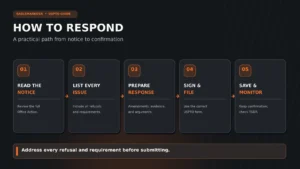
- Read the entire Office Action, including attachments, cited registrations, and proposed amendments.
- List every refusal and requirement. Address each one, including requested declarations.
- Determine what can be amended. Compare proposed wording with the original identification and your actual business.
- Gather evidence. Use genuine specimens, dated records, or relevant materials that answer the objection and satisfy applicable timing rules.
- Prepare arguments where needed. Answer the examiner’s specific reasoning with support; a generic disagreement rarely helps.
- Use the correct USPTO form. Non-final and final examining attorney actions have different TEAS forms.
- Obtain the correct signature. The applicant, properly authorized entity representative, or attorney must sign as applicable; foreign-domiciled applicants need a U.S.-licensed attorney.
- Submit before the deadline. Check the final form and attachments before transmission.
- Save confirmation and monitor TSDR for the filed document and future notices. USPTO: Responding to Office Actions
Which USPTO Form Do You Use?
As of October 2026, the USPTO lists these paths for examining attorney actions. Verify the live form and your notice before filing. USPTO: Response Forms
| Situation | Current Response Path |
|---|---|
| Non-final examining attorney Office Action | TEAS Response to Examining Attorney Office Action |
| Final examining attorney Office Action | TEAS Request for Reconsideration after Final Action; consider a separate appeal if appropriate |
| Eligible three-month response extension | Request for Extension of Time to File a Response through Trademark Center or the listed TEAS form, before the original deadline |
| Appeal of appealable final refusal | File a timely Notice of Appeal with the TTAB through ESTTA; this is separate from reconsideration |
The USPTO has also launched Trademark Center functions, including extension requests. It still directs ordinary examining attorney responses to the listed TEAS forms. An action from the Intent-to-Use or Post-Registration unit calls for a different form. USPTO: Response Forms · USPTO: TTAB Proceedings
Can You Change Your Goods or Services in an Office Action Response?
Yes, within limits. You can generally clarify, narrow, or delete goods or services from an existing identification. You generally cannot add new offerings or broaden the original scope in the same application. A requested class correction is not permission to expand what the original wording covered; Madrid applications have additional classification restrictions. USPTO: Correcting Errors
For example, narrowing “clothing” to “T-shirts” may be possible if accurate, while changing an application for T-shirts into one for retail clothing store services is a different offering. If the change would sacrifice important products, assess the consequences before submitting it. Read Trademark Cost for related filing considerations.
Trademark Office Action Response Example
Consider a fictional application with three objections. Organize the response by issue.
Issue 1 — Disclaimer Requirement
Provide the disclaimer if appropriate, or state supported reasons for disputing it.
Issue 2 — Goods/Services Identification
Propose definite wording within the original scope, identifying the item amended.
Issue 3 — Specimen Issue
Explain the existing specimen or submit a qualifying substitute with required verification and timing statements. Do not fabricate evidence.
This is not filing-ready legal language. A Section 2(d) refusal needs a case-specific comparison of the marks and offerings.
Can You Use a USPTO Office Action Response Template?
There is no single Office Action response template that safely works for every trademark refusal. A template may help you organize headings, but factual corrections, disclaimers, specimens, Section 2(d) analyses, and descriptiveness arguments address different legal problems.
A practical framework is: issue raised → requested change or position → supporting facts and evidence → precise action requested. Apply that framework separately to each issue. Copying someone else’s legal argument can misstate your goods, overlook an objection, or assert facts you cannot support.
Should You Contact the USPTO Examining Attorney?
Yes, contact can help clarify what wording the examiner would accept, understand an instruction, or resolve a minor procedural point. The examiner’s contact details appear on the Office Action. The USPTO may handle some minor matters by phone or email, including an examiner’s amendment or priority action where appropriate.
The examining attorney cannot provide your legal advice or represent your interests. A conversation does not itself replace a required written response or stop the deadline. Check the notice and confirm that any agreed change is reflected in the application record. USPTO: Responding to Office Actions
Can You Respond to a Trademark Office Action Yourself?
Yes, if you are eligible to represent yourself and can meet the specific requirements. A U.S.-domiciled applicant may handle a clear disclaimer, a straightforward clarification, or basic application information. A likelihood-of-confusion refusal, descriptiveness issue, contested specimen, failure-to-function refusal, or final action can call for more specialized analysis.
Foreign-domiciled applicants must use a U.S.-licensed attorney in USPTO trademark matters. For other applicants, professional help is a choice that should reflect the issues, value of the mark, and consequences of any amendment. USPTO: Do I Need an Attorney?
When Should You Consider Professional Office Action Help?
Consider qualified help when the notice cites a Section 2(d) conflict, claims the mark is merely descriptive, maintains a final refusal, questions a specimen or real use, raises multiple issues, or proposes narrowing goods and services you still need. A possible TTAB appeal deserves particular attention because its deadline runs independently of a reconsideration request.
Need Help Responding to a USPTO Trademark Office Action?
EagleMarkUSA Office Action Assistance can help you review the notice, identify the issues and response options, and understand the next steps. Ask about the scope of assistance and who will prepare and sign any legal submission. No service can guarantee USPTO approval.
What Happens After You Submit an Office Action Response?
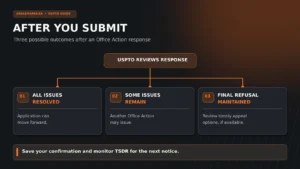
All Issues Resolved
The examining attorney may approve the application to move forward, often toward publication. That is progress, not an immediate registration; the remaining process depends on the filing basis and subsequent events.
Some Issues Remain
The USPTO may issue a final Office Action on previously raised, unresolved issues. If the response presents a new problem, it may issue another non-final action instead. Read the new document and calendar its deadline.
Final Refusal Maintained
If reconsideration does not resolve the matter, a timely TTAB appeal may be relevant for an appealable refusal. Filing reconsideration alone does not preserve appeal rights after the appeal deadline. Check the status and any TTAB correspondence rather than assuming that silence means the application has advanced. USPTO: Responding to Office Actions
What Happens If You Don’t Respond?
The application may be declared abandoned if a required, timely response is not filed. It will not proceed to registration in that state. In some situations, an applicant whose delay was unintentional may file a Petition to Revive with the required statement, fee, and response or other material. Revival is conditional and time-limited: the USPTO generally requires the petition within two months of the Notice of Abandonment, with a separate rule if the notice was not received. Act promptly and check the official instructions. USPTO: Reviving an Abandoned Application
Common Office Action Response Mistakes
- Missing the deadline. Calculate from the issue date and file early enough to handle technical problems.
- Addressing only one issue. Make a checklist covering every refusal and requirement, including attachments.
- Using the wrong form. A final action uses a different response form from a non-final action; other USPTO units have separate forms.
- Using a generic internet template. It may answer a different refusal or include unsupported factual claims.
- Improperly broadening goods/services. Check every proposed amendment against the existing identification.
- Submitting weak specimen evidence. A mockup or image of future intended use does not establish qualifying actual use.
- Assuming a final action ends all options. Review timely reconsideration and appeal possibilities.
- Assuming reconsideration extends the appeal deadline. It does not automatically do so; preserve the appeal path separately if needed.
- Letting an unauthorized person sign. A filing signed by the wrong person may be treated as incomplete. Follow the USPTO’s applicant, entity, and attorney signature rules.
Frequently Asked Questions About Trademark Office Action Responses
What is a USPTO trademark Office Action?
An official letter from a trademark examining attorney listing issues with your application. It states what must be addressed and by when; receipt is not automatically a denial.
How long do I have to respond?
Usually three months from the issue date for Section 1 and 44 applications, or six months for Section 66(a) Madrid applications. Check your notice because other correspondence may differ.
Can I get an extension?
Eligible Section 1 and 44 applicants may request one three-month extension for a fee before the initial deadline. Section 66(a) applicants do not have this option.
What is a non-final Office Action?
It generally raises an issue for the first time. Respond with the appropriate correction, evidence, or argument. Unresolved issues may lead to a final action.
What is a final Office Action?
It maintains a previously raised issue. Timely reconsideration and, for an appealable refusal, a separate TTAB appeal may be possible. Track both deadlines.
How do I respond to a trademark Office Action?
Verify the notice in TSDR, calendar its deadline, answer every issue, use the appropriate form, obtain an authorized signature, file, and save confirmation.
Can I respond myself?
Generally yes if you are U.S.-domiciled. Evaluate the complexity first. Foreign-domiciled applicants must use a U.S.-licensed attorney for USPTO trademark matters.
What happens if I don’t respond?
The application may be abandoned. An unintentional delay may qualify for a time-limited Petition to Revive, subject to the USPTO’s requirements and fee.
Can I change my goods or services?
You can generally clarify, narrow, or delete items within the original identification’s scope. You cannot broaden it to cover new offerings.
Can I add another trademark class?
Possibly, if the original identification already encompasses the goods or services and applicable requirements and fees are met. Adding a class cannot introduce new offerings.
Is there an Office Action response template?
A framework can organize issues, but no universal template supplies the facts, evidence, and arguments needed for every refusal. Tailor each answer to the actual notice.
Can I contact the examining attorney?
Yes, for clarification and potentially minor fixes. The attorney cannot give you legal advice, and a conversation does not automatically replace a required filing.
What happens after I submit the response?
The examiner reviews it. The application may move forward, receive a final action on unresolved issues, or receive a new non-final action if a new issue arises.
Can I appeal a final refusal?
An appealable final refusal may be taken to the TTAB by a timely Notice of Appeal and required fee. Reconsideration does not automatically extend the appeal deadline.
Conclusion
A trademark Office Action is a request to deal with issues in your application, not an automatic end to it. First verify the notice, identify its issue date and response deadline, and make a complete list of the examiner’s refusals and requirements. A non-final action and a final action lead to different filing choices, especially when reconsideration and appeal are possible. Likewise, a wording correction needs a different response from a specimen problem or a likelihood-of-confusion refusal.
An effective office action response addresses every issue with accurate amendments, evidence, or arguments as appropriate. Generic templates can miss the facts that matter in your application. This intent-to-use trademark guide goes hand in hand with this article.
Need Help With a Trademark Office Action?
Contact EagleMarkUSA to discuss reviewing your Office Action and the possible response options. For earlier-stage filing questions, explore EagleMarkUSA Trademark Registration Services. This article provides general education, not legal advice for a particular application, and no outcome is guaranteed.
Also Read:
Trademark Statement of Use: How to File, Fees, Deadline & Example

Pingback: Trademark Statement of Use: How to File, Fees & Deadlines