You filed a trademark application on the Principal Register, but the USPTO says your mark is descriptive of your goods or services. The examining attorney may suggest the Supplemental Register. Should you accept it, argue that the mark is suggestive, or try to show that customers already recognize it as your brand?
The Supplemental Register is an actual federal trademark register. Registration there can be helpful, but it has several important disadvantages compared to the Principal Register. Your options also depend on your filing basis: an applicant relying solely on intent to use cannot just switch to the Supplemental Register before establishing use.
This guide compares the registers, explains the often overlooked consequences of a changed effective filing date, and gives a practical way to evaluate a descriptiveness refusal. Both registrations can have legal effects, but neither settles every marketplace dispute. The answer depends on the actual mark, identified goods or services, the evidence, and your business objectives. This is general educational information and not legal advice in relation to any specific application.
What Is the Principal Register?
The Principal Register is the USPTO’s main federal trademark registry. Some marks are inherently distinctive and can be registered without proof of acquired distinctiveness. Other marks can qualify if they acquire distinctiveness under Section 2(f). There are other requirements. USPTO TMEP §§801.02(a), 1209.01.
Principal registration offers statutory presumptions of ownership and exclusive use for the goods or services listed in the registration, constructive notice of the ownership claim, and potential constructive-use priority from filing. An eligible registration may subsequently support Section 15 incontestability and CBP recordation. Both registers support a federal court action and can assist with foreign filings. These benefits are within legal limits. USPTO: Definitions of Registration
What Is the Supplemental Register?
The Supplemental Register is the USPTO’s alternative federal register for certain designations that can indicate source but are not currently eligible to be registered on the Principal Register. Generic language will not qualify. Merely descriptive language may qualify. Eligibility depends on the mark and the goods/services. U.S.P.T.O. T.M.E.P. §§ 801.02(b), 1209.01.
It’s not an automatic backup. There may be an unrelated likelihood-of-confusion refusal, specimen problem, failure-to-function problem, or ineligible filing basis that may prevent registration.
Supplemental Register vs Principal Register: What’s the Difference?

| Issue | Principal Register | Supplemental Register |
|---|---|---|
| Federal USPTO registration | Yes | Yes |
| ® Use after registration | Yes | Yes |
| Cited against later confusingly similar applications | Yes | Yes, potentially |
| Statutory Ownership and Exclusive Use Presumptions | Available under applicable provisions | Not the same as Principal Register presumptions |
| Constructive notice of claim of ownership | Available | Not the same statutory benefit |
| Constructive-use priority from filing date of application | Potentially available if statutory conditions are satisfied | Not same Section 7(c) benefit |
| Section 15 incontestability | May be available if requirements are met | Not available |
| CBP trademark recordation | Eligible if meeting CBP requirements | Not eligible |
| Publication for opposition before registration | Yes, in general | No; registration published when granted |
| Later Principal registration | Already on Principal | Requires new Principal application after Supplemental registration |
The distinction concerns statutory benefits, not whether your business is legitimate. A Supplemental registration may remain important for later USPTO applicants and can be maintained if required filings are made. The comparison is guided by USPTO TMEP §801.02 and CBP’s recordation eligibility guidance.
Is the Supplemental Register a Valid Federal Trademark Registration?
Yes. A mark on the Supplemental Register has a USPTO registration and registration number at the federal level. To call it “unregistered” is incorrect. Its statutory effects are different from those of Principal registration, especially in cases where someone relies on presumptions of ownership, constructive notice or incontestability.
Nor does it settle every dispute. The strength of the mark, actual use in the marketplace, prior rights, and the particular goods or services remain relevant. A registration certificate is important, but it does not give its owner exclusive rights in every industry. USPTO: Registration Definitions.
Can You Use the ® Symbol with a Supplemental Registration?
Yes. Once the USPTO registers the mark on the Supplemental Register, the owner may use ® with the registered mark in connection with the covered goods or services. An application or an Office Action offering the Supplemental Register does not constitute a registration per se. USPTO: Benefits of the Supplemental Register
If you are not sure what symbol is appropriate for your current status, use EagleMarkUSA’s TM / SM / ® Symbol Helper. Do not use ® on an unregistered version of a mark just because you intend to seek registration later.
Can a Supplemental Registration Bar a Later Trademark Application?
Maybe, yes. The USPTO may rely on an existing Supplemental registration in a Section 2(d) likelihood-of-confusion refusal of a subsequent application. This is one practical advantage of registration even without Principal Register presumptions. This does not mean that all similar marks will be rejected. The examining attorney will look at the marks and the goods or services. USPTO: Supplemental Register Amendment.
For a more detailed discussion of how the USPTO compares marks and offerings, please see USPTO Trademark Likelihood of Confusion.
What Benefits Do You Lose on the Supplemental Register?
No Equivalent Principal Register Presumptions
Supplemental does not carry the statutory presumption of ownership and exclusive use of Principal registration. An owner may be called upon to establish these matters by evidence.
No Equivalent Constructive Notice Benefit
Principal registration gives the statutory constructive notice of ownership claim, which is not given by supplemental registration. The record is still searchable; it is the legal effect that is different.
No Comparable Constructive-Use Priority
If the eligible Principal application proceeds to registration, it will be entitled to a constructive-use priority associated with filing, subject to prior rights. Supplemental registration doesn’t have that advantage.
No Incontestability Under Section 15
Supplemental registrations cannot become incontestable under Section 15; eligible Principal registrations can, subject to statutory requirements and defences. USPTO post-registration FAQs
No Equivalent CBP Recordation Benefit

CBP allows recordation of trademarks for Principal registrations, but not for Supplemental registrations. CBP intellectual property frequently asked questions. See USPTO TMEP §801.02.
Can a Supplemental Registration Become Incontestable?
No. Section 15 declarations are for eligible registrations on the Principal Register. A Supplemental registration remains on the same register and does not become incontestable by virtue of having been maintained for five, ten, or more years. USPTO Post-Registration FAQs
Five years of substantially exclusive and continuous use of a mark in connection with goods or services may be relevant to a new Principal Register application claiming acquired distinctiveness. That is another matter than incontestability, and five years’ use alone does not establish either result.
Read our incontestable trademark guide for eligibility requirements, benefits, and statutory limits.
Who Can Register on the Supplemental Register?
The mark must be capable of distinguishing source, meet the other registration requirements, and have an eligible filing basis. Use requirements differ by filing basis. USPTO TMEP § 815.02.
Use-Based Applications Under Section 1(a)
Use-based applicants who qualify for Supplemental registration may ask for it, but amending the register will not fix a separate refusal or a claim of defective use.
Section 1(b) Applications for Intent to Use
A Section 1(b)-only applicant cannot amend to the Supplemental Register until qualifying use has begun and an acceptable allegation of use is filed. The effective filing date can change. USPTO TMEP § 1102.03.
Section 44 Applications
An eligible Section 44-only applicant may seek Supplemental registration without alleging U.S. use, if the required bona fide intent and other Section 44 requirements are met. An application with both Section 1(b) and Section 44 bases requires separate analysis.
Madrid Applications Under Section 66(a)
Applications under Section 66(a) are not eligible for the Supplemental Register. USPTO TMEP § 816.01.
Can a Generic Trademark Be Registered on the Supplemental Register?
No. A generic term for the identified goods or services cannot function as a trademark for that category, and is not registrable on either register. Descriptive matter can be registered on the Supplemental Register if it is capable of distinguishing source; generic matter cannot be saved by choosing a different register. USPTO TMEP §1209.01.
The difference is in how the relevant purchasers interpret the wording in relation to the real offer. If the examiner states your term is generic, address that finding head-on. A descriptiveness refusal calls for a review of the actual wording and the goods or services it identifies.
Can an Intent-to-Use Application Seek the Supplemental Register?
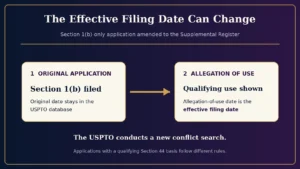
A Section 1(b) applicant may request the Supplemental Register, but a Section 1(b)-only application cannot be amended to it until the applicant has begun qualifying use and filed an acceptable allegation of use. The allegation of use must include the required specimen. An Amendment to Allege Use may be filed during the permitted pre-publication period; a Statement of Use is filed during the post-Notice of Allowance period. The correct order depends on the status of the application. See Trademark Application for Intent to Use. USPTO TMEP §1102.03.
The often-unnoticed consequence: if an application is filed only under Section 1(b) and then is amended to the Supplemental Register after a satisfactory allegation of use, then the effective filing date is the date of filing of that allegation of use. The USPTO performs a new conflict search. The original filing date may still appear in the USPTO database even though the effective filing date has changed for this purpose. There are different rules for a Section 1(b) application with a qualifying Section 44 basis. Check the whole record before accepting a change that could affect priority. USPTO TMEP §§ 1102.03, 816.02.
Are Supplemental Register Applications Published for Opposition?
No. In general, an application that is pending in the Principal Register is published for opposition before registration. Supplemental Register applications are not published for opposition before registration. Instead, when registration issues, it is published in the Trademark Official Gazette. An available cancellation proceeding may be used later to challenge the registration by an interested party. U.S.P.T.O. T.M.E.P. § 815.
That procedural distinction does not mean that a Supplemental application is not substantively examined. The USPTO still determines eligibility and other grounds of refusal.
Does a Supplemental Registration Automatically Become Principal After Five Years?
No. There is no automatic upgrade. Five years of use does not change the existing Supplemental certificate to a Principal registration. Once a mark is registered on the Supplemental Register, that registration cannot simply be amended to a Principal registration. The owner will have to file a new Principal Register application and meet its requirements, including publication for opposition. USPTO TMEP § 1609.09.
Know the difference between a pending application and an issued registration. Amendments may be made while an application is pending, but an issued Supplemental registration does not become a Principal registration.
Does Five Years on the Supplemental Register Guarantee Principal Registration?
No. Section 2(f) provides that in an appropriate case the applicant may submit a verified statement of substantially exclusive and continuous use of a trademark in commerce for the five years preceding the statement. The relevant period is the period of use of the mark, not the period of existence of a Supplemental certificate. The USPTO may require further evidence of consumer recognition, especially for highly descriptive matter. USPTO TMEP § 1212.05.
An older Supplemental registration alone does not prove that consumers now understand the wording as your brand. Consider actual use, third-party use, and available evidence. For the possible paths to proof and their limitations, see our guide on acquired distinctiveness under Section 2(f).
How Do You Move from the Supplemental to the Principal Register?
An issued Supplemental registration cannot be converted. To apply for Principal registration at a later time:
- Keep using the mark as a source identifier. Keep dated evidence.
- Check consumer recognition and any other possible refusals.
- File a new Principal Register application, with the required fee.
- Claim Section 2(f) if supported, or otherwise establish inherent distinctiveness.
- Complete examination and, if approved, publication for opposition.
The new application must meet its own requirements. If you want to keep the existing Supplemental registration, make the required maintenance filings. USPTO TMEP §1609.09.
Supplemental Register vs. Section 2(f) on the Principal Register

These are different answers to a different problem of distinctiveness. Section 2(f) provides a means of registration in the Principal Register based on acquired distinctiveness. The Supplemental Register is a second register for registrable matter capable of acquiring distinctiveness.
| Question | Section 2(f) Principal Register | Supplemental Register |
|---|---|---|
| Where would the mark register? | Principal Register | Supplemental Register |
| Does acquired distinctiveness need to be shown now? | Yes, with an acceptable claim and evidence. | No, but the matter must be capable of distinguishing the source. |
| What constitutes evidence? | Previous Principal registration, verified claim of five years’ use in proper case, other evidence of recognition, or combination | Eligibility, basis of filing, use when required, and disposition of other refusals |
| Statutory benefits | Principal Register benefits, if registration issues | Supplemental benefits; several Principal benefits unavailable |
| Good for a recently used descriptive mark | Often difficult without proof of recognition | May be available if mark and basis are good |
| Does five years guarantee success? | No | No automatic change after 5 years |
For a detailed discussion of consumer surveys, advertising, substantially exclusive use and Section 2(f) proof, see Acquired Distinctiveness Trademark. USPTO TMEP § 1212.
Do You Challenge the Descriptiveness Refusal or Accept the Supplemental Register?
Read the Office Action first. Separate Section 2(d) and specimen or other objections will not be cured by a register amendment. Refer to Response to Trademark Office Action.
Path 1 — Argue That the Mark Is Suggestive
Where imagination is required to link the mark to the offering, a supported suggestiveness argument may save a Principal path. Answer the actual evidence of the examiner; “the name is creative” is not enough. USPTO TMEP §1209.01.
Path 2 — Present Strong Evidence of Acquired Distinctiveness
If the mark is already known to buyers as yours, consider Section 2(f). It may be supported by a qualifying earlier registration, an appropriate five-year claim or evidence of consumer recognition. Highly descriptive wording can require stronger proof. USPTO TMEP 1212.
Path 3—Descriptive Mark, Weak Section 2(f) Evidence
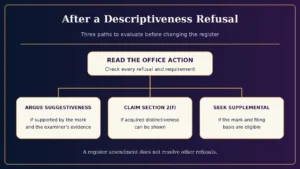
If the mark is descriptive but capable of distinguishing source, and recognition evidence is weak, the Supplemental Register may be practical if the filing basis allows it. Before amending, check the effective filing date and any other refusals.
When Might the Supplemental Register Make Sense?
It may suit a business that already uses an eligible descriptive mark, lacks sufficient evidence for Principal registration, and wants federal registration while building consumer recognition. Before accepting, check the actual refusal, the distinctiveness of the mark, any other impediments, and the cost of a subsequent new application. A Section 1(b)-only applicant must also be aware of the effective-filing-date consequence.
When Is the Principal Register Worth Fighting For?
A supported suggestiveness argument or substantial evidence of acquired distinctiveness may be grounds to pursue Principal registration, particularly where statutory presumptions, priority, or CBP recordation are important to the business. Never argue blindly. Judge the evidence of the examiner, and the expense of the reply. Where procedurally appropriate, an applicant may alternatively argue for Principal and request Supplemental. TMEP §816.03.
Is the Supplemental Register a Bad Option?
No. It allows ® after registration, can be cited against later applications, provides access to federal court, and can help with foreign filings. It lacks several Principal Register benefits. Whether it makes sense depends on the mark, filing basis, and business plans. USPTO: Definitions of Register.
Supplemental Register Examples
Examples are illustrative, and results will be dependent on the full application record.
Example 1 — New Descriptive Service Mark
A cleaning business has a phrase that describes their services very well. It has customers but scant evidence that buyers recognize the phrase as its brand. If the phrase is capable of distinguishing source, Supplemental registration may be worth looking into.
Example 2 — Descriptive Mark in Long Use
The business has for years used a descriptive phrase, and has meaningful customer research, advertising records and other evidence of recognition. It may consider a Principal Register application with a Section 2(f) claim. Years of use alone may not be sufficient.
Example 3 — Suggestive Mark Found Descriptive
A software name might suggest a benefit without immediately telling you what the product is. A supported argument for inherent distinctiveness might justify continuing to seek Principal registration.
Example 4 — Generic Word
The seller wants the plain product name for the product itself. Supplemental registration cannot remedy genericness.
Example 5 — Intent-to-Use Application
A startup under Section 1(b) before launch. It has to show use and file a proper allegation of use before it can apply for Supplemental registration; the effective filing date can be different.
Common Supplemental Register Errors
- Calling it unregistered: It is federal registration with different statutory effects.
- Avoiding ® after registration: The symbol is allowed for the registered mark in connection with covered goods or services.
- Claiming Principal presumptions: They are not given by Supplemental registration.
- Expecting an upgrade: Registration issued does not change after 5 years.
- Treating five years as guaranteed proof: Section 2(f) may need more proof.
- Expecting the register to cure genericness: It does not.
- Seeking a Supplemental amendment of a Section 1(b)-only application before use: Qualifying use and an acceptable allegation of use are required.
- Overlooking a changed effective filing date: A Supplemental amendment in a Section 1(b)-only application moves the effective filing date to the allegation-of-use filing date.
- Subsequent applicants ignored. A Supplemental registration may be cited under Section 2(d).
Can You File Yourself to Amend to the Supplemental Register?
Yes, to the extent that law and procedure allow. The applicant may view the Office Action and file a response using the appropriate USPTO response form. The USPTO response-forms page lists the forms for nonfinal and final actions. Its Supplemental Register amendment guidance explains the amendment, but its form instructions were last updated in 2022; check the current response form and your Office Action before filing. Please see your own notice for instructions and the deadline.
The hard part is often not choosing a box, but deciding: Is the term descriptive or generic? Can you prove 2(f)? Do you have a valid claim of use? Will the effective filing date change? Are there other refusals? Foreign-domiciled applicants must be represented by a U.S.-licensed attorney in USPTO filings. USPTO: Do I need an attorney? A qualifying applicant who resides in the United States does not need to have an attorney simply because the issue pertains to the Supplemental Register.
When Should You Seek Professional Help?
Seek case-specific help: When the mark is core to a major brand investment, when a Section 1(b) amendment might affect priority, or when an Office Action alleges genericness. The same goes for if you have compelling but complex evidence of consumer recognition, multiple grounds for refusal, a final action, or a possible appeal.
Trouble Deciding Between the Principal and Supplemental Registers?
EagleMarkUSA can help you organize your Office Action, filing history, goods or services, and available evidence, and help you understand the application-support options it provides. If you need legal analysis or legal representation, you should hire a trademark attorney licensed in the U.S. No service can guarantee registration of any particular mark with the USPTO.
Questions Frequently Asked About the Supplemental Register
What Is the Supplemental Register?
It is the second federal register of the USPTO for eligible matter that can distinguish source but is not currently eligible for Principal registration. Descriptive language may be used, but generic language for the identified offerings may not.
Is registration on the Supplemental Register a federal trademark?
Yes. A successful application results in a federal registration, but it does not have several of the benefits afforded by statute to the Principal Register. It can still be cited against a later application involving a confusingly similar mark for related goods or services.
What’s the difference between the Principal and Supplemental Registers?
Principal registration provides increased statutory presumptions and potential priority advantages. Supplemental registration provides coverage for eligible matter that may become distinctive, but is not currently entitled to Principal. Both allow ® after registration.
Can I use ® with a Supplemental Register trademark?
Yes, upon registration of the mark for the goods or services concerned. An application or an Office Action providing for Supplemental registration is not enough.
Can a Supplemental Registration Block a Later Application?
Maybe. If a later mark for related goods and services is likely to confuse, the USPTO can cite it under Section 2(d). It does not block every later use of similar wording.
Can a Supplemental Registration Become Incontestable?
No. Section 15’s incontestability provision applies only to qualifying Principal Register registrations. A Supplemental registration still requires timely maintenance filings, including the Section 8 declaration of continued use or excusable nonuse where applicable.
Does the Supplemental Register Automatically Become Principal After Five Years?
No. An issued Supplemental registration is not automatically upgraded or converted. Where there is a supportable basis, seek Principal registration through a new application.
How do I go from supplemental to principal?
File a new Principal Register application supported by inherent distinctiveness or, if appropriate, acquired distinctiveness under Section 2(f). The application will be examined and published in the usual way.
Is five years enough to show acquired distinctiveness?
Not always. A verified statement of substantially exclusive and continuous use may be sufficient in an appropriate case, but the USPTO may require more, especially for highly descriptive wording.
Can a generic trademark be registered on the Supplemental Register?
No. Choosing a different register will not permit registration on either register of a generic name for the relevant goods or services.
Can an intent-to-use application be filed on the Supplemental Register?
A Section 1(b)-only application cannot be amended to the Supplemental Register until qualifying use begins and an acceptable allegation of use is filed. Its effective filing date then becomes the allegation-of-use filing date. Applications with a Section 44 basis require separate review.
Can a Section 66(a) Application Use the Supplemental Register?
No. A Section 66(a) application under the Madrid Protocol may not be amended to the Supplemental Register. Review the particular refusal and available response options.
Is it worth registering on the Supplemental Register?
Sometimes. It can be useful for an eligible descriptive mark when Principal registration is not supported at this time. Weigh the real benefits against lost Principal benefits and any filing date effect.
Conclusion
The Principal Register offers additional statutory benefits. The Supplemental Register is still a federal registration: it allows ® after registration and can be relevant to later applicants, but it lacks several important Principal Register presumptions and benefits.
Five years of use does not automatically upgrade a registration. A Supplemental registration does not automatically become a Principal registration; a new application is required. Five years of substantially exclusive and continuous use may support an acquired-distinctiveness claim in an appropriate case, but it does not ensure acceptance. The right decision is based on the actual mark, evidence, filing basis, and business objectives. Read the entire Office Action, then decide on a course of action.
Which Register Is Best For Your Trademark? Need Help?
EagleMarkUSA can assist with your descriptiveness refusal, supplemental amendment requirements, Section 2(f) materials, and response options. The USPTO decides whether to grant registration; no result is guaranteed.

Pingback: Incontestable Trademark: Section 15 Requirements & Benefits