
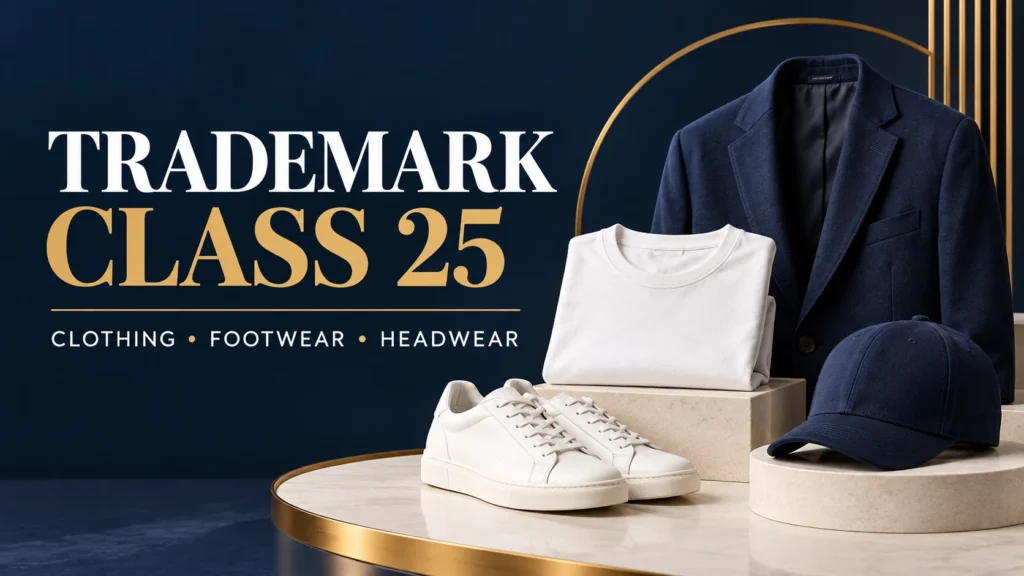
Trademark Class 25 primarily covers clothing, footwear, and headwear for people. T-shirts, jackets, sneakers, and hats are familiar examples. If you are applying to register a clothing brand with the USPTO, Class 25 is usually the first class to investigate.
But a fashion business can sell products in several classes. Handbags, jewelry, fabrics, and clothing fasteners are generally classified elsewhere. Retail store services are different from the clothing goods offered in the store. Even an item you wear, such as a protective helmet, may belong outside Class 25 because of its function.
This guide covers Class 25 goods and exclusions, related classes, and how to describe your products in a U.S. application. Check proposed wording in the USPTO Trademark ID Manual.
What Is Trademark Class 25?
Class 25 is one of the 45 classes in the international Nice Classification system used by the USPTO. It groups certain goods—chiefly human clothing, footwear, and headwear. It is not a class for every product made by a fashion company, and it does not describe a retail service. WIPO’s 2026 Nice Classification explanatory note for Class 25 identifies both the main category and important exceptions.
What Does Class 25 Mean in a Trademark Application?
Class 25 is the category for specified goods; it is not the trademark itself. You must identify your goods, such as T-shirts or footwear. Naming the class does not claim every item in it.
For the full system, see Trademark Classes Explained: Complete Guide to All 45 USPTO Classes.
Trademark Class 25 List: What Does It Include?
Here are common Class 25 goods. An application should identify your particular products rather than copy this table wholesale.
| Category | Examples |
|---|---|
| Everyday tops | T-shirts, shirts, blouses, sweatshirts, sweaters, hoodies |
| Bottoms | Pants, jeans, shorts, skirts, leggings |
| Dresses and coordinated apparel | Dresses, suits, uniforms |
| Outerwear | Jackets, coats, rainwear |
| Underwear and nightwear | Underwear, socks, pajamas, sleepwear |
| Sports apparel worn as clothing | Athletic shirts, sports jerseys, workout leggings, swimwear |
| Ordinary footwear | Shoes, sneakers, boots, sandals, slippers |
| Headwear | Hats, caps, beanies |
These examples are not a ready-made USPTO identification. Check the terms in the USPTO ID Manual, especially for specialized goods.
Clothing Covered by Trademark Class 25
Ordinary apparel is central to Class 25. Describe what customers buy under your mark.
Shirts, T-Shirts and Tops
T-shirts, shirts, blouses, hoodies, sweaters, and sweatshirts are common examples. A founder launching only T-shirts should not list every possible garment. Later additions depend on the original identification.
Pants, Shorts and Bottoms
Jeans, pants, shorts, skirts, and leggings are typical examples. Name the products rather than “fashion bottoms.”
Jackets and Outerwear
Jackets, coats, and ordinary rainwear generally fit. Protective clothing may be classified differently.
Dresses and Fashion Apparel
Dresses and suits are Class 25 clothing examples. Handbags and jewelry need separate evaluation.
Underwear and Sleepwear
Underwear, pajamas, and socks are also clothing. Describe the goods your mark covers.
Does Class 25 Cover Footwear?
Yes. Ordinary footwear generally belongs in Trademark Class 25. Shoes, sneakers, boots, sandals, slippers, and many athletic shoes are examples. Selling footwear alongside apparel can still involve just one class for those particular goods, though each item needs an accurate identification.
Function can change the answer: orthopedic footwear belongs in Class 10, while ice skates are Class 28 sports equipment. Check specialized products in the ID Manual. WIPO, Class 25 explanatory note
Does Class 25 Cover Hats and Headwear?
Yes. Hats, caps, beanies, and other ordinary headwear generally fit Class 25. A brand selling branded caps alongside shirts should investigate Class 25 for both goods.
Protective helmets, including sports helmets, generally fall in Class 9. Their protective function matters more than where they are worn. WIPO, Class 25 explanatory note
What Is Not Included in Trademark Class 25?
Finished apparel differs from accessories and specialized equipment. These are typical classes to investigate; identify each exact item before filing.
| Product | Typical different class | Why |
|---|---|---|
| Handbags and luggage | 18 | Bags are separate goods from the clothing worn with them. |
| Animal clothing | 18 | Class 25 concerns clothing for people. |
| Fabrics and textiles sold as fabric | 24 | Fabric goods are distinct from finished clothing. |
| Buttons and clothing zippers sold as goods | 26 | Fasteners and haberdashery items have their own classification. |
| Protective helmets | 9 | Their protective function controls. |
| Clothing for protection against fire | 9 | This is specialized protective clothing. |
| Orthopedic footwear | 10 | It serves an orthopedic purpose. |
| Baseball or boxing gloves | 28 | These are equipment essential to particular sports. Ordinary gloves worn as clothing can be Class 25. |
| Ice skates | 28 | They are sports equipment, not ordinary footwear. |
| Dolls’ clothing | 28 | Clothing for dolls is classified with toys. |
| Jewelry | 14 | Jewelry is a separate goods category. |
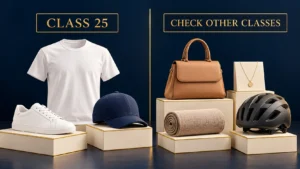
See WIPO’s Class 25 explanatory note for these exclusions. “Fashion-related” is not a trademark class.
Trademark Class 25 Description: How Should You Describe Your Goods?
The identification of goods should name products associated with the mark or covered by a bona fide intent-to-use filing. Do not list a speculative fashion catalog.
“T-shirts, sweatshirts, and hats” identifies products; “fashion merchandise” does not. The USPTO says “T-shirts,” “shirts,” and “tops as clothing” can all accurately describe short-sleeved T-shirts. Choose wording that matches your goods. USPTO goods and services guidance
Use the USPTO Trademark ID Manual
Search each product in the Trademark ID Manual. Check its wording and class. An accurate listed entry can avoid the additional free-form identification fee for Section 1 or 44 applicants; never choose an inaccurate term simply to avoid a fee. USPTO ID Manual search guide · USPTO fee guidance
Avoid Vague or Overly Broad Descriptions
“Merchandise,” “fashion products,” and “clothing accessories” may be too vague or span classes. Name the goods. You can generally narrow or clarify an identification after filing, but cannot expand it to add unrelated goods. USPTO TMEP §§1402.01, 1402.06
Make Sure Your Mark Functions as a Clothing Brand
For a use-based filing, classification and wording are not the only concerns. A large slogan across the front of a T-shirt may be perceived as decoration rather than a source-identifying trademark. A properly used neck label, hangtag, or other qualifying display can better show brand use, depending on the facts. Plan your specimen around how customers actually encounter the mark; the USPTO evaluates the overall presentation. USPTO ornamental-refusal guidance
Class 25 vs Class 35: What’s the Difference?

Class 25 covers goods, including clothing, footwear, and headwear. Class 35 covers certain services, including appropriately identified retail store services. For example:
- A mark identifying the source of branded T-shirts may be the subject of a Class 25 goods application.
- A mark identifying online retail store services featuring clothing may also be relevant to Class 35, if the applicant actually provides or has a qualifying intent to provide the claimed service.
Selling your own shirts does not automatically mean you need Class 35. The USPTO does not treat “sales” of one’s own goods as a registrable service. A boutique offering a retail store service featuring third-party clothing has reason to examine Class 35, subject to its actual mark use. USPTO TMEP §§1402.11, 1402.11(a)(vi)
See our future Trademark Class 35 Explained guide for more detail.
Class 25 vs Other Fashion-Related Trademark Classes
| Class | Typical relevance to a fashion business |
|---|---|
| 14 | Jewelry and watches |
| 18 | Handbags, luggage, and certain leather goods |
| 24 | Fabrics and textile goods |
| 25 | Clothing, footwear, and headwear |
| 26 | Buttons, zippers, and certain clothing accessories |
| 35 | Certain retail store and other business services |
One company can offer goods and services in several classes. A finished jacket and fabric sold by the yard need different descriptions. Our future Trademark Class 18 Explained guide will cover bags. USPTO coordinated classes guidance · WIPO Nice Classification 2026
Does a Clothing Brand Need More Than Class 25?
Example 1: Basic Apparel Brand
A T-shirt, hoodie, and hat brand should investigate Class 25 and identify its actual or genuinely intended goods.
Example 2: Fashion Brand With Accessories
A label offering clothing, handbags, and jewelry should investigate Classes 25, 18, and 14.
Example 3: Apparel Company With Retail Services
A separately identifiable retail store service may warrant Class 35. Merely selling your own apparel does not automatically warrant it.
Each added class has a filing fee.
How to Choose the Correct Class 25 Goods for Your Application
Step 1: List What You Actually Sell
Write down the product types under the proposed mark. Separate goods already sold from goods you genuinely intend to offer under an appropriate filing basis.
Step 2: Separate Clothing From Related Products
Put finished apparel, fabrics, handbags, jewelry, and any protective or sporting equipment into separate groups. A product collection may span multiple classes.
Step 3: Search the USPTO Trademark ID Manual
Look for each product by its ordinary name. Read the complete entry and any qualifying language. If “hats” fits, do not choose a different description that sounds more expansive but is inaccurate.
Step 4: Determine Whether Other Classes Apply
Check whether you are claiming only goods or also a distinct service. Investigate each additional class and its fee only when the offering warrants it. Check out our Trademark class finder.
Step 5: Review the Identification Before Filing
Check that the goods match the mark’s actual or qualifying intended use, the filing basis, and the wording submitted. An identification normally cannot be broadened after filing. EagleMarkUSA can assist with the trademark registration process and help you assess the next practical steps. USPTO goods and services guidance
Can Two Clothing Brands Register Similar Trademarks in Class 25?
Being in the same class does not by itself answer whether two marks conflict. The USPTO considers the marks and whether the identified goods or services are related in a way likely to confuse consumers. Different class numbers also do not guarantee that similar marks can coexist: the USPTO treats clothing, jewelry, handbags, and retail services as potentially related categories in trademark searching. Search beyond the exact Class 25 filter. USPTO likelihood of confusion guidance · USPTO coordinated classes guidance
For more, read Can the Same Trademark Be Registered in Different Classes?
Can You Add Class 25 After Filing?
Sometimes, if the original application already identified goods properly classified in Class 25. For certain U.S. filing bases, a class correction or an added class can be possible, with applicable fees. You generally cannot add a new clothing product that falls outside the original goods identification. Madrid Protocol Section 66(a) applications follow stricter classification rules. Read Can You Add a Trademark Class After Filing? before treating an amendment as a substitute for a new application. USPTO TMEP §1403.02
Trademark Class 25 Examples by Business Type
| Business type | Class 25 relevance |
|---|---|
| T-shirt brand | Typically worth investigating for branded T-shirts. |
| Sneaker company | Generally relevant for ordinary sneakers. |
| Hat brand | Generally relevant for hats and caps worn as headwear. |
| Streetwear brand | Relevant to the actual apparel offered; bags and jewelry need separate review. |
| Boutique selling third-party goods | Class 35 retail services may be more relevant to its store mark; Class 25 depends on whether it has its own clothing goods. |
| Jewelry-only brand | Investigate Class 14, not Class 25 solely because jewelry is fashionable. |
| Handbag-only brand | Investigate Class 18 for handbags. |
| Fabric manufacturer | Investigate Class 24 for the fabrics it sells; finished apparel is a different question. |
Frequently Asked Questions About Trademark Class 25
What is Trademark Class 25?
Trademark Class 25 is the Nice Classification category that primarily covers human clothing, footwear, and headwear. The USPTO uses the class to organize goods in trademark applications, searches, and fees. Your application must still name the specific goods associated with your mark.
What products are included in Class 25?
Common examples include T-shirts, sweatshirts, pants, dresses, jackets, ordinary shoes, sneakers, boots, hats, and caps. Many sports garments and athletic shoes also fit. A specialized item’s function can change its class, so confirm its precise identification in the USPTO ID Manual.
Is clothing Trademark Class 25?
Ordinary clothing for people is generally in Class 25. That does not mean every item sold by a clothing company is in Class 25: its handbags, jewelry, fabrics, or retail services may require different classes. Identify each offering separately.
Are shoes in Trademark Class 25?
Ordinary shoes, including many sneakers, boots, and sandals, are generally Class 25 footwear. Orthopedic footwear belongs in Class 10, while ice skates are Class 28. Classification depends on the particular product and its function.
Are hats in Trademark Class 25?
Ordinary hats and caps worn as headwear generally fall in Class 25. Protective helmets, including helmets for sports, are generally Class 9. Check what the item is designed to do before treating every head-worn product as Class 25.
Are handbags included in Class 25?
No. Handbags are generally Class 18 goods, even when a clothing brand sells them under the same mark as its apparel. A business offering both clothing and handbags should investigate Classes 25 and 18 for the respective goods.
Is jewelry in Class 25?
Jewelry generally belongs in Class 14, not Class 25. The fact that jewelry is worn with clothing or sold in an apparel store does not turn it into clothing. A brand offering both needs to evaluate its specific goods in both classes.
What is the difference between Class 25 and Class 35?
Class 25 covers clothing, footwear, and headwear goods. Class 35 covers certain services, including properly identified retail store services. Merely selling your own Class 25 goods does not automatically require a Class 35 application; identify a distinct service and assess the mark’s use for it.
Can one trademark cover Class 25 and another class?
Yes. One mark can be the subject of a multiple-class application when the applicant has appropriate goods or services in each class and meets the applicable requirements. For example, clothing and handbags may call for Classes 25 and 18. USPTO filing fees are generally assessed per class.
How should I describe clothing in a trademark application?
Name the actual goods clearly, such as “T-shirts” or “sweatshirts,” rather than using “fashion products.” Search the USPTO ID Manual for an accurate accepted identification. The wording should match the goods connected to your mark and your filing basis; the class number alone is insufficient.
Registering a Clothing or Apparel Trademark?
Trademark Class 25 is the main category to investigate for clothing, footwear, and headwear. A fashion brand’s other offerings may belong elsewhere: handbags in Class 18, jewelry in Class 14, fabrics in Class 24, certain fasteners in Class 26, and qualifying retail services in Class 35. Specialized protective or sporting products can follow other rules too.
Before filing, make a precise product list, check the USPTO ID Manual, and review how the mark will be used for each good or service. Class 25 should describe the actual apparel involved, not stand in for an entire fashion business.
Need help reviewing your classes and U.S. trademark application? Contact EagleMarkUSA to discuss its trademark registration services and your next steps. This guide provides general educational information, not legal advice for an individual matter. USPTO approval is never guaranteed.
Also read
Trademark Class 42 Explained: SaaS, Software & Technology Services

Pingback: Trademark Classes: Complete USPTO Guide to All 45 Classes (2026)
Pingback: Trademark Class 35 Explained: Advertising, Business & Retail Services
Pingback: Same Trademark in Different Classes and USPTO Rules - EagleMark USA
Pingback: Can You Add a Trademark Class After Filing an Application?
Pingback: Trademark Class 9 Explained: Software, Electronics & Technology Goods
Pingback: How Much Does It Cost to Renew a Trademark in 2026?
Pingback: How to Submit a Trademark Specimen Correctly
Pingback: How Much Does It Cost to Trademark a Name in 2026? USPTO Fees Explained