
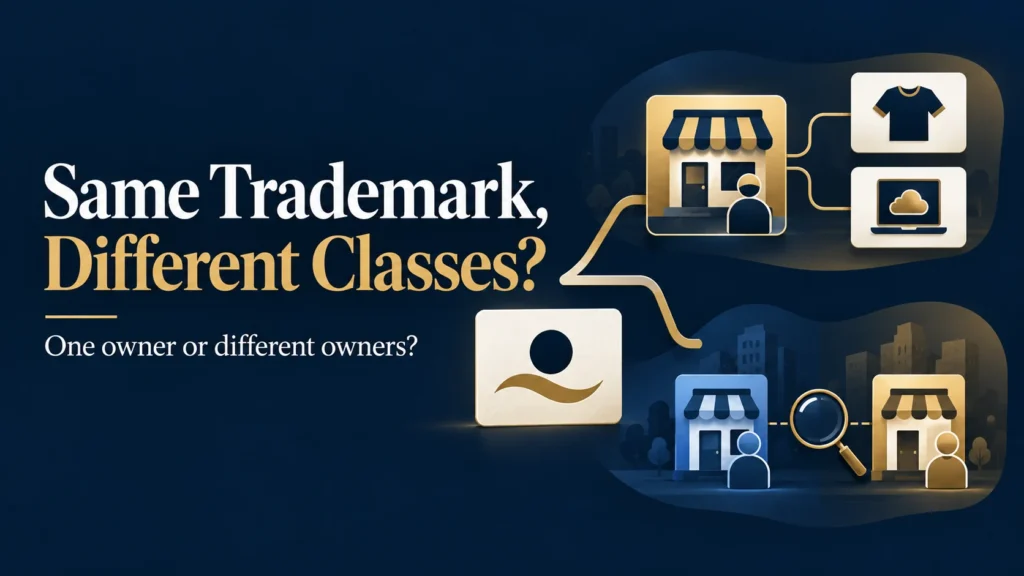
Yes, sometimes—but there are two different questions behind that answer. One business may register the same mark for its own goods or services in multiple trademark classes when its offerings qualify. Two separate businesses may also sometimes hold registrations for identical or similar marks if their goods or services are sufficiently unrelated.
What you cannot assume is that a different class number makes a name available. The United States Patent and Trademark Office (USPTO) considers whether the marks are similar and whether consumers might think the associated goods or services come from the same source. Clothing and a store that sells clothing, for instance, sit in different classes but can be closely related.
This guide explains both situations, shows how the USPTO evaluates potential conflicts, and gives you a practical checklist for a name you have found in another class. If you need a class-by-class starting point, see our Trademark Classes: Complete USPTO Guide to All 45 Classes.
Can the Same Trademark Be Registered in Different Classes?
Yes, in some circumstances. First, determine who owns the marks. Filing one mark for several offerings made by your business is different from trying to register a mark that another business already uses.
One Owner Registering the Same Trademark in Multiple Classes
A software business offering a downloadable app and a separate online subscription platform under one mark might investigate Class 9 for the download and Class 42 for SaaS. Exact classification depends on what customers receive.
The owner can file a multiple-class application and pay per class. Each class needs an accurate description and must meet filing-basis requirements. See USPTO multiple-class guidance and the ID Manual.
Different Owners Using the Same or Similar Trademark
Different owners can sometimes register identical marks where the goods or services are sufficiently unrelated. The USPTO points to Dove for soap and ice cream bars, and Delta for faucets and air transportation, as examples. Those examples illustrate how different markets can support coexistence; they do not mean any new applicant can use those names. See the USPTO’s likelihood-of-confusion guidance.
For a new filing, ask whether buyers would likely assume the businesses are connected.
Does Being in a Different Trademark Class Prevent a Conflict?
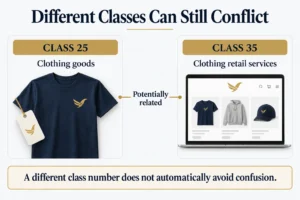
No. Goods or services can be related even when they belong to different classes. Class numbers organize applications under the Nice Classification; they are not separate zones in which identical names are automatically available.
Clothing is commonly in Class 25; online clothing retail services may be in Class 35. Buyers could still assume a connection between a shirt brand and a same-named clothing store. The USPTO treats these as potentially related and coordinates Classes 25 and 35 in searches.
Sharing a class does not itself prove a conflict either.
How Does the USPTO Decide Whether Two Trademarks Conflict?
Likelihood of confusion asks whether buyers might mistake the source of the offerings. A USPTO examining attorney searches for conflicts; a similar registered mark for related offerings can prompt a Section 2(d) refusal. An earlier pending application can affect examination if it registers. See USPTO guidance on these outcomes.
Similarity of the Trademarks
Marks need not be letter-for-letter identical. The USPTO considers how they look and sound, what they mean, and their overall commercial impression. A different spelling or font does not automatically solve a potential conflict. A useful search therefore includes plausible variations, not just your exact proposed wording.
Relatedness of the Goods or Services
Offerings may be related when customers use them together, find them in similar channels of trade, or expect one company to provide both. The USPTO gives clothing and clothing retail, and banking and mortgage lending, as examples.
Trademark Class Number Is Not Decisive
Different classes may still conflict; identical marks may sometimes coexist. Examine the marks and the specific descriptions, not just the numbers.
Examples of the Same Trademark in Different Classes
These are illustrations, not predictions. The first two pairs come from the USPTO; the others show relationships to investigate.
| Situation | Could Coexist? | Why |
|---|---|---|
| Dove soap and Dove ice cream bars | Yes; USPTO-cited example | The USPTO uses this pair to illustrate registered identical marks with different owners and unrelated goods. |
| Delta faucets and Delta air transportation | Yes; USPTO-cited example | The USPTO uses this pair to illustrate coexistence across different kinds of offerings. |
| Same name on clothing and online clothing retail services | Potential conflict; investigate closely | Class 25 goods and Class 35 services may be commercially related. |
| Same name for banking and mortgage lending | Potential conflict; investigate closely | The USPTO gives these as an example of related financial services. |
| Same name for a downloadable app and a SaaS platform | Potential conflict; investigate closely | Class 9 and Class 42 can involve related software offerings, depending on their functions and customers. |
These examples do not permit to adopt an existing name.
Can One Business Register the Same Trademark in Multiple Classes?
Yes, when the business has qualifying goods or services in those classes. A multiple-class application groups those offerings under one mark while identifying and paying for each class separately. Filing more classes is appropriate when the offerings justify them; it is not a way to reserve every future business idea.
Example of a Multiple-Class Trademark Application
Imagine a hypothetical business using the mark NOVA for T-shirts, qualifying online retail store services, and a downloadable inventory app. It might investigate Class 25 for T-shirts, Class 35 for retail services, and Class 9 for the app. Whether each class belongs in an application depends on its exact activities, accurate descriptions, and filing basis. “NOVA” here is an illustration, not a cleared or recommended mark.
If the company also provides customers with online non-downloadable software, it might investigate Class 42. It should describe each offering precisely using the USPTO Trademark ID Manual, rather than filing under every plausible technology category.
USPTO Filing Fees for Multiple Classes
As of 2026, the USPTO’s base electronic application fee for a Section 1 or Section 44 application is $350 per class, if the application meets the base requirements. At that rate, two classes start at $700 and three at $1,050 in USPTO application fees. Additional fees can apply, including for certain custom goods-and-services descriptions. Professional service fees, if any, are separate. Check the current USPTO trademark fee information before filing.
Can Two Different Businesses Own the Same Trademark?
Sometimes. The useful question is not whether the marks appear in two different columns of a class list. It is whether consumers encountering both businesses would likely assume a common source, sponsorship, or connection.
The Dove and Delta examples show that separate businesses can hold identical marks for sufficiently distinct offerings. But product lines expand, sales channels overlap, and marks differ in strength. A result for soap and ice cream does not establish a rule for a new pair of products. A USPTO registration search is only part of evaluating another business’s use; an unregistered mark may also matter to a broader clearance review. The USPTO recommends a comprehensive search across multiple resources.
What If Someone Already Registered My Trademark in Another Class?
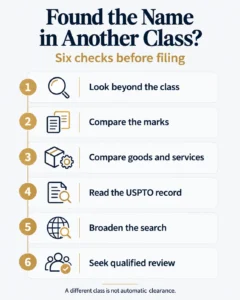
Finding the name is a reason to investigate, not an automatic rejection or a green light. Work through these six checks before deciding whether to file.
Step 1 — Don’t Look Only at the Trademark Class
Record the other class, but do not stop there. Search related and coordinated classes too. The USPTO’s coordinated-class guidance can help you broaden your search.
Step 2 — Compare the Marks
Compare their wording, appearance, pronunciation, meaning, and overall commercial impression. Check variants that customers might hear or remember as the same name.
Step 3 — Compare the Goods and Services
Ask whether buyers could expect the two offerings from one source. Consider common customers, typical brand extensions, overlapping stores or websites, and similar advertising or trade channels.
Step 4 — Review the Actual USPTO Record
Read the registration or application’s specific identification of goods or services, its owner, and its status. A broad label such as “Class 9” tells you much less than the description in the record. A pending application and an existing registration can present different procedural issues.
Step 5 — Conduct a Broader Trademark Search
Search more than the identical phrase. The USPTO calls an exact-word search a starting “knock-out search” and advises expanding it. Look for alternative spellings and similar-sounding marks, related offerings, and relevant uses beyond the federal database. See the USPTO’s federal search instructions and clearance-search guidance.
Step 6 — Consider Professional Trademark Review
When a similar mark appears for related offerings, ask a qualified U.S. trademark attorney to assess the specific risk before committing to branding or filing. EagleMarkUSA can discuss assistance with your registration process and help you understand the next steps it offers; any legal assessment or representation should come from a qualified attorney.
Does Registering in More Classes Give Broader Trademark Protection?
A legitimate additional class can extend the identified offerings in an application and eventual registration. It does not confer rights to every item in that class.
The mark and identified offerings matter. Related offerings can still create conflict across class boundaries.
Can You Register the Same Name in Every Trademark Class?
Applicants should not select all 45 classes to try to monopolize a name. Each identified good or service must match the applicant’s actual use or bona fide intent to use the mark under the applicable filing basis. Each class adds a fee and class-specific requirements. Start with offerings the business genuinely has or plans, then verify each description in the USPTO ID Manual.
Common Mistakes When Evaluating Trademarks in Different Classes
Mistake 1 — Assuming Different Class Means No Conflict
Clothing and clothing retail services can be related across Classes 25 and 35. Compare the actual offerings, not just their numbers.
Mistake 2 — Searching Only for Identical Names
Similar spelling, sound, meaning, or commercial impression can matter. Expand the search to plausible variants.
Mistake 3 — Ignoring Related Goods and Services
Consider how customers shop and what they might expect one company to offer. Relatedness is not limited to identical products.
Mistake 4 — Choosing Extra Classes “Just in Case”
Extra classes cost more and must correspond to legitimate identified offerings. They do not automatically make a name safer.
Mistake 5 — Reading Only Class Numbers
Open the actual record. Its goods-and-services identification tells you what was listed, while a class heading gives only a broad category.
Mistake 6 — Relying on an Exact-Match USPTO Search
A database search for one exact phrase can miss similar marks and uses elsewhere. Broaden the clearance search before concluding.
Frequently Asked Questions
Can the same trademark exist in two different classes?
Yes. One owner may register a mark for qualifying offerings in multiple classes, and different owners may sometimes hold similar or identical marks for sufficiently unrelated offerings. A different class number alone does not establish that the marks can coexist.
Can two companies have the same trademark?
Sometimes. The USPTO gives Dove soap and Dove ice cream bars as an example of identical marks registered by different owners. The outcome for any other pair depends on the marks and whether consumers would likely believe the associated goods or services share a source.
Can I register a trademark if the same name exists in another class?
Possibly, but the other class does not answer the question. Review the existing record’s exact goods or services, compare the marks, and evaluate whether buyers might assume a connection. Search for similar marks in related categories before deciding to file.
Does a different trademark class avoid likelihood of confusion?
No. Goods or services in different classes can still be related. The USPTO considers the similarity of the marks and the relationship between the offerings, rather than treating class boundaries as automatic protection against conflict.
Can I register one trademark in multiple classes?
Yes. A multiple-class application may list the same mark with goods or services in several classes when the filing requirements are met. Each class needs accurate descriptions and the required fee; the appropriate classes depend on what your business actually offers or genuinely intends to offer.
Do I pay separately for each trademark class?
Yes. USPTO application fees are assessed per class. For qualifying Section 1 or Section 44 electronic applications, the 2026 base fee is $350 for each class. Other USPTO fees can apply depending on the application, and fees may change.
Can identical trademarks be registered by different owners?
Yes, sometimes. The USPTO cites identical Dove and Delta marks for different owners’ sufficiently unrelated goods or services. Those examples illustrate a possibility, not a right to register an existing brand in a different category.
Are trademark classes the same as trademark rights?
No. Classes organize goods and services for filing and searching. A registration identifies particular offerings under a mark; it does not grant ownership of an entire numbered class. Potential conflicts can involve related offerings in different classes.
Can two similar trademarks coexist?
They may, depending on how similar the marks are and how consumers understand the associated goods or services. Different buyers or distinct markets may be relevant, but class numbers alone are not decisive. A real answer requires a search and assessment of the specific facts.
What should I do if I find my trademark name in another class?
Open the USPTO record and read its identification and status. Compare the marks, investigate whether the offerings are related, and expand the search to similar names and other relevant uses. If the overlap is material, seek professional review before filing or investing further in the name.
Conclusion
The same trademark can sometimes be registered in different classes. One owner can file across multiple classes for legitimate goods or services. Different owners may also sometimes hold identical or similar marks when their offerings are sufficiently unrelated.
Neither situation turns on class numbers alone. A different class does not eliminate a potential conflict, and a shared class does not settle every case. The USPTO assesses the marks and whether consumers could mistake related goods or services for offerings from the same source. If you find a similar name, read its actual record, search beyond exact matches, and evaluate the business relationship before filing.
Found a Similar Trademark in Another Class?
Contact EagleMarkUSA to discuss assistance with your U.S. trademark registration options and next steps. No search or service can guarantee USPTO approval.
This article provides general educational information, not individualized legal advice

Pingback: Trademark Class 25 Explained: Clothing, Apparel & Footwear
Pingback: Can You Add a Trademark Class After Filing an Application?
Pingback: Trademark Classes: Complete USPTO Guide to All 45 Classes (2026)