
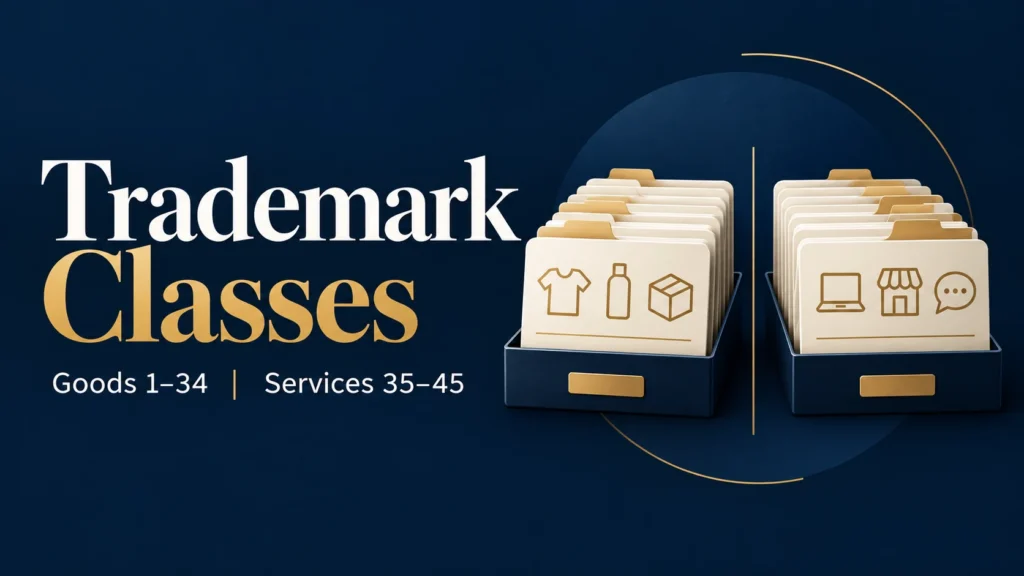
There are 45 international trademark classes used in U.S. trademark applications. Classes 1–34 cover goods, such as clothing, cosmetics, and downloadable software. Classes 35–45 cover services, such as advertising, education, and restaurant services. When you apply to register a mark with the United States Patent and Trademark Office (USPTO), you must identify the goods or services associated with that mark and place them in the appropriate classes.
That sounds straightforward until a business does more than one thing. A clothing company may sell shirts, operate an online retail store, and publish educational videos. A software company might offer a downloadable app, an online subscription platform, or both. Those activities can call for different descriptions and potentially different classes.
This guide gives you a complete trademark class list, explains how common business offerings are classified, and walks through a practical way to research your own goods or services. The table is a starting point; the wording in your application must accurately describe what you actually sell or have a genuine plan to offer.
What Is a Trademark Class?
A trademark class is a numbered group of related goods or services. For example, Class 25 includes clothing goods, while Class 41 covers education and entertainment services.
The class number is only part of the application. A business applying for shirts must identify its actual goods, not merely write “Class 25.” Two businesses in the same class may sell very different products. The USPTO says class headings alone are insufficient identifications.
Why Does the USPTO Use Trademark Classes?
Classes help organize applications and registrations, group goods and services for filing, and guide trademark searches. They also affect cost: the USPTO assesses its application fee for each class in an application.
Searching only your proposed class can miss relevant marks: offerings in different classes may still be related in customers’ minds. The USPTO’s “coordinated classes” guidance helps searchers look beyond one number.
What Is the Nice Classification System?
The Nice Classification is the international system that assigns goods and services to 45 numbered classes. The USPTO uses it to classify U.S. trademark applications. As of 2026, the current edition is the 13th edition, version 2026 (NCL 13-2026), effective January 1, 2026. The USPTO publishes the current class headings and explanatory notes; WIPO publishes the Nice Classification.
An international classification system does not make a U.S. registration valid worldwide. USPTO rules still control acceptable wording in U.S. applications.
How Many Trademark Classes Are There?
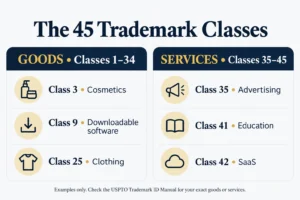
There are 45 international trademark classes: Classes 1–34 for goods and Classes 35–45 for services. Each class describes a broad area, not a single product or an entire industry.
Trademark Classes for Goods
Goods are products offered under a mark: skin creams (often Class 3), handbags (often Class 18), and shirts (often Class 25). Downloadable software generally belongs in Class 9.
Trademark Classes for Services
Services are activities performed for others: marketing (often Class 35), online courses (often Class 41), and restaurants (Class 43). Providing access to non-downloadable software may involve Class 42. Selling your own product does not automatically create a separate Class 35 retail service.
Complete Trademark Classes List — Classes 1–45
The 45 trademark classes are summarized below. Examples illustrate possible offerings, not ready-made application wording. Consult the USPTO’s current explanatory notes for the full scope of a class.
| Class | General Category | Simple Business Example |
|---|---|---|
| 1 | Chemicals for industry, science, and agriculture | A company selling industrial adhesives |
| 2 | Paints, coatings, and colorants | A paint manufacturer selling wall paint |
| 3 | Non-medicated cosmetics and cleaning products | A beauty brand selling facial moisturizer |
| 4 | Fuels, lubricants, and candles | A candle brand selling scented candles |
| 5 | Pharmaceuticals and medical-use preparations | A company selling vitamin supplements |
| 6 | Common metals and metal building materials | A supplier selling metal pipes for construction |
| 7 | Machines and power-operated tools | A maker of electric food processors |
| 8 | Hand-operated tools and cutlery | A seller of hand-operated garden shears |
| 9 | Electronics, scientific devices, and downloadable software | A developer selling a downloadable mobile app |
| 10 | Medical and veterinary apparatus | A maker of blood pressure monitors |
| 11 | Lighting, heating, cooling, and sanitary apparatus | A manufacturer selling ceiling lights |
| 12 | Vehicles and vehicle parts | A bicycle manufacturer |
| 13 | Firearms, ammunition, and fireworks | A company selling fireworks |
| 14 | Jewelry, watches, and precious metals | A brand selling necklaces |
| 15 | Musical instruments | A guitar manufacturer |
| 16 | Paper goods, printed matter, and stationery | A publisher selling printed notebooks |
| 17 | Rubber, plastics in semi-processed form, and insulation | A supplier selling pipe insulation |
| 18 | Leather goods, bags, and luggage | A brand selling handbags |
| 19 | Non-metal building materials | A supplier selling concrete bricks |
| 20 | Furniture and certain non-metal household items | A furniture maker selling chairs |
| 21 | Household or kitchen utensils and containers | A seller of drinking glasses |
| 22 | Ropes, tents, and raw textile fibers | A camping brand selling tents |
| 23 | Yarns and threads for textile use | A seller of knitting yarn |
| 24 | Textiles and household linens | A brand selling bath towels |
| 25 | Clothing, footwear, and headwear | A clothing brand selling T-shirts |
| 26 | Lace, buttons, zippers, and similar sewing items | A supplier selling clothing zippers |
| 27 | Carpets, rugs, and other floor coverings | A home brand selling area rugs |
| 28 | Games, toys, and sporting articles | A game company selling board games |
| 29 | Meat, dairy, and certain processed foods | A food company selling canned soup |
| 30 | Coffee, tea, baked goods, and similar foods | A bakery brand selling packaged cookies |
| 31 | Fresh produce, live plants, and animal feed | A farm selling fresh apples |
| 32 | Beer and non-alcoholic beverages | A beverage brand selling bottled water |
| 33 | Alcoholic beverages other than beer | A winery selling wine |
| 34 | Tobacco, smoking articles, and electronic cigarettes | A brand selling cigars |
| 35 | Advertising, business, and certain retail services | An agency providing marketing services |
| 36 | Insurance, finance, and real estate services | An insurance provider |
| 37 | Construction, installation, and repair services | A contractor providing roof repair |
| 38 | Telecommunications and broadcasting services | A company providing internet access |
| 39 | Transportation, delivery, and storage services | A courier company delivering packages |
| 40 | Treatment of materials and certain custom manufacturing services | A shop providing custom printing for others |
| 41 | Education, training, entertainment, and sports services | A business offering online photography courses |
| 42 | Scientific and technology services, including SaaS | A provider offering online non-downloadable project management software |
| 43 | Food and drink services and temporary accommodation | A restaurant serving meals |
| 44 | Medical, beauty, and agricultural services | A salon offering hair styling |
| 45 | Legal, personal, and physical security services | A security company providing guards |
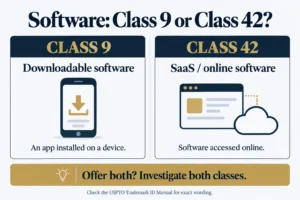
Verify exact goods or services in the USPTO Trademark ID Manual. These simplified labels are not acceptable identification wording. Software can involve Class 9 for downloads, Class 42 for SaaS, or other classes depending on the offering.
Most Common Trademark Classes for Businesses
These common classes are examples. Your actual offering determines what to investigate.
Trademark Class 25 — Clothing and Apparel
Class 25 covers many clothing, footwear, and headwear goods, including T-shirts. Handbags generally point toward Class 18 and jewelry toward Class 14. An online store may raise a separate Class 35 question if it provides retail store services; a website selling your shirts does not settle that question by itself.
Trademark Class 35 — Advertising and Business Services
Class 35 includes advertising, business consulting, and certain retail or online retail store services. It is not a universal class for every seller. Branded goods belong in their respective goods classes; a separately identified retail service depends on what the business actually provides. The Nice explanatory note distinguishes retail services from selling goods.
Trademark Class 9 — Software and Electronics
Class 9 often covers downloadable apps, computer programs, and electronics. Identify software’s function, such as managing inventory. A company offering a downloadable app and a browser-based platform should investigate both Classes 9 and 42.
Trademark Class 42 — Technology and SaaS Services
Class 42 includes SaaS, online non-downloadable software, computer programming, and scientific or technical services. A browser-based project-management platform may belong here; a downloadable version may also involve Class 9. Describe what the software does.
Trademark Class 41 — Education and Entertainment
Class 41 covers education, training, entertainment, and sporting activities. Live workshops or online courses may belong here. A downloadable educational app raises a separate software question: describe both what customers access and what services you perform.
Trademark Class 43 — Restaurants and Hospitality
Class 43 includes restaurant and café services, catering, and hotels. A café should investigate Class 43 for serving customers, but branded packaged coffee beans or bottled drinks may require additional goods classes.
Trademark Class 3 — Cosmetics and Beauty Products
Class 3 generally covers non-medicated cosmetics such as makeup, perfume, and facial moisturizer. Medical or therapeutic products may raise a Class 5 question; salon treatments are generally services in Class 44.
How to Choose the Right Trademark Class
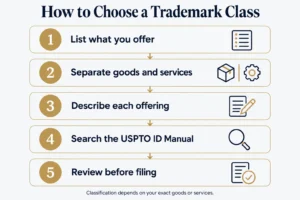
Start with what customers receive under your mark.
Step 1 — Identify What Customers Actually Buy From You
List each offering separately: product, service, or both? A salon provides beauty services; a restaurant may serve meals and also sell packaged hot sauce.
For future offerings, the USPTO requires a bona fide intent to use the mark for the listed goods or services. See its guidance.
Step 2 — Describe Your Goods or Services Specifically
“App,” “clothing,” or “consulting” may be too vague. “Downloadable mobile application for tracking household expenses,” “T-shirts,” and “business consulting in the field of inventory management” are more specific research starting points, not verified ID Manual wording.
Describe delivery accurately: installed software differs from online access; serving meals differs from selling packaged food.
Step 3 — Search the USPTO Trademark ID Manual
Search the USPTO Trademark ID Manual for each offering; review both its wording and class. Try specific terms and alternative phrasing.
The manual is not exhaustive. Choose an entry only if it accurately describes your offering. If none fits, consult USPTO guidance or qualified help before drafting custom wording. Free-form descriptions may add a fee.
Step 4 — Determine Whether More Than One Class May Apply
Consider distinct offerings under the mark: necklaces and qualifying retail services (Classes 14 and 35); courses and printed workbooks (41 and 16); SaaS and a downloadable companion app (42 and 9).
These are research possibilities, not instructions to file in every class. Each class costs more and must correspond to your application. See USPTO multiple-class guidance.
Step 5 — Review the Selection Before Filing
Check that each description matches your actual or genuinely planned offering and its class. Review evidence-of-use requirements for your filing basis. The right number cannot fix inaccurate wording, and amendments cannot simply broaden the original goods or services.
Not Sure Which Trademark Class Applies to Your Business?
Search the USPTO Trademark ID Manual for what your customer receives. If several entries seem plausible, compare delivery and the service performed.
Get professional assistance when offerings cross categories or wording is unusual. A class-finding tool can suggest classes to investigate; it cannot guarantee registration.
Can One Trademark Cover Multiple Classes?
Yes. One U.S. application can cover multiple classes, with a description and required information for each. A brand selling T-shirts and providing online training might investigate Classes 25 and 41. Many businesses need fewer classes.
As of 2026, the USPTO electronic base application fee is $350 per class. Two classes start at $700; three at $1,050. Certain free-form descriptions or other filing choices may add USPTO fees; professional service fees are separate. Check the current USPTO fee schedule before filing. For details, see our forthcoming USPTO trademark fees guide.
Can You Add Another Trademark Class After Filing?
An application can sometimes be amended to correct classification or move originally identified offerings into another class, subject to USPTO rules and fees. You generally cannot add new goods or services or broaden the original identification. A new offering outside its scope may require a new application.
What matters is whether the original filing included the relevant goods or services. See the USPTO’s amendment limits and multiple-class requirements.
Read our guide: Can You Add Goods, Services, or Classes to a Trademark Application After Filing?
Does a Trademark Class Determine Your Entire Trademark Protection?
No. A registration does not grant every use of a word across an entire class. Trademark conflicts can depend on the similarity of the marks and the relationship between goods or services, even across different classes.
Clothing (Class 25) and handbags (Class 18) can be related; sharing a broad class does not itself prove confusion. The USPTO explains likelihood of confusion and coordinated classes. Search beyond one number.
Common Trademark Classification Mistakes
- Choosing by industry label alone. A “fashion business” might offer shirts, handbags, jewelry, or retail services. Each offering needs its own analysis.
- Using vague descriptions. “Software” or “beauty products” can leave important details unresolved and may draw a request for clarification.
- Assuming one class covers the whole business. Class 43 restaurant services do not automatically identify a restaurant’s branded bottled sauce.
- Filing in unnecessary classes. Each additional class usually adds fees and additional filing requirements. A class should reflect actual use or a bona fide plan for the described offering.
- Confusing goods with services. Selling printed workbooks and providing teaching services are different offerings, even when both support the same course.
- Copying a competitor’s class. Two companies in the same industry may deliver different products, operate differently, or describe their services in different ways.
- Skipping the final identification check. The class and the written description must match the applicant’s real offering. A plausible number cannot fix inaccurate wording.
None of these mistakes necessarily end an application, but they can create extra work, added fees, or gaps between the filing and the business’s actual activities.
Trademark Class Examples by Business Type
Use these examples to build a research shortlist. “Worth investigating” does not mean every listed class belongs in your application. The details of the offering and the mark’s use decide which, if any, are appropriate.
| Business Type | Classes Worth Investigating | Why |
|---|---|---|
| Clothing brand | 25; possibly 18, 14, or 35 | Shirts are different from handbags, jewelry, or qualifying retail services. |
| SaaS company | 42; possibly 9 | Online non-downloadable software and a separate downloadable app can require different identifications. |
| Restaurant | 43; possibly 29, 30, or 32 | Serving meals differs from selling branded packaged food or drinks. |
| Cosmetics brand | 3; possibly 5 or 44 | Non-medicated cosmetics differ from certain medical-use products or beauty services. |
| Online education company | 41; possibly 9 or 16 | Teaching differs from selling a downloadable app or printed workbooks. |
| Marketing agency | 35; possibly 42 | Advertising services differ from separately offered software or technology services. |
| Jewelry brand | 14; possibly 35 | Necklaces are goods; qualifying retail store services are a separate question. |
| Financial services company | 36; possibly 9 or 42 | Financial services differ from downloadable software or a separately offered SaaS tool. |
Frequently Asked Questions About Trademark Classes
How many trademark classes are there?
There are 45 international trademark classes in the Nice Classification used by the USPTO. Classes 1–34 generally cover goods, and Classes 35–45 cover services. The class number helps organize a filing, but applicants must also identify their specific goods or services.
What is a trademark class?
A trademark class is a numbered category for related goods or services in a trademark application. For example, many clothing goods fall in Class 25 and restaurant services fall in Class 43. A class heading gives a general area; it is not a complete description of what your business offers.
What are Trademark Classes 1–34?
Classes 1–34 are the goods classes. They cover products ranging from chemicals and cosmetics to electronics, furniture, clothing, food, and beverages. A product’s precise nature determines its class, so the broad category list should be checked against the USPTO Trademark ID Manual.
What are Trademark Classes 35–45?
Classes 35–45 are the services classes. They cover areas such as advertising, finance, repairs, telecommunications, transportation, education, SaaS and scientific services, restaurants, medical and beauty services, and certain legal or personal services. The exact service you provide matters more than the label you give your industry.
Can I register the same trademark in multiple classes?
Yes. A U.S. application may include multiple classes if the mark is used, or you have the required bona fide intent to use it, with goods or services in those classes. Each class needs an accurate identification and the applicable filing fee. The filing basis also affects what evidence or statements may be required.
Do I have to pay for every trademark class?
Yes. USPTO application fees are assessed per class. As of 2026, the electronic base application fee is $350 per class; additional charges may apply based on how the application is completed. Review the current USPTO fee schedule before submitting an application.
What happens if I choose the wrong trademark class?
The USPTO may require a correction or clarification if the class does not match the identified goods or services. What can be corrected depends on the original wording and the filing circumstances. You generally cannot use an amendment to add new goods or services beyond the scope of the application as filed, so review both the class and identification carefully before filing.
What trademark class is clothing?
Many clothing goods, including T-shirts, jackets, and hats, are in Class 25. A fashion brand may also sell items that belong elsewhere, such as handbags in Class 18 or jewelry in Class 14. Specify the actual goods rather than filing for an entire industry.
What trademark class is software?
It depends on what users receive. Downloadable software is generally investigated under Class 9, while SaaS or online non-downloadable software is generally investigated under Class 42. The application should describe the software’s function and delivery accurately; a business offering both may need to consider both classes.
What is Trademark Class 35?
Class 35 generally covers advertising, marketing, business administration, and certain retail or online retail store services. It does not automatically cover every company that sells products. The products themselves belong in their appropriate goods classes, and any claimed retail service needs its own accurate description.
What is Trademark Class 45?
Class 45 includes legal services, physical security services, and certain personal services such as dating, online social networking, and babysitting. It does not cover every kind of “security”: computer and data security services may belong in Class 42. Check the specific service in the USPTO ID Manual.
Conclusion
There are 45 trademark classes, but choosing one is not a matter of picking the heading that sounds closest to your industry. Identify what people actually buy from you, separate goods from services, and research each offering in the USPTO Trademark ID Manual. A clothing company can sell products in several goods classes; a software company can offer both downloadable software and an online service. The details determine what belongs in an application.
Review your descriptions and filing costs before submitting. Classes help organize a U.S. trademark application, but they do not promise registration or define an entire market that one business can own. If your products or services cross categories, careful research now can save an avoidable correction later.
Need Help With Your U.S. Trademark Application?
Contact EagleMarkUSA to discuss assistance with the trademark registration process and the goods or services you plan to identify. The right approach depends on your business and the USPTO’s review; approval cannot be guaranteed.
