
A website, social media account, product listing, logo, or even an early transaction does not automatically establish trademark use in commerce. For goods, the mark generally must be associated with products that are genuinely sold or transported in qualifying commerce. For services, the mark must identify services that are actually rendered—not merely planned or advertised.
The use must also be bona fide and in the ordinary course of trade, rather than a token transaction arranged only to support a trademark filing. That makes the answer fact-specific. An infrequent sale may be normal for costly industrial equipment, while an engineered purchase of an inexpensive consumer item may look artificial.
This guide explains the USPTO rules for goods, services, websites, advertising, SaaS, first-use dates, and specimens. It also helps you evaluate whether your current activity supports a Section 1(a) use-based application or whether a Section 1(b) intent-to-use filing may fit better.
Educational note: This article provides general U.S. trademark information, not legal advice. Whether particular activity qualifies depends on the complete facts.
What Does “Use in Commerce” Mean for a Trademark?
Trademark use in commerce generally means bona fide use of a mark in the ordinary course of trade in commerce Congress may regulate. The business uses the mark as a source identifier in real commercial activity—not merely by creating a logo, reserving a domain, promoting a future launch, or arranging a sham transaction to reserve rights.
For goods, there must be proper use of the mark plus genuine sale or transport. For services, the service must actually be rendered while the mark is used or displayed in its sale or advertising.
Why Does Use in Commerce Matter?
The requirement matters when filing a Section 1(a) application, submitting an Amendment to Allege Use or Statement of Use in a Section 1(b) application, claiming first-use dates, and providing a trademark specimen.
A Section 1(a) applicant must have qualifying use for every good or service claimed under that basis by the filing date. A Section 1(b) applicant can file before launch based on a bona fide intent to use the mark, but generally must establish qualifying use before registration.
Use in Commerce for Goods vs. Services
The key distinction is: goods require actual sale or transport; services require actual rendering.
| Requirement | Goods | Services |
|---|---|---|
| Commercial activity | Goods are genuinely sold or transported | Services are genuinely rendered |
| Mark association | On goods, labels, tags, packaging, containers, or a qualifying point-of-sale display | In the sale, advertising, or rendering of the services, with a direct mark-service association |
| Advertising | Advertising alone generally is insufficient | May show use if the services are also being rendered |
| Website | May be a point-of-sale display if it connects the mark, product, and purchasing information | May show use if it identifies services actually available and rendered |
| “Coming soon” | Does not show sale or transport | Does not show service rendering |
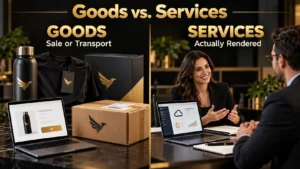
Classification is separate from use. The Trademark Class Finder and Trademark Classes Explained can help categorize an offering, but a correct class does not establish use.
What Counts as Use in Commerce for Goods?
For goods, the mark generally appears on the product, its containers, packaging, labels, tags, or a qualifying display associated with the goods. The goods must also be genuinely sold or transported in commerce. Both elements matter.
Product Labels and Packaging
A label on a coffee bag or branded cosmetic box can connect the mark to the product. Empty packaging printed before launch does not establish sale or transport.
Tags and Hangtags
A hangtag on shirts sold to real customers may be strong evidence; a photograph of unused branded tags is not commercial use.
Point-of-Sale Displays
A display may qualify when it associates the mark with the goods and provides ordering information. A promotional display with no way to purchase ordinarily is only advertising.
E-Commerce Product Pages
A product page may be a specimen when it shows the mark and provides a way to order. It must also include its URL and access or print date.
The page is still only evidence. The product must genuinely be sold or transported. A mock storefront created solely for an application cannot manufacture use.
What Counts as Use in Commerce for Services?
A service mark may appear on a website, advertisement, brochure, sign, menu, or service materials. It should directly associate the mark with services actually rendered in commerce.
Consulting Firm
A firm that completes strategy work for a client under its brand may have use. A page announcing consulting “next quarter” does not show rendered services.
Restaurant
A restaurant may use its mark on signs, menus, and webpages while serving customers. An “opening soon” sign at an unopened location advertises future services.
SaaS Platform
A SaaS company may establish service use when customers can access and receive the identified online software service under the mark. A waitlist for an unfinished platform is different.
Web Design or Marketing Business
A website can show the mark-service association, but a portfolio does not replace real service delivery.
Does Advertising Alone Count as Trademark Use?
For Goods
Advertising alone generally does not establish use for goods. Social posts, catalogs, and launch promotions do not replace sale or transport. A qualifying point-of-sale display must do more than advertise.
For Services
Advertising may show service-mark use when it directly associates the mark with the identified services and those services are actually rendered. Advertising a future service does not satisfy the underlying requirement.
Does Listing a Product on a Website Count as Use in Commerce?

Not automatically. Ask two questions:
- Does the page connect the mark, the product, and information needed to purchase it?
- Is a genuine sale or transport actually occurring behind the page?
A live listing may be good specimen evidence, but a placeholder checkout cannot prove a product launched. Preserve orders, invoices, shipping records, and dated webpage captures.
Does One Sale Count as Use in Commerce?
There is no universal minimum sales number. The question is whether use is bona fide, occurs in the ordinary course of trade, and fits normal practices in the industry.
Low-Cost Consumer Product
One inexpensive item sold to a friend through an arranged transaction may look token. A genuine launch with inventory, customers, fulfillment, and continuing sales presents different facts.
Expensive Industrial Equipment
Infrequent sales may be normal for costly machinery. Low volume is not automatically disqualifying when the transaction is genuine and normal for the industry.
Transaction quality, amount of use, industry norms, and continued commercial activity may all matter. “One sale always qualifies” is not a safe rule.
What Does “Bona Fide Use in the Ordinary Course of Trade” Mean?
Bona fide use is genuine business activity, not a token act performed to reserve rights. Relevant facts include real customers, actual delivery or performance, commercial purpose, ordinary records, and continued activity.
“Ordinary course” is flexible. Seasonal goods, test markets, rare-disease products, and expensive equipment can involve less frequent activity than mass-market e-commerce.
What Is Interstate Commerce for Trademark Purposes?
The Trademark Act reaches commerce Congress may regulate, including interstate, U.S.-foreign, territorial, and some intrastate activity with an adequate federal connection.
A package need not cross a state line in every case. A local restaurant serving interstate travelers may qualify, for example. Local-only and foreign activity can require a fact-specific review.
First Use Anywhere vs. First Use in Commerce
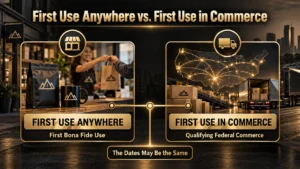
Section 1(a) applications request two dates:
| Date | Meaning |
|---|---|
| First use anywhere | First bona fide use of the mark in ordinary trade with the listed goods or services, even if it did not yet qualify as federally regulated commerce |
| First use in commerce | First bona fide use with those goods or services in commerce Congress may regulate |
First Use Anywhere
This is not when a name was conceived, logo designed, company formed, or domain registered. It is the first real trademark use with the relevant goods or services.
First Use in Commerce
This date requires qualifying commerce plus sale or transport of marked goods or actual rendering of services under the mark.
Can First Use Anywhere and First Use in Commerce Be the Same Date?
Yes. The dates match when the first bona fide use also qualifies as use in commerce—for example, the first genuine sale of a marked product shipped to an out-of-state customer. First use anywhere cannot logically be later than first use in commerce.
How Do You Determine Your First Use in Commerce Date?
Step 1 — Identify the Goods or Services
Review the exact items in the application. Different products or services may launch on different dates.
Step 2 — Confirm the Mark Was Actually Being Used
Customers must encounter the applied-for mark as a source identifier. Internal planning ordinarily does not count.
Step 3 — Identify When Genuine Commercial Activity Began
For goods, find the first bona fide sale or transport. For services, find the first actual service delivery—not the first advertisement.
Step 4 — Evaluate the Commerce Connection
Consider customers, shipments, locations, service delivery, and any interstate, foreign, territorial, or other federal connection.
Step 5 — Preserve Supporting Records
Keep invoices, contracts, orders, shipping records, photographs, dated webpages, and service records. Do not substitute an LLC formation, domain, social launch, or logo date unless qualifying use began then.
Years of trademark use may also matter when an applicant claims acquired distinctiveness, although five years of use alone does not guarantee that the USPTO will accept the claim.
What If You Enter the Wrong First-Use Date?
An honest error may sometimes be corrected through a verified amendment. For Section 1(a), amended dates still must support qualifying use no later than the filing date.
If actual use began after filing, you may amend Section 1(b) in some pending applications if you meet the requirements. Options depend on the record and application stage.
How Do You Prove Trademark Use in Commerce?
The underlying use happens first; evidence documents it.
For Goods
Evidence may include marked products, labels, packaging, invoices, shipping records, and point-of-sale pages. The specimen should show how purchasers encounter the mark.
For Services
Evidence may include contracts, invoices, work records, bookings, signs, menus, brochures, advertisements, or webpages associated with rendered services.
Use in Commerce vs. Trademark Specimen
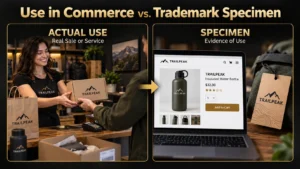
| Concept | Meaning |
|---|---|
| Use in commerce | The real-world sale, transport, or rendering of services under the mark |
| Specimen | Evidence submitted to the USPTO showing how customers encounter the mark with those goods or services |
A good screenshot cannot create qualifying use when the required activity never occurred. Genuine use can also exist when an applicant initially submits an unacceptable specimen, although any response depends on timing and available evidence. See Trademark Specimen Explained.
Trademark Use in Commerce Examples
Clothing Brand — Class 25
The mark appears on labels or hangtags, and genuine orders are fulfilled. See Trademark Class 25 Explained.
Online Store
The store displays the mark with a real product, accepts orders, and fulfills purchases. The page is evidence; sale or shipment supports use.
SaaS Platform — Class 42
Customers can access an operational hosted platform under the mark. A waitlist is not equivalent. See Trademark Class 42 Explained.
Downloadable Software — Class 9
Downloadable software is generally a good. Users must be able to obtain the marked software. See Trademark Class 9 Explained.
Restaurant — Class 43
Signs and menus used while serving customers support real service activity. An “opening soon” banner before customers are served does not.
Consulting or Professional Services
A consultant advertises under the mark and completes a client engagement. The completed work supplies actual rendering.
Does a “Coming Soon” Website Count as Use in Commerce?
Generally, not by itself. It may show promotion or a bona fide intention to use the mark, but it does not prove sale, transport, or service rendering. Before launch, Section 1(b) may be more appropriate than claiming Section 1(a) use. See Intent-to-Use Trademark Application.
Use in Commerce vs. Intent to Use

| Factor | Section 1(a): Use in Commerce | Section 1(b): Intent to Use |
|---|---|---|
| Current qualifying use | Required by filing date | Not required at filing |
| Initial specimen | Required | Generally submitted later |
| Use dates | Included initially | Supplied when use is claimed |
| Core statement | Current bona fide use | Bona fide intent to use |
| Before registration | Proceeds on existing use | Applicant must timely establish use, usually through an allegation of use |
A Section 1(b) filing postpones proof of use; it does not eliminate the requirement. See Intent-to-Use Trademark Application and How Long Does It Take to Get a Trademark?
When Does an Intent-to-Use Applicant Need Use in Commerce?
A Section 1(b) applicant may establish use before publication through an Amendment to Allege Use or, after a Notice of Allowance, through a Statement of Use. The filing includes first-use information and a specimen. See Trademark Statement of Use.
Can You Claim Use for Only Some Goods or Services?
Use is evaluated item by item. If only shirts have launched, do not also claim listed hats and shoes merely because they share a class.
Depending on the stage, unlaunched items may need to be deleted, divided, or handled through an available intent-to-use procedure. Review the scope before signing a verified statement.
Common Trademark Use-in-Commerce Mistakes
| Mistake | Why It Creates a Problem |
|---|---|
| Treating logo creation as use | Artwork preparation is not commercial use with goods or services |
| Treating domain registration as use | A URL does not prove what customers can buy or receive |
| Relying on a “coming soon” page | Future promotion does not show current activity |
| Assuming one token sale always qualifies | Genuineness and industry practice matter |
| Advertising goods without sale or transport | Promotion alone generally does not satisfy the goods rule |
| Advertising services not yet rendered | Service advertising does not replace delivery |
| Confusing a specimen with actual use | Evidence cannot manufacture the activity it purports to show |
| Guessing first-use dates | Dates are verified statements and should be record-based |
| Claiming unlaunched goods | Use for one product does not transfer to another |
| Filing Section 1(a) too early | Current qualifying use must exist by the filing date |
What Happens If the USPTO Disagrees With Your Claimed Use?
An examining attorney may issue an Office Action refusing the specimen, requesting clarification or evidence, or identifying another use problem. A response might involve explanation, a supported amendment, deletion of unsupported items, or a substitute specimen meeting the relevant timing rules.
Options depend on why the evidence failed and whether use existed by the required date. A later screenshot cannot fix every problem. See Trademark Specimen Explained and Trademark Office Action Response.
Can You File a Use-in-Commerce Trademark Application Yourself?
Yes. Applicants may file their own use-based applications. Care is still needed with ownership, basis, first-use dates, goods versus services, classes, specimens, and partial use. Unusual local or foreign commerce, multiple classes, or an incomplete launch can make the analysis harder.
When Should You Consider Professional Help?
Assistance may be useful when use or dates are unclear, only part of a product line has launched, several classes are involved, a service is not fully available, commerce is local or foreign, or the USPTO has refused a specimen.
Need Help Determining Whether Your Trademark Is in Use?
EagleMarkUSA can help review the filing basis, goods and services, classes, dates, and specimens. No service can guarantee registration, but careful preparation can reduce avoidable errors.
Frequently Asked Questions About Trademark Use in Commerce
What does trademark use in commerce mean?
It generally means bona fide use of a mark in ordinary trade in commerce Congress may regulate. Goods must be sold or transported with proper mark association; services must be rendered while the mark is used in their sale or advertising.
What counts as use in commerce for goods?
The mark generally appears on goods, packaging, containers, labels, tags, or a qualifying point-of-sale display, and the goods are genuinely sold or transported in qualifying commerce.
What counts as use in commerce for services?
The mark is used or displayed in selling, advertising, or rendering identified services, and the services are actually rendered in commerce. Promotion of a future service is insufficient.
Does advertising count as trademark use?
For goods, advertising alone generally does not qualify. For services, it can show service-mark use if it directly associates the mark with services that are actually being rendered.
Does a website count as use in commerce?
It can be evidence. A goods page may qualify as a point-of-sale display; a service page may show service-mark use. Genuine sale, transport, or rendering must still exist.
Does one sale count as trademark use?
Possibly, but not automatically. The transaction’s genuineness, commercial quality, industry norms, and surrounding activity matter. A sham purchase arranged only for filing is not reliable use.
What is bona fide use in the ordinary course of trade?
It is genuine commercial activity consistent with normal industry practice, not token activity intended only to reserve rights. Infrequent transactions may be normal for expensive or specialized goods.
What is interstate commerce for trademark purposes?
It refers broadly to commerce Congress may regulate, including interstate, U.S.-foreign, territorial, and some intrastate activity. A physical interstate shipment is not required in every case.
What is first use anywhere?
It is the first bona fide use of the mark in ordinary trade with the listed goods or services, even if that activity did not yet qualify as federally regulated commerce.
What is first use in commerce?
It is the first bona fide use with the identified goods or services in commerce Congress may regulate—sale or transport for goods, and actual rendering for services.
Can first use anywhere and first use in commerce be the same date?
Yes, when the initial bona fide use also qualifies as use in commerce. First use anywhere should never be later than first use in commerce.
How do I prove use in commerce?
Submit an acceptable specimen and preserve records such as marked products, labels, packaging, orders, invoices, shipping documents, contracts, service records, and dated webpages.
What is the difference between use in commerce and a specimen?
Use is the actual commercial activity. A specimen is evidence showing how customers encounter the mark. A specimen cannot create use when the underlying activity did not happen.
Does a “coming soon” page count?
Generally not alone. It indicates planned activity, not that goods are sold or transported or services rendered. A Section 1(b) filing may fit the pre-launch stage.
What if only some of my products are being sold?
Claim use only for qualifying items. Unlaunched goods may need to be deleted, divided, or handled through an available intent-to-use procedure, depending on the application stage.
What if I entered the wrong first-use date?
Review the records promptly. A verified correction may be possible, but Section 1(a) use must still exist by the filing date. If use began later, another basis may be needed if available.
Trademark Use in Commerce: The Practical Bottom Line
Use in commerce requires more than creating or advertising a brand. For goods, look for proper mark association plus bona fide sale or transport. For services, look for actual rendering under the mark. The activity should occur in the ordinary course of trade, not through a token or sham transaction.
First-use dates should reflect real commercial milestones supported by records. A specimen proves use; it does not create use that never occurred. If the business has not launched—or only some goods and services are available—Section 1(b) may be more accurate than prematurely claiming Section 1(a) use.
Need Help With Your Trademark Filing Basis?
Contact EagleMarkUSA for help reviewing Section 1(a) versus Section 1(b), goods and services, trademark classes, first-use dates, specimens, and application preparation. EagleMarkUSA does not guarantee USPTO approval or registration. Not sure whether to use ™, ℠ , or ®? Use our Trademark Symbol Helper.
Authoritative Sources
- USPTO — Trademark Filing Basis
- USPTO — Dates of Use
- USPTO — Specimens
- USPTO — Examination Guide 1-20: Examination of Specimens for Use in Commerce
- USPTO Trademark Manual of Examining Procedure, Chapter 900 — Use in Commerce

Pingback: How to Submit a Trademark Specimen Correctly
Pingback: Trademark Statement of Use: How to File, Fees & Deadlines
Pingback: How Long Does It Take to Get a Trademark? USPTO Timeline
Pingback: Trademark Class 25 Explained: Clothing, Apparel & Footwear
Pingback: USPTO Likelihood of Confusion: Section 2(d) Trademark Guide
Pingback: Acquired Distinctiveness Trademark: Section 2(f) & Secondary Meaning
Pingback: Trademark Opposition: Process, Grounds, Deadlines & Response
Pingback: Trademark Clearance Search: How to Search Before Filing
Pingback: Trademark Cancellation: TTAB Process, Grounds & Petition
Pingback: Trademark Abandonment: Nonuse, 3-Year Rule & Rights
Pingback: Incontestable Trademark: Section 15 Requirements & Benefits