

If your USPTO Office Action requires you to disclaim a portion of your trademark, the word or design will not be removed from your mark. The disclaimer is of rights in a component apart from the mark as a whole. Your mark is not registered yet and can still be registered.
That’s a decision to take note of. If a required disclaimer is not accepted, registration may not be possible. Naming a generic product may be easy, but the examiner’s rationale or the combination of other words may be worth a closer look.
What standard wording means, when to accept or challenge, and what to do after an Office Action. This is general information, not legal advice.
What Is a Trademark Disclaimer?
A trademark disclaimer is a statement in a USPTO application or registration that the applicant is not claiming exclusive rights to some wording or design matter separate from the mark as a whole. The component is still in the trademark. The question is not whether the applicant can show or use the whole mark, but whether there is a separate right to that element. USPTO: How to comply with a disclaimer requirement
Under Section 6 of the Trademark Act, 15 U.S.C. §1056, the USPTO may require a disclaimer of an unregistrable component of an otherwise registrable mark. A generic term, however, does not become the exclusive property of one business. It preserves rights existing or thereafter acquired therein. TMEP 1213.02

Placement: After the first paragraph under “What Is a Trademark Disclaimer?”
Why Would the USPTO Require a Disclaimer?
A composite mark can feature distinguishing wording and language that others need. COFFEE SHOP is a coffee-shop service provided by ZAIN’S COFFEE SHOP. SHIRTS also serves to identify the goods in a mark used for shirts.
The USPTO may require a disclaimer if a separable component is generic, descriptive, geographic, informational, or otherwise unregistrable by itself. A descriptive-looking word doesn’t always need a separate disclaimer. The full mark and identified offerings count. TMEP §§ 1213.01(a), 1213.03
What Does “No Claim Is Made to the Exclusive Right to Use” Mean?
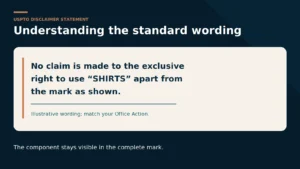
The standard trademark disclaimer language is:
No claim is made to the exclusive right to use “SHIRTS” other than the mark as shown.
In plain English, by that registration, the applicant is not claiming SHIRTS by themselves. The word remains in the full scope. The statement does not allow competitors to copy the whole trademark. The USPTO also gives examples for designs and specific classes. Examples of USPTO disclaimer
Placement: After the quoted statement under “What Does ‘No Claim Is Made to the Exclusive Right to Use’ Mean?”
A disclaimer in a trademark does not remove the word from your mark.
No. It doesn’t erase a word, change the drawing, or change your packaging. The same complete mark is seen by customers. The disclaimer is recorded in the USPTO. TMEP §§ 1213, 1213.10
Does a Disclaimer Dilute Your Trademark?
It limits the independent claim to a component; it does not kill the full mark. The disclaimed language still plays a part in the likelihood of confusion analysis.
A disclaimer of a commercially significant term may be important, and not needed. A well-supported disclaimer of a product name may meet a requirement. Section 6 preserves the possibility of existing or later acquired rights in non-generic matter, if proved. Avoid both extremes of “no effect” and “no rights forever.” TMEP §§ 1213, 1213.10–.11
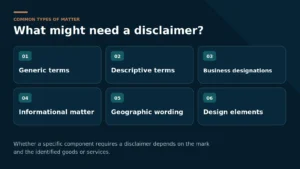
What Trademark Wording Typically Needs a Disclaimer?
Common Words
A generic term identifies the offering itself: COFFEE SHOP in ZAIN’S COFFEE SHOP for coffee shop services. It is not unique, as the term appears in a bigger mark. You cannot disclaim a totally generic mark to save it.
Terms that are Merely Descriptive
A term can denote a feature, function, quality, ingredient, or use. ORGANIC SOAP for qualifying organic soap could raise a disclaimer question as to RIVERA ORGANIC SOAP. Evidence and separability are important. A component disclaimer is not the same as a Section 2(e)(1) refusal of the whole mark. See our Merely Descriptive Trademark guide.
Type of Business Designations
LLC, INC., CORP., CO., BROS., etc. are often not source, but are business type or structure. The USPTO looks at their role in the particular trademark. TMEP §1213.03(d)
Information Material
EST. 2026 net weight, contact information or ingredients are for the information of buyers only. A separable element may require a disclaimer. A disclaimer cannot fix a mark that does not function as a trademark in its entirety. TMEP §§ 1202.04, 1213.03(b)
Location Wording
A separable place name might be a geographic origin. The origin of the goods and the buyer’s understanding is also relevant; a disclaimer doesn’t cure every geographic refusal. TMEP § 1210
Elements of Design
A distinctive stylised design may be something else. A realistic shirt drawing in a mark for shirts may need a disclaimer. The design in issue must be found by the examiner. Design example and USPTO wording
Sample Trademark Disclaimer Statements
These examples are not findings of availability or registrability, but hypothetical.
| Example mark and offer | Problem | Exemplary statement |
|---|---|---|
| ZAIN’S COFFEE SHOP for coffee shop services | COFFEE SHOP | No claim is made to the exclusive right to use COFFEE SHOP except as shown in the mark. |
| VELA ORGANIC SOAP for organic soaps | ORGANIC SOAP, if required on the facts | No claim is made to the exclusive right to use “ORGANIC SOAP” other than the mark as shown. |
| LLC MERIDIAN GEAR LLC for bags | LLC | No claim is made to the exclusive right to use “LLC” apart from the mark as shown. |
| ZAIN’S SHIRTS plus a realistic shirt drawing for shirts | SHIRTS and the shirt design | No claim is made to the exclusive right to use “SHIRTS” and the design of a shirt apart from the mark as shown. |
| NOVA SHIRTS for shirts in Class 25 and unrelated services in another class | SHIRTS in Class 25, if limited by the examiner | No claim is made to the exclusive right to use “SHIRTS” in International Class 25 other than the mark as shown. |
Use the same matter and any class or goods limitation you requested in your own USPTO record. Check the mark drawing and Office Action before pasting an example into a response. USPTO: Disclaimer Statements Examples
Is it Possible to Limit a Disclaimer to Certain Goods, Services or Classes?
If it’s appropriate, yes. One term may apply to one offering but not to another. For example, a disclaimer might apply only to Class 25 shirts in an application covering unrelated services. A disclaimer may be limited to certain goods, services, or a class.
Discover what products triggered the requirement. Clarify an ambiguous statement. Our Trademark Class Finder explains the categories. It can’t resolve this legal question. USPTO: Class-specific language
What Is a Unitary Mark?
A single mark creates a single commercial impression. A phrase, double meaning, or merged word and design can completely change how buyers see the parts. It may be unnecessary to disclaim a separate part of a truly unitary element. TMEP § 1213.05
Can it escape a disclaimer? Sometimes. Simply combining words or attaching a logo is not determinative. Let buyers know why they would see a single expression about your offerings. “Unitary” is not a saviour for a mark which is not registrable at all.
How Are Foreign Words, Misspelt Words, or Compound Words Disclaimed?
Typo
The USPTO may require the correct spelling of misspellings in a disclaimer. Descriptive matter is not distinctive by virtue of creative spelling. TMEP § 1213.08(c)
Compounds Compressed
A merged word may be unitary, so separate parts need not be disclaimed. If the whole merged term is unregistrable with distinctive matter, it may need a disclaimer itself. TMEP §§ 1213.05(a), 1213.08(b)-(c)
Foreign Language and Non-Latin Characters
Disclaim the foreign language of the mark, and not just the English translation thereof. For non-Latin characters, the USPTO recommends displaying the transliteration. TMEP § 1213.08(d)
Can You Disclaim Part of a Trademark Voluntarily?
Yes. The USPTO generally will accept even a voluntary disclaimer of registrable matter. But an unnecessary statement gets into the record and can not cure a likelihood of confusion refusal or an otherwise unregistrable mark. You may not disclaim the whole trademark. TMEP 1213.01(c)
Can a Trademark Disclaimer Be Removed?
“Sometimes.” In examination, an unnecessary voluntary disclaimer (entered by mistake) can usually be withdrawn. That is different from one the examiner still considers legally necessary. USPTO: Withdrawal of voluntary disclaimer
After registration, different procedures and an agency decision apply, and removal is not automatic. USPTO: Post-Approval and Registration Changes
What Happens If You Refuse to Sign a USPTO Disclaimer Requirement?
If you don’t provide a maintenance requirement or successfully challenge it, the USPTO may refuse to register the entire application. It won’t just delete the word. TMEP §1213.01(b)
What to Do When You Get a Trademark Disclaimer Requirement
Non-Final Office Action
Read the examiner’s evidence and know the exact component and affected offerings. Accept the wording if it is appropriate, or explain why the matter is special, means something else, or is part of a unitary mark, with evidence. Ask the examiner for clarification of an unclear requirement.
For a regular nonfinal action, use the Response to Examining Attorney Office Action form. Please meet all deadlines. See our Office Action Response guide and response forms from the USPTO.
Final Action
A later action supersedes an earlier one. You can comply with the requirement, file a timely Request for Reconsideration after Final Action, or appeal an appealable refusal to the TTAB. Reconsideration does not automatically extend the time to file an appeal. Use the actual notice and USPTO forms. A future Trademark Office Action Checker could sort issues, not replace notice.
Should You Take the Disclaimer or Fight It?
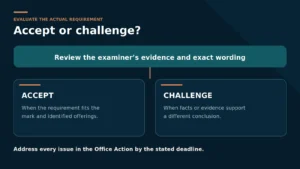
| Accepting may make sense if … | Challenging may make sense if … |
|---|---|
| The component simply gives the name of the goods or services. | The component may be unique in itself. |
| The examiner has good evidence of descriptive meaning. | The meaning or evidence of the examiner does not apply to your goods or services. |
| You don’t have to assert independent exclusivity in that element. | The mark produces a real unitary impression or a double meaning. |
| This requirement helps to move forward the full mark. | Your business strategy is important to have independent rights in the element. |
It is contingent upon a lot of things. A disclaimer resolves that requirement, not other refusals. An unsupported challenge can be a waste of time. — Consult competent U.S. trademark attorneys on major contested issues.
Just Descriptive Refusal vs. Trademark Disclaimer:
| Issue | Required Disclaimer | Section 2(e)(1) Denial |
|---|---|---|
| Common Issues | A separable, non-registrable element of an otherwise registrable mark | Whether the mark as a whole applied for is merely descriptive |
| Can the mark advance? | Often, if the requirement is met and there is no other issue left | Depends on the response and any legal route available |
| Main question | What is the claim on the component independent? | Is the whole mark entitled to the applied-for registration? |
| Supplemental Register | Disclaimer may still be required for certain components | May be an alternative for eligible marks depending on filing basis and facts |
| Section 2(f) distinctive component | May be relevant to a potentially distinctive component | May be a response if can prove acquired distinctiveness of the mark |
A Section 2(e)(1) refusal cannot be automatically cured by the disclaimer of a purely descriptive mark. Analysis may support acquired distinctiveness or a permissible Supplemental Register route. Check out our upcoming guides to Merely Descriptive Trademarks, Acquired Distinctiveness, and Supplemental vs. Principal Register. TMEP §§ 1213.03, 1213.06
Is a Disclaimer Effective in Reducing Confusion?
The disclaimer does not carve out language of the mark for Section 2(d) analysis. The USPTO compares marks in their entirety, including disclaimed matter. Its relative importance may shift, but it does not disappear or automatically resolve a conflict. Refer to our Likelihood of Confusion guide. TMEP 1213.10
Common Mistakes Trademark Disclaimers
- Belief that the word is deleted: The submitted mark is visually unchanged.
- Thinking you lose the whole trademark: The statement refers to a part of the composite mark.
- Assuming it gets rid of a conflict: The whole mark still matters in a Section 2(d) analysis.
- Unnecessary disclaimers are volunteered: First, see if the component actually needs one.
- Failing to add a required disclaimer: An outstanding requirement can prevent registration.
- Copy the erroneous statement: Correspond the actual word or design and any class limitation appearing in your Office Action.
- If you think that all the descriptive words must be separate: A unitary mark is capable of a different analysis.
- Treating it as a patent terminal disclaimer by mistake: this is a different patent-law concept and not related to this trademark requirement.
Common Questions About Trademark Disclaimers
What is a trademark disclaimer?
It states that the applicant does not claim exclusive rights to the identified wording or design other than to the mark as a whole. The component remains in the mark. The USPTO may require this if the component cannot be registered on its own.
Why does the USPTO want a disclaimer?
A mark that would otherwise be registrable may contain a separable generic, descriptive or informational component that others may need to use. This requirement is dependent on the component, the full mark, and the identified goods or services.
A disclaimer does not remove words from your trademark.
No. That word sticks in your branding. A disclaimer is a statement in the USPTO record about the component’s independent claim. It does not edit your trademark drawing or packaging.
What does ‘no claim is made to the exclusive right to use’ mean?
The applicant is not separately claiming the component from the mark as shown by that registration. The full mark can still be displayed and compared with other marks.
Does a disclaimer dilute a trade mark?
It records a limitation regarding a component alone. It does not nullify the protection of the full mark, nor does it remove the component from a comparison. The practical effect depends upon the facts and the matter disclaimed.
Yes, you can still use the wording of the disclaimer.
Yes. You can continue to use the full mark on products and in advertising. The disclaimer itself is not decisive for the protectability of the separate use of the component or the infringement by another party.
Could I contest a disclaimer requirement?
Yes. You can argue that the matter is unique, unitary, or subject to a narrower requirement with supporting facts. Meet the deadline and handle every other Office Action issue.
Yes, you may rescind a disclaimer.
Generally, an unnecessary voluntary disclaimer can be withdrawn in examination. One that is legally required is different. Timing and registration status are important; withdrawal is not automatic.
What happens if I decline a disclaimer?
If you fail or don’t meet a disclaimer that’s required, the USPTO may not register it. It won’t just delete the word. Please reply by the due date.
Can a disclaimer apply to a class?
Yes, if it makes sense. It may be limited to specific goods, services, or a class. The extent of the support depends on the actual application and office action.
Does a disclaimer affect the likelihood of confusion?
The USPTO still considers the mark as a whole under Section 2(d), including any disclaimed wording. That language may carry different weight, but a disclaimer alone does not eliminate a conflict.
A trademark disclaimer is not the same as a patent terminal disclaimer.
Nope. A trademark disclaimer concerns rights claimed in a portion of a mark, not in the mark as a whole.” A patent terminal disclaimer is a separate issue of patent law.
Conclusion
A trademark disclaimer does not remove wording or a design from your mark. It states that you don’t claim exclusive rights to the identified component except for the mark as a whole. The disclaimed component continues to play a role in a likelihood-of-confusion analysis, and the full mark could still be registered.
The practical question is whether the examiner’s requirement matches your actual mark and goods or services. Some applicants will reasonably accept a disclaimer of a generic product name; others may have grounds to contest a proposed disclaimer or limit it to certain offerings. Can prevent registration if the problem is ignored. Read the Office Action, review the cited evidence, and respond to each requirement by the deadline. This article provides general information for educational purposes and is not advice regarding your particular rights.
Need Assistance With a USPTO Disclaimer Requirement?
Call EagleMarkUSA for help understanding the requirement, organising an Office Action response, and reviewing the next steps in the registration process. We do not guarantee any specific decision

Pingback: Trademark Office Action Response: How to Respond to the USPTO
Pingback: USPTO Likelihood of Confusion: Section 2(d) Trademark Guide