

You filed under Section 1(b), intent-to-use, and received a Notice of Allowance. Your mark has cleared examination and publication but has not been registered. You now need to show qualifying use in commerce for the goods or services you will retain.
Already using the mark? File a Statement of Use with dates, specimen, declaration, and fee. Not using it yet? Request an extension. The initial deadline is six months from the Notice of Allowance issue date; extra time is not automatic. USPTO intent-to-use guidance
Here is how use, specimens, fees, extensions, partial launches, and USPTO acceptance work.
What Is a Trademark Statement of Use?
A trademark Statement of Use (SOU) is a filing by a Section 1(b) applicant, generally made after a Notice of Allowance, stating that the mark is now actually used in commerce with the identified goods or services. It includes use information, at least one qualifying specimen for each class, a verified declaration, and a fee. An intent to use the mark alone does not establish the use needed for this application to register. USPTO intent-to-use guidance
Who Needs to File a Statement of Use?
The SOU primarily applies to a Section 1(b) application after a Notice of Allowance. A Section 1(a) application based on existing use generally supplies use information and a specimen earlier, so it does not normally require this post-allowance step.
Check your filing status in TSDR, especially if the application has mixed bases or divided goods and services.
What Happens After a Notice of Allowance?
A Notice of Allowance means the mark passed the publication stage; it is not a registration certificate. The next choice depends on real use in commerce:
| Your situation | Next step |
|---|---|
| The mark is in qualifying use for the goods/services you will claim | File the SOU, supply use dates and a specimen for each class, sign the declaration, and pay the per-class fee. |
| Qualifying use has not begun | File a timely six-month extension request, pay its per-class fee, and continue toward genuine use. |
| Use exists for only some listed items | Consider deleting unsupported items or an appropriate request to divide before claiming use. |
For goods, the mark generally must appear on the goods, packaging, or a qualifying point-of-sale display, and the goods must actually be sold or transported in commerce. For services, the mark must be used in selling, advertising, or rendering services that are actually rendered in commerce. Token activity solely to reserve rights does not qualify. USPTO: What “Use in Commerce” Means
How Long Do You Have to File a Statement of Use?
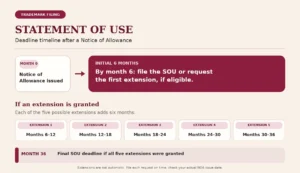
Initial Deadline
The USPTO must receive an SOU or an eligible extension request within six months after the Notice of Allowance issue date. Calendar the date shown in your official record, not the date you first read the email.
If You Are Not Ready
A timely, granted extension gives another six months. It must be requested and paid for; it is not automatic. If you still are not using the mark, file the next eligible request before the current period ends.
Maximum Period
The USPTO allows five successive six-month extensions following the six-month initial extension period. If all are granted, the SOU must be filed within 36 months of the Notice of Allowance issue date. Extensions are measured from that notice, not from the day you submit each request. USPTO ITU forms and deadlines
How Much Does a Trademark Statement of Use Cost?
As of October 2026, the USPTO electronic Statement of Use filing fee is $150 per class. These are government fees for the SOU itself, excluding professional fees and any earlier application or extension fees. Official USPTO fee schedule
| Number of Classes | Current SOU Government Fee |
|---|---|
| 1 | $150 |
| 2 | $300 |
| 3 | $450 |
| 4 | $600 |
Why Trademark Classes Affect the Statement of Use Fee
Clothing in Class 25 and SaaS in Class 42 count as two classes if both are claimed. Use and specimen evidence must support each. See Trademark Classes Explained and the Trademark Class Finder.
How Much Does a Statement of Use Extension Cost?
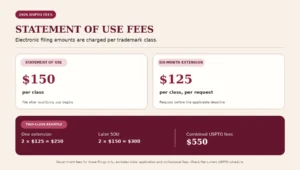
As of October 2026, each electronic extension request costs $125 per class. That is the fee for one six-month extension request, not the total price of all possible extensions. Official USPTO fee schedule
| Classes | One 6-Month Extension Fee |
|---|---|
| 1 | $125 |
| 2 | $250 |
| 3 | $375 |
| 4 | $500 |
Two classes with two extensions cost $500 in extension fees, plus $300 for a later two-class SOU. See Trademark Cost.
How Do Statement of Use Extensions Work?
The timing runs in consecutive periods:
Notice of Allowance → initial six months → extension 1 (month 12) → extension 2 (month 18) → extension 3 (month 24) → extension 4 (month 30) → extension 5 (month 36, final limit).
The first request verifies continued bona fide intent to use. Later requests also show good cause through efforts such as product development or finding distributors. Each needs a timely filing and fee. USPTO intent-to-use guidance
An extension buys time; it does not prove use.
What Do You Need to File a Statement of Use?
Prepare the following for the goods and services you will retain:
- Qualifying use in commerce with the identified offering in the ordinary course of trade.
- First-use dates anywhere and in commerce for each class; the anywhere date cannot be later.
- A specimen for each class showing actual use. One specimen can support multiple classes only if it shows use for each.
- A verified declaration, authorized signature, and per-class fee.
“First use anywhere” is the first bona fide use with the offering; “first use in commerce” is the first qualifying use in federally regulated commerce. They may coincide but cannot be future launch dates. USPTO: Dates of Use · USPTO: Verified Statements
What Is a Statement of Use Specimen?
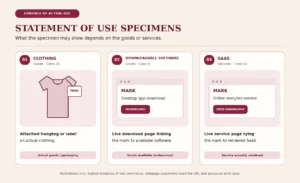
A Statement of Use specimen shows real use with the claimed offering. Mockups and draft websites do not qualify. Webpage specimens need a URL and an access or print date. See Trademark Specimen Explained. USPTO: Specimens
Clothing — Class 25
A photographed attached label, hangtag, packaging, or qualifying purchase page may work. A decorative shirt slogan may not function as a trademark. See Trademark Class 25 Explained.
Downloadable Software — Class 9
An app-store download page or actual software launch screen displaying the mark may work. Advertising a future download does not establish current use. See Trademark Class 9 Explained.
SaaS — Class 42
A webpage may qualify if it directly associates the mark with an actually rendered online service. A generic brand landing page may not. See Trademark Class 42 Explained.
What If You Are Using the Trademark for Only Some Goods or Services?
Suppose your Class 25 application lists T-shirts, hats, and footwear, but qualifying use exists only for T-shirts. Do not claim use for all three.
You may delete unused items. To preserve them in a separate pending application, a request to divide may be available, with additional requirements and fees. You cannot retain unsupported items in the same SOU. USPTO intent-to-use guidance
Likewise, an available Class 9 app does not establish use for an unlaunched Class 42 SaaS service.
Statement of Use vs Amendment to Allege Use
Both are allegations of use for a Section 1(b) application. The central difference is when you file.
| Factor | Amendment to Allege Use (AAU) | Statement of Use (SOU) |
|---|---|---|
| Purpose | Claim actual use in a pending ITU application | Claim actual use after allowance |
| Filing stage | After the application is filed, before approval for publication | On or after the Notice of Allowance, within the applicable period |
| Specimen | Required for each class claimed | Required for each class claimed |
| Electronic government fee (2026) | $150 per class | $150 per class |
| Timing concern | Cannot be processed in the gap after approval for publication and before NOA | Must meet the NOA-based deadline or a granted extension |
During the publication “blackout” period, wait for the NOA and file an SOU. Check status first. USPTO ITU forms
Statement of Use vs Declaration of Use
A Statement of Use is a pre-registration filing in a Section 1(b) application. A Section 8 Declaration of Use is generally a post-registration maintenance filing showing continued use for an existing registration. They occur at different stages and use different forms and fees. A Notice of Allowance calls for an SOU or an extension, not a Section 8 filing. See Trademark Renewal Fees for maintenance costs.
How to File a Statement of Use
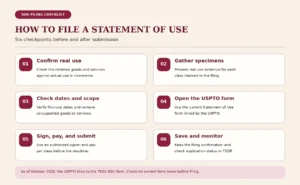
- Proof of qualifying use: the goods are sold/transported and/or the services provided under qualifying use of the marks.
- Review the NOA: compare listed items and classes with actual use; consider deletion or division.
- Gather specimens: show the mark with the claimed offerings.
- Confirm first-use dates: check records, including first use in commerce.
- Open the current form: as of October 2026, the ITU forms page links to the TEAS SOU/AAU form.
- Sign the statement: get an authorized signatory; foreign applicants require U.S. licensed attorneys.
- Pay the per-class fee for the retained classes.
- Review and submit the goods/services, dates, specimen, and attachments.
- Save confirmation and monitor TSDR. Submission is not acceptance.
TEAS vs Trademark Center — Where Do You File in 2026?
As of October 2026, the USPTO lists the Statement of Use/Amendment to Allege Use form in TEAS. It added the SOU extension request to Trademark Center in September 2026, while its official ITU forms page also lists a TEAS extension form. The systems are in transition; the USPTO says the SOU itself is a forthcoming Trademark Center feature. USPTO ITU forms · USPTO Trademark Center updates
Use the current official form index when you file. Trademark Center for an extension does not mean the SOU has already moved there.
Trademark Statement of Use Examples
These examples do not pre-approve a specimen or establish qualifying use.
Example 1 — Clothing Brand
A Class 25 brand selling branded T-shirts confirms the NOA list and dates, then submits an attached-label photo or qualifying purchase page. One class costs $150 in 2026 government SOU fees.
Example 2 — SaaS Startup
A Class 42 startup actually rendering SaaS may submit a live page directly associating its mark with the service. The one-class government SOU fee is $150.
Example 3 — Business Has Not Launched
A product mockup exists, but no qualifying sales or transport. Do not file the SOU prematurely. Request an eligible extension before the deadline: $125 for one class.
Example 4 — Two-Class Software Business
If downloadable software (Class 9) and SaaS (Class 42) both have qualifying use, the SOU fee is $300. Evidence must support both; a download page alone may not establish SaaS use.
What Happens After You File a Statement of Use?
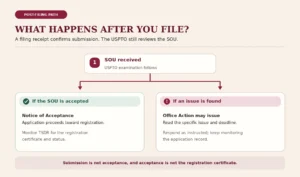
Statement of Use Accepted
The USPTO reviews the SOU. If it is accepted, the mark proceeds toward registration and is not sent through the opposition period again. The registration certificate is later made available in TSDR. Submission by itself is not acceptance. USPTO intent-to-use guidance
Problem Found
The USPTO may issue an Office Action about an unacceptable specimen, dates, declaration, owner information, or another issue. Read it promptly and follow its specific response instructions. See Trademark Office Action Response.
What Is a Notice of Acceptance of Statement of Use?
A filing confirmation means the USPTO received your submission. A Notice of Acceptance of Statement of Use means the USPTO has reviewed and accepted the SOU. The mark then proceeds toward registration, subject to any exceptional intervening issue. Monitor TSDR for the registration itself before treating the application as registered. USPTO: After an SOU Is Accepted
What Happens If You Miss the Statement of Use Deadline?
Without a timely SOU or extension request, the application can become abandoned. An unintentional delay may qualify for a Petition to Revive with required filings and fees, generally within two months of the Notice of Abandonment; nonreceipt has different rules. Revival is not automatic and cannot extend the statutory SOU limit. USPTO: Reviving an Abandoned Application
Can You Withdraw or Correct a Statement of Use?
Do not treat a filed SOU like an editable draft. The USPTO says an applicant may not withdraw an SOU after the Notice of Allowance if it fails statutory requirements. Some deficiencies can be addressed in response to an Office Action, depending on the facts and remaining time. In limited circumstances an eligible “insurance” extension filed with or after the SOU can provide time to correct a defect; it has specific timing and extension-limit conditions. USPTO ITU forms
Verify real use, the goods/services, classes, dates, specimen, and authorized signature before filing. Incorrect claims about use cannot always be repaired after the fact.
Common Statement of Use Mistakes
- Filing before qualifying use exists: A planned launch or mockup does not prove actual use.
- Missing the six-month deadline: Calculate from the NOA issue date and track every extension period.
- Assuming extra time is automatic: Each extension requires a timely request, verification, and fee.
- Using a weak specimen: Show the actual mark with the stated goods or services, not a digital rendering.
- Claiming use for unsupported items: Delete or evaluate division rather than certifying use for unlaunched offerings.
- Entering incorrect dates: Verify records and distinguish first use anywhere from use in commerce.
- Forgetting per-class fees: Check the retained classes before paying.
- Confusing the SOU with Section 8: The latter maintains a registration after it issues.
- Following outdated form instructions: Confirm the live TEAS and Trademark Center paths on the USPTO site.
Can You File a Statement of Use Yourself?
A U.S.-domiciled applicant may generally file without an attorney. The challenging part is often not clicking through the form; it is deciding whether use qualifies, whether the specimen shows it, and what to do with partially launched goods or multiple classes. A foreign-domiciled applicant must have a U.S.-licensed attorney represent them before the USPTO. USPTO: Do I Need an Attorney?
When Should You Consider Professional Help?
Consider help if you are uncertain about use in commerce, your specimen, first-use dates, a pending deadline, only some goods/services being used, a multi-class filing, division, or an earlier Office Action. A review before filing may be especially valuable because an SOU generally cannot be withdrawn simply to return to intent-to-use status.
Need Help Filing a Trademark Statement of Use?
Contact EagleMarkUSA to discuss your Notice of Allowance, use evidence, goods/services, specimens, and extension options. You can also explore EagleMarkUSA Trademark Registration Services for broader application assistance. No service can guarantee USPTO acceptance or registration.
Frequently Asked Questions About Trademark Statements of Use
What is a trademark Statement of Use?
A Section 1(b) applicant files it after a Notice of Allowance to claim actual use in commerce. It includes use dates, a verified declaration, specimen evidence, and a fee.
When do I need to file a Statement of Use?
Within six months of the Notice of Allowance issue date, or within a timely granted extension period. If not yet using the mark, request an extension before the current deadline.
How much does a Statement of Use cost?
The 2026 electronic USPTO fee is $150 per class: $300 for two classes, $450 for three. Other filing and professional fees are separate.
Are Statement of Use fees charged per class?
Yes. Count the classes covered by your SOU. Paying for a class does not replace the need for actual use and appropriate specimen evidence.
What is a Statement of Use specimen?
A real example showing the mark used with the claimed goods or services, such as an attached clothing label or a qualifying service webpage. Mockups do not establish actual use.
How many Statement of Use extensions can I request?
Up to five consecutive six-month extensions may be available, for a maximum of 36 months from the Notice of Allowance. Later requests require a showing of good cause.
How much does a Statement of Use extension cost?
Each six-month request costs $125 per class electronically in 2026. Two classes cost $250 per request; repeated requests have separate fees.
What if I am not using the trademark yet?
Do not claim future use as current use. If eligible, file a timely extension request and continue working toward a genuine commercial launch.
What is the difference between a Statement of Use and an Amendment to Allege Use?
Both claim use in a Section 1(b) application. The Amendment to Allege Use is filed before approval for publication; the Statement of Use follows the Notice of Allowance.
What is the difference between a Statement of Use and Declaration of Use?
An SOU is filed before registration in an intent-to-use application. A Section 8 Declaration of Use is a later maintenance filing for an existing registration.
What happens after USPTO accepts my Statement of Use?
The mark proceeds toward registration without a second opposition period. Check TSDR for the actual registration and certificate before describing it as registered.
What happens if my specimen is rejected?
The USPTO may issue an Office Action explaining the problem. A qualifying substitute or explanation may be possible, but it must meet the relevant use and timing rules.
What happens if I miss the deadline?
The application can become abandoned. A time-limited Petition to Revive may be available for an unintentional delay if its conditions are met.
Can I file the Statement of Use myself?
A U.S.-domiciled applicant generally may. Foreign-domiciled applicants need a U.S.-licensed attorney. Confirm use, dates, specimens, classes, and the declaration before signing.
Conclusion
A trademark Statement of Use is the step that turns a Section 1(b) intent-to-use claim into a claim of actual use after a Notice of Allowance. That notice starts a six-month filing period. If qualifying use has begun, prepare accurate first-use dates and real specimen evidence for the goods and services you will retain. If it has not, request an eligible extension before the deadline.
The 2026 electronic government fee is $150 per class for an SOU or $125 per class for each extension. Filing and paying do not automatically mean the USPTO has accepted the evidence or issued a registration. Check the application record after submission.

Pingback: Trademark Office Action Response: How to Respond to the USPTO
Pingback: How Long Does It Take to Get a Trademark? USPTO Timeline