

A trademark specimen is real-world evidence showing how a mark is actually used in commerce with the goods or services named in a USPTO filing. Depending on the offering, it might be a photograph of a product label or package, a qualifying product webpage, an advertisement for a service, or a software launch screen.
A specimen is not simply a clean image of your logo. Evidence that works for a consultant or SaaS company may fail for a clothing brand. A webpage for goods may fail if customers cannot order the product through it.
This guide covers filing timing, goods and service examples, website screenshots, and specimen refusals. USPTO specimen overview.
What Is a Trademark Specimen?
A trademark specimen shows the mark as consumers actually encounter it in commerce with identified goods or services. The USPTO uses it to assess source-identifying use. A photograph, screenshot, or scan may document that use.
Trademark Specimen vs. Trademark Drawing
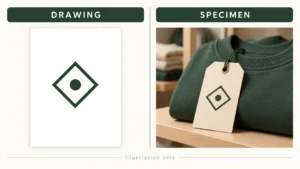
The drawing depicts the mark sought; the specimen shows its real use. In a use-based claim, they must show substantially the same mark. USPTO drawing guidance.
| Drawing | Specimen |
|---|---|
| The mark identified in the application | Evidence of the mark used with particular goods or services |
| May be standard characters or a particular stylized/design form | Could be a product-label photo, sales page, or service advertisement |
| Submitted to show what you want registered | Submitted when proof of use is required |
Uploading the drawing again as the specimen does not establish marketplace use.
When Is a Trademark Specimen Required?
Timing depends on the filing basis. See USPTO guidance and Trademark Filing Basis 1(a) vs. 1(b).
Section 1(a) — Use in Commerce
Section 1(a) generally requires a specimen with the application, showing use by its filing date. A planned launch does not establish current use.
Section 1(b) — Intent to Use
The initial Section 1(b) application needs no specimen. After actual use begins, submit an Amendment to Allege Use before approval for publication or a Statement of Use after a Notice of Allowance, within the applicable window. See USPTO guidance and our planned Statement of Use guide.
Section 44 and Madrid-Based Applications
Section 44(e) foreign-registration and Section 66(a) Madrid applications do not need a U.S. specimen to register. However, Section 44(d) priority alone needs a registration basis. Applicable Section 8 or 71 maintenance filings later require use specimens. USPTO overview.
How Many Trademark Specimens Do You Need?
Generally, one acceptable specimen per class when proof is due. One image can support multiple classes if it establishes use for each; the USPTO can request more. USPTO requirements.
A company claiming Class 9 downloadable software and Class 42 SaaS should examine both offerings. A hosted-service page may not prove the downloadable good; an app-store listing may not prove the SaaS service. One specimen per class does not excuse claiming other goods or services never offered. See Trademark Classes Explained: Complete Guide to All 45 USPTO Classes.
What Makes a Trademark Specimen Acceptable?
Before uploading, check whether the evidence:
- Shows the mark you applied for in substantially the same form.
- Connects that mark to the specific goods or services in the filing.
- Shows actual use in the ordinary marketplace, not a proposed design or mockup.
- Is the right kind of specimen for goods or for services.
- Presents the mark as an identifier of source, rather than only decoration or background information.
- Meets any webpage URL and access-date requirements.
What the image truthfully shows matters more than its polish. USPTO requirements.
Trademark Specimen Examples for Goods
For goods, the specimen generally shows the mark on the product, its label, tag, container, packaging, or a point-of-sale display associated with the goods. Ordinary advertising alone usually does not qualify. USPTO TMEP §904.03.
| Specimen type | Typical usefulness |
|---|---|
| Mark directly on the product | Often useful if shown on the actual goods and perceived as a mark. |
| Product label | Often useful when it identifies the actual product. |
| Hangtag | Often useful when attached to the goods; an unattached tag needs enough context to show actual use. |
| Packaging | Often useful when it bears the mark for the claimed goods. |
| Point-of-sale display | May qualify if it associates the mark with goods being offered for sale. |
| Product webpage | May qualify if it identifies the goods, connects the mark, and offers a means to order. |
| Ordinary advertisement | Generally insufficient for goods unless it functions as a qualifying sales display. |
Product Labels and Hangtags
A sewn-in label or attached hangtag can show source use. An unattached tag needs enough context to establish actual commercial use.
Product Packaging
A real branded cleanser box may show use for that cleanser; it does not prove use for unrelated products.
Point-of-Sale and Product Webpages
A store display or qualifying product page connects the mark to goods offered for sale. A promotional article alone generally does not.
Trademark Specimen Examples for Services
A service mark specimen directly associates the mark with the claimed service. A webpage, advertisement, brochure, signage, invoice, or material used in performing the service may qualify. A business card needs a meaningful service connection. TMEP §1301.04.
What Does “Direct Association” Mean?
The viewer should understand that this mark identifies this service. A mark near a description of consulting work helps; a logo on a generic homepage may not. The USPTO considers layout and context.
See Trademark Class 35 Explained for examples of business and advertising services.
Trademark Specimens for Goods vs. Services
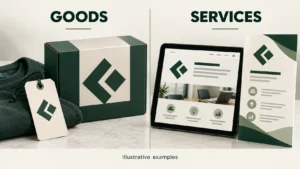
| Evidence | Goods | Services |
|---|---|---|
| Mark on actual product | Often useful | Usually does not, by itself, show the claimed service |
| Attached label or hangtag | Often useful | Usually does not show a separate service |
| Product packaging | Often useful | Usually does not show a separate service |
| Qualifying e-commerce sales page | May qualify as a point-of-sale display | May also qualify if it directly identifies a claimed service |
| Ordinary advertisement | Generally insufficient | May qualify with direct mark-service association |
| Brochure | Usually insufficient unless it functions as a sales display | May qualify with direct association |
| Service webpage | Does not automatically prove use for goods | May qualify with direct association |
| Business signage | May qualify if it functions as a sales display for goods | May qualify where services are offered or rendered |
| Mockup or digitally fabricated image | Does not show actual use | Does not show actual use |
Advertising can be evidence for services; ordinary advertising generally cannot serve as a specimen for goods. The precise presentation still matters in both columns.
Can a Website Be a Trademark Specimen?
Yes, depending on what the webpage shows and what the application claims. A screenshot of any page with a logo is not automatically acceptable.
Website Specimen for Goods
A goods page should identify the product, associate the mark with it, and offer a means to buy, download, or order. An “Add to cart” button or adequate ordering instructions can help; price is not invariably required. A future-product announcement is different. TMEP §904.03(i).
Website Specimen for Services
A webpage offering bookkeeping under a prominent mark may qualify; a generic “About” page may not. The claimed service must actually be rendered in commerce.
URL and Access-Date Requirement
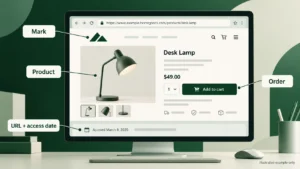
Include the URL and access or print date on the specimen or in designated form fields. Missing information may be supplied in an appropriate verified response. USPTO instructions.
Can an E-Commerce Product Page Be a Trademark Specimen?
An online-store listing may qualify if it links the mark to the identified product, describes or depicts it, and offers ordering. An Amazon-style listing is not automatically acceptable: check source-identifying use, actual availability by the relevant date, URL, and access or print date.
A store header may identify a retail service without proving product-brand use for every item sold.
Trademark Specimen for Clothing
For clothing, consider a real neck label, attached hangtag, packaging, or qualifying sales listing. Show the actual garment and legible mark. See Trademark Class 25 Explained.
Ornamental Use on Clothing
A large slogan across a T-shirt may appear decorative. Placement and consumer perception matter; a neck label or hangtag often communicates source more clearly. Front-of-shirt use is not categorically excluded. USPTO guidance.
Trademark Specimens for Software and Mobile Apps
For downloadable software, an actual launch screen, app-store download listing, or webpage offering the program may qualify. A mockup or webpage without a download, purchase, or ordering method generally fails. TMEP §904.03(e).
Class 9 commonly covers downloadable software. The evidence should match the downloadable good named in your identification. See Trademark Class 9 Explained.
Trademark Specimens for SaaS and Online Services
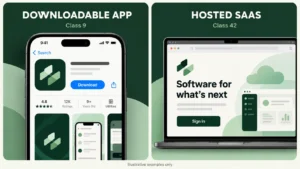
SaaS generally calls for a service specimen, often in Class 42. A live landing page, access page, advertisement, or contextualized sign-in screen may work if it connects the mark to the hosted service. A sign-in screen’s sufficiency depends on context and any accurate description. TMEP guidance.
A companion-app download page may not establish the SaaS service. See Trademark Class 42 Explained.
How to Describe a Trademark Specimen
When the filing asks for a specimen description, identify what the evidence is and how it displays the mark with the claimed goods or services. This is different from describing the visual features of the logo. The description should be truthful and consistent with the submitted image; it cannot turn a mockup into real use. Examples:
Example 1 — Product Label
“Photograph showing the ABC mark on a label attached to the shirts sold under the mark.”
Example 2 — Service Website
“Screenshot of applicant’s website displaying the ABC mark above a description of its bookkeeping services.” Include the webpage URL and access or print date separately or on the screenshot.
Example 3 — Software
“Screenshot of the launch screen of applicant’s downloadable software showing the ABC mark.” Only use this if the screen is from the actual distributed program.
Example 4 — Product Webpage
“Screenshot of a product page showing the ABC mark beside the listed mugs and an Add to cart button.” Again, include the URL and date as required. No universal sentence fits every specimen.
Acceptable vs. Unacceptable Trademark Specimens
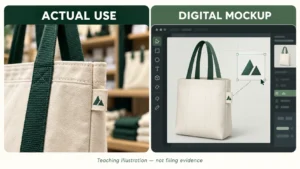
These assessments are general; the complete image, use date, identification, and filing record can change the outcome.
| Example | General assessment | Why |
|---|---|---|
| Real branded product packaging | Often useful | Shows mark on packaging for the goods. |
| Real attached hangtag | Often useful | Connects mark to the garment. |
| Qualifying purchase webpage | May qualify | Identifies goods, mark, and ordering method. |
| Service webpage | May qualify | Must directly associate mark with claimed service. |
| Service brochure | May qualify | Must advertise the actual service under the mark. |
| Mockup of a future product | Generally insufficient | Does not show real use in commerce. |
| Digitally added label on a product photo | Generally insufficient | Fabricated placement does not prove actual use. |
| Logo alone | Generally insufficient | Does not connect mark to goods or services. |
| Coming-soon webpage | Commonly problematic | Does not by itself show current qualifying use. |
| Ordinary ad for physical goods | Generally insufficient | Usually lacks qualifying point-of-sale character. |
| Product unrelated to claimed goods | Generally insufficient | Does not show use for the identified goods. |
The USPTO’s current TMEP expressly addresses digitally created, altered, and mockup specimens.
Common Trademark Specimen Mistakes
- Uploading only the logo: Include the mark as used with the product or service.
- Submitting an ordinary advertisement for goods: Look for an actual product label, packaging, or qualifying sales display.
- Using a mockup: A proposed label or future website does not document actual use.
- Digitally adding the mark: Photograph the mark genuinely applied to the item or shown on a live, qualifying page.
- Showing the wrong offering: Match the specimen to the exact goods or services identified.
- Omitting webpage URL or date: Supply both on the screenshot or through the filing’s dedicated fields.
- Relying on decoration on clothing: Consider how buyers perceive the mark and whether labels or tags show source use.
- Assuming one image covers every class: Examine what it actually proves for each class.
Why Does the USPTO Refuse Trademark Specimens?
Common reasons include a missing mark, a mark that does not substantially match the drawing, evidence for different goods or services, a mockup, an unacceptable specimen type, no established actual use in commerce, or too little connection between the mark and the offering. Webpage screenshots can be refused for missing URL or date information. A decorative shirt design may receive an ornamentation refusal. A polished photograph is not a substitute for the required commercial context.
Read the specific Office Action: it explains the refusal and may raise more than one issue. USPTO specimen refusals and response options.
What Can You Do After a Trademark Specimen Refusal?
Depending on the refusal, an applicant may explain why the original specimen qualifies, provide missing webpage information, or submit a properly verified substitute specimen. Some applicants may have other basis-related options. Address every issue and follow the particular Office Action. See the planned USPTO Trademark Specimen Refusal: Why It Happens & How to Respond guide.
The substitute must show real use by the applicable date: for a Section 1(a) application, at least as early as its filing date; for an Amendment to Allege Use, before that amendment’s filing; for a Statement of Use, before the deadline for filing it expires. A verification is required. Creating a new label only after receiving a refusal does not establish that it existed and was used by an earlier required date. USPTO substitute-specimen guidance.
Frequently Asked Questions About Trademark Specimens
What is a trademark specimen?
A trademark specimen is evidence showing how consumers actually encounter a mark with the goods or services claimed in a U.S. trademark filing. A real product label, qualifying sales page, or service advertisement may be a specimen. A standalone logo image shows what the mark looks like but usually does not show its commercial use.
What is an acceptable trademark specimen?
It shows the applied-for mark as a source identifier in genuine commerce with the identified goods or services. The right format depends on the claim: goods commonly use a marked product, label, package, or sales display; services can use advertising or materials that directly connect the mark with the service.
What is a trademark specimen for goods?
It is proof of a mark used with the actual product, such as a photo of a marked item, an attached label, packaging, or a qualifying point-of-sale webpage. Ordinary promotional advertising usually does not establish trademark use for goods. The image should correspond to the product identified in the application.
What is a service mark specimen?
It shows the mark directly associated with the service being claimed. A website offering the service, brochure, advertisement, sign at the service location, or material used to provide the service may qualify. A generic company logo with no meaningful connection to the identified service may not.
Can a website be a trademark specimen?
Yes. A goods page generally needs to identify the goods, link the mark to them, and offer a means to order. A services page must directly associate the mark with the service. A webpage specimen also needs its URL and the date it was accessed or printed, either on the image or in the appropriate filing fields.
Can an e-commerce or Amazon listing be a trademark specimen?
It may qualify for goods if the listing displays the mark as identifying the actual product, describes or shows that product, and enables ordering. Marketplace placement alone is insufficient. Confirm the product was genuinely available in commerce by the required date and include the listing’s URL and access or print date.
Is a product photo an acceptable trademark specimen?
Sometimes. A photograph of the actual product with the mark physically applied, or of its real marked packaging or attached label, can be useful. A product photo with a mark added digitally does not show actual commercial use. A photo of an unmarked product with a logo placed elsewhere may lack the needed connection.
Is an advertisement a trademark specimen?
For services, a real advertisement can qualify if it directly associates the mark with the claimed service. For goods, ordinary advertising usually does not qualify; a display with product information and a genuine means to order may be different. The evidence also must meet the applicable use-date requirement.
Can a business card be a service-mark specimen?
Possibly. A card bearing the mark can work when its wording and context make the claimed service reasonably clear. Merely printing a company name, telephone number, and logo on a card may not establish the required association. Assess what a prospective customer would understand from the card.
Do I need one specimen for every trademark class?
Generally, one acceptable specimen per class is required when use evidence is due. A single image may support multiple classes if it truly shows qualifying use for each, and the USPTO may request more. A Class 9 app download page should not automatically be assumed to prove a Class 42 SaaS service.
What is a specimen description?
It is a short, accurate statement of what the submitted evidence depicts: for example, “Photograph of a label attached to the shirts showing the ABC mark.” For a service webpage, explain how the page displays the mark with the service. Describe the evidence rather than the colors or shape of the logo.
Can I use a mockup as a trademark specimen?
No. A mockup showing how a mark might appear on a product or website does not prove actual use in commerce. Digitally placing a mark onto a stock product photo creates the same problem. Submit genuine evidence of use by the applicable date, not a preview prepared for filing.
Does an intent-to-use application require a specimen?
The initial Section 1(b) application does not. The applicant later submits an acceptable specimen with a qualifying Amendment to Allege Use or Statement of Use after actual use begins. The timing and other requirements depend on the application’s stage. Registration on a use basis cannot be completed merely on an intention to launch.
What happens if the USPTO rejects my specimen?
The USPTO issues an Office Action explaining the refusal. Depending on the facts, you may be able to explain the original evidence, submit missing webpage information, or provide a verified substitute specimen used by the applicable date. Other options may apply. A newly created specimen cannot automatically cure earlier nonuse; review the complete Office Action and response deadline.
Conclusion
A trademark specimen documents real use of a mark with the goods or services in a USPTO filing. Product labels, packaging, and qualifying sales displays often serve goods claims; service websites and advertising can serve services claims when the connection is clear. Webpage submissions need a URL and access or print date. The evidence must also match the mark, offering, and applicable use date.
Review each class separately before uploading. Mockups, digitally added branding, and generic logo images can invite refusals because they fail to show the use being claimed. If you receive an Office Action, its specific reasons and your actual records determine the available response.
Not Sure Whether Your Trademark Specimen Meets USPTO Requirements?
Contact EagleMarkUSA for help reviewing your U.S. trademark filing and specimen options. Explore EagleMarkUSA Trademark Registration Services for filing assistance. This article is general education, not legal advice, and no specimen or application outcome can be guaranteed. Check out our guide on intent-to-use trademark

Pingback: Trademark Office Action Response: How to Respond to the USPTO
Pingback: How Long Does It Take to Get a Trademark? USPTO Timeline