

If you are planning a U.S. trademark application, the starting government cost is $350 per class for a qualifying electronic application under Section 1 or 44. That means a name used for goods or services in one class generally starts at $350 in USPTO filing fees; two classes start at $700. The fee can rise if your application triggers additional charges, if you file on an intent-to-use basis and later prove use, or if you hire professional help. These are application costs, not a promise that the USPTO will register the mark.
The type of product you have will affect the number of classes in which you must register. The information below covers 2026 USPTO fees, sample government fees, and future maintenance fees. Government fees are independent of any professional fees.
How Much Does It Cost to Trademark a Name?
For a Section 1 application based on current use or intent to use, the USPTO’s base application fee is $350 per class if the application meets its base requirements. The same base rate applies to Section 44 applications. You file one mark per application, but that application may list appropriate goods and services in more than one class. USPTO trademark fee information
| Application scope | Base USPTO application fee | Possible later or additional costs |
|---|---|---|
| One class | $350 | Application surcharges, intent-to-use filings, professional services, and maintenance, if applicable |
| Two classes | $700 | The same potential costs, often assessed per class |
| Three classes | $1,050 | The same potential costs, often assessed per class |
Totals assume one mark, a qualifying electronic Section 1 or 44 application, and no surcharges. Intent-to-use filings and professional services cost extra.
Current USPTO Trademark Filing Fees
The USPTO replaced the older TEAS Plus/TEAS Standard fee distinction for new Section 1 and 44 applications with a base application fee and specified additional fees. In 2026, new applications are filed through Trademark Center. The following figures come from the USPTO’s trademark fee page and current fee schedule.
| USPTO charge | 2026 amount | When it matters |
|---|---|---|
| Base application, Section 1 or 44 | $350 per class | Each class included in an application that meets base requirements |
| Insufficient information | $100 per class | The application omits information required for the base fee |
| Free-form identification | $200 per class | You use the free-form text box instead of selecting ID Manual entries within the electronic application |
| Excess characters in a free-form identification | $200 for each additional group of 1,000 characters beyond the first 1,000, per affected class | A class with free-form text has a lengthy identification |
These charges apply when their conditions arise. A one-class free-form identification, for example, totals $550 before any other charge. Selecting an ID Manual entry inside the application differs from copying its words into the free-form box. See USPTO examples.
The $350 base amount is for the common Section 1 and 44 route. Madrid Protocol applications under Section 66(a) have a different fee structure; consult the official schedule if that is your filing route.
Why Trademark Classes Change the Cost

The USPTO groups goods and services into international trademark classes. Each class included in your application adds a base filing fee. The correct selection depends on the goods or services identified, not merely the name of your company or industry. See our guide to all 45 trademark classes and Trademark Class Finder when planning your identification.
A clothing brand selling T-shirts might investigate Class 25. If it also sells handbags under the mark, it may need to investigate Class 18, which would bring a qualifying two-class application’s base filing total to $700. A software company may need to distinguish downloadable software in Class 9 from certain software as a service (SaaS) offerings in Class 42. That distinction depends on how customers receive and use the product. A website or app alone does not automatically put every business in Class 9 or 42.
Include only goods and services supported by your filing basis and plans. Verify exact wording in the USPTO ID Manual.
Trademark Cost Examples by Number of Classes
Here is the base-fee math for one mark in one qualifying Section 1 or 44 application. These amounts exclude surcharges, later intent-to-use filings, optional professional help, and future maintenance.
| Number of classes | Calculation | Base USPTO filing fee |
|---|---|---|
| 1 | 1 × $350 | $350 |
| 2 | 2 × $350 | $700 |
| 3 | 3 × $350 | $1,050 |
| 4 | 4 × $350 | $1,400 |
One application can cover several classes for the same mark. A separate word mark and distinct logo generally require two applications. USPTO drawing guidance
How Much Does It Cost to Trademark a Business Name?
A business name used as a trademark has the same fee structure for a federal trademark application as any other marks: usually $350/class for a qualifying Section 1 or 44 application. The USPTO doesn’t offer a reduced fee just because the wording is your LLC or corporation name. A business providing consulting services in one class will probably pay a different fee from a business marketing several products or services in many classes.
A registration for an LLC, a filing of your name as a business name in your state, or registration of a web address cannot be considered a trademark registration. Your name must be a mark used for certain goods/services. USPTO basics of trademarking. USPTO trademark basics
How Much Does It Cost to Trademark a Logo?
The basic fee by the USPTO for a logo trademark application is $350/class. Usually, a logo is filed as a special form drawing. An artwork of the logo does not automatically bring you any extra government discounts: the number of classes and additional fees determine your costs. See the USPTO drawing guide.
How Much Does It Cost to Trademark a Name and Logo?

If there are to be separate applications filed for the words used separately from the design that makes up your logo, you will need two separate trademark applications and filing fees. In other words, if you have a name application for one class and a logo application for one class, you are looking at an initial filing cost of $700. Two classes in each application would start at $1,400.
You may instead apply for a combined wording-and-design mark as one mark, but that is not the same as separately registering the wording alone and the logo alone. The application drawing and use must support what you file. Do not assume a combined registration gives the same scope as two separate registrations. USPTO drawing and specimen requirements
Intent-to-Use Trademark Costs
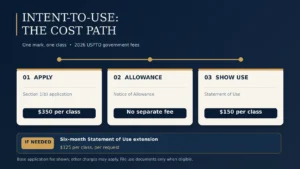
An intent-to-use application under Section 1(b) lets an applicant with a bona fide intent to use a mark begin the process before actual use in commerce. Its starting base application fee is still $350 per class. Registration generally requires a later, properly supported allegation of use for the relevant goods or services. The USPTO fee page lists these 2026 charges:
| Later intent-to-use filing | USPTO fee |
|---|---|
| Amendment to Allege Use or Statement of Use | $150 per class |
| Request for a six-month extension to file a Statement of Use | $125 per class, per request |
An Amendment to Allege Use may be filed before approval for publication; a Statement of Use follows a Notice of Allowance. Both require qualifying use and a suitable specimen. USPTO intent-to-use guidance
For one class, $350 initially plus $150 for a later use filing totals $500, assuming no other charge; one extension makes it $625. After a Notice of Allowance, there is an initial six-month period to file a Statement of Use or extension request. Further extensions have limits. See our intent-to-use and specimen guides.
Additional USPTO Fees to Keep in Mind
Other government charges may include:
- Application surcharges: $100 per class for insufficient information; $200 per class for a free-form ID; possible $200 excess-character increments.
- More classes: $350 base per added class, plus applicable fees.
- Intent-to-use filings: $150 per class for an allegation of use; $125 per class for each extension.
- Maintenance: Required later filings have per-class fees.
- Petition to revive: Currently $250 for an eligible abandoned application; success is not assured.
An eligible pre-registration Office Action response extension costs $125; an ordinary timely response has no universal USPTO response fee. See the fee schedule. New goods generally cannot broaden the identification after filing; see our adding classes after filing guide.
DIY Filing vs. Professional Trademark Assistance
| Approach | USPTO fees | Other costs and work |
|---|---|---|
| File yourself, if eligible | Same government fees | You research conflicting marks, select the mark format and identification, submit evidence, monitor deadlines, and answer USPTO correspondence. |
| Use a filing service | Same government fees | The provider charges separately; check exactly which tasks are included and whether legal advice is available. |
| Hire a U.S.-licensed trademark attorney | Same government fees | Legal fees vary with the scope of searching, advice, preparation, responses, and follow-up. |
U.S.-domiciled applicants may represent themselves. Foreign-domiciled applicants need a U.S.-licensed attorney. Filing services are distinct from law firms. Compare quotes for included responses, specimens, and later filings. USPTO attorney guidance
What Does a Trademark Attorney Cost?
Attorney fees vary with the work: clearance search, ownership and filing advice, application preparation, Office Action responses, use filings, and maintenance. Some quote a defined package; others charge separately for later issues.
Ask what the quote includes and whether government fees, conflict searching, and later responses cost extra. EagleMarkUSA service pricing is separate from USPTO fees; request the current scope and price.
What Happens to the Filing Fee If the USPTO Rejects the Application?
Generally, the USPTO does not refund trademark fees because an application is refused, abandoned, or otherwise does not lead to registration. Payment is for the filing and examination process, not for a guaranteed result. A refusal may be addressable, but some issues require more work or lead to an unsuccessful application. This is one reason to investigate possible conflicts, ownership, the goods or services, and the filing basis before submitting and paying. USPTO refunds and processing fees
Does an Office Action Cost Extra?
An Office Action is a USPTO examiner’s letter identifying an issue or requiring information. It might ask for a clearer goods-and-services identification or a better specimen, or raise a substantive concern such as a likelihood-of-confusion refusal. There is no single USPTO fee charged for every timely Office Action response. However, a requested deadline extension for an eligible pre-registration action carries a fee, and some underlying corrections or additional classes can create other charges. USPTO response guidance
If a professional prepares the response, their fee depends on the problem and their engagement terms. A simple clarification may take less work than researching and arguing a legal refusal. Read the actual Office Action and deadline before estimating cost. See our future Office Action guide for the response process.
Lifetime Costs: Maintaining and Renewing a Trademark
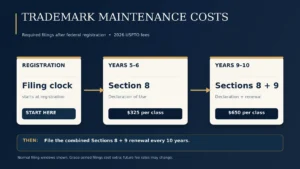
A registration needs later filings to stay active. For a typical registration based on U.S. use or Section 44, a Section 8 Declaration of Use or Excusable Nonuse is due between the fifth and sixth years after registration. A combined Section 8 and 9 filing is due between the ninth and tenth years, then every ten years. The USPTO maintenance guidance provides the timing; its fee page lists these current electronic fees:
| Required filing | Normal filing window | 2026 USPTO fee |
|---|---|---|
| Section 8 declaration | Years 5–6 after registration | $325 per class |
| Combined Sections 8 and 9 declaration and renewal | Years 9–10, then each ten years | $650 per class |
A six-month grace period exists after the applicable deadline, with extra fees. The USPTO lists $100 per-class grace charges for Section 8 and Section 9; filing the combined Sections 8 and 9 form during the grace period currently costs $850 per class. An optional Section 15 declaration is a different filing, with its own requirements and charge, and is not necessary merely to satisfy these routine maintenance milestones.
For one class, timely required filings at years 5–6 and 9–10 currently total $975 ($325 + $650). Later renewals and fee changes alter the lifetime cost. See our renewal guide.
Real Trademark Cost Scenarios
These examples show how the fees fit together. Class assignments are illustrative only; verify the precise goods and services in the ID Manual. They assume a qualifying Section 1 application with no application surcharge or paid professional help. The initial figures do not include later maintenance.
| Business scenario | Classes worth investigating | Initial USPTO base fee | Later government fee, if needed |
|---|---|---|---|
| Clothing label selling T-shirts | 25 | $350 | None assumed for a supported use-based filing |
| Brand selling clothing and handbags | 25 and 18 | $700 | None assumed for a supported use-based filing |
| Hosted SaaS offering | 42 | $350 | None assumed for a supported use-based filing |
| Downloadable app plus separately identified SaaS service | 9 and 42 | $700 | None assumed for a supported use-based filing |
| Planned one-class product, not yet used in commerce | Relevant class | $350 | $150 for an eligible allegation of use; $125 for each extension request if needed |
The last example totals $500 through the use filing, or $625 with one extension. See our Class 9, 25, 35, and 42 guides for further research.
How to Reduce Avoidable Trademark Costs
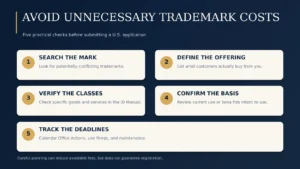
- Search before you file. Look for relevant existing marks and consider a more thorough clearance review when the risk justifies it. A filing fee generally will not be returned if the USPTO refuses the mark.
- List what you actually sell. Distinguish goods from services and identify each with enough detail. A company name or website category is not itself an identification.
- Use the ID Manual inside Trademark Center when accurate. Selecting suitable entries there can help avoid the free-form identification fee. Never choose a misleading description merely to save $200.
- Check every class. Use the Trademark Class Finder and our all-45-classes guide to narrow your research, then verify the actual ID Manual entry. Avoid paying for classes unrelated to your bona fide plans.
- Match the filing basis to reality. If you are already using the mark in qualifying commerce, review the evidence requirements. If not, account for the later intent-to-use filing and possible extensions.
- Calendar deadlines. Office Action, intent-to-use, and post-registration deadlines can create extra expense or loss of an application or registration if missed.
Is the Cheapest Filing Strategy Always Best?
Filing fewer classes can omit a genuine offering, while adding speculative goods can waste fees and complicate proof of use.
Budget around actual use, bona fide plans, the chosen mark format, and likely later filings.
Frequently Asked Questions About Trademark Costs
How much does it cost to trademark a name in 2026?
A qualifying Section 1 or 44 application starts at $350 per class in USPTO fees. Two classes start at $700. Surcharges, intent-to-use filings, professional services, and maintenance can add to the total.
How much does it cost to trademark a business name?
A business name used as a mark follows the same rate: $350 per class for a qualifying Section 1 or 44 application. An LLC or state name registration is separate from federal trademark registration.
How much does it cost to trademark a logo?
A qualifying logo application starts at $350 per class. Applicable surcharges and optional professional assistance add to that amount.
How much does it cost to trademark a name and logo together?
Separate registrations for wording alone and a distinct logo require separate applications: one class in each starts at $700 total. A single combined name-and-design application covers one particular mark.
Is the trademark fee charged per class?
Yes. The Section 1 and 44 base application fee is $350 per class. Many later intent-to-use and maintenance fees are also per class.
How much does a two-class trademark application cost?
A qualifying two-class application for one mark starts at $700 in USPTO base fees, before surcharges, later filings, and professional services.
Can I file a trademark myself for $350?
A U.S.-domiciled applicant can generally file independently. A qualifying one-class application starts at $350, but other fees may apply. Foreign-domiciled applicants require a U.S.-licensed attorney.
Do I need to hire a trademark attorney?
U.S.-domiciled applicants are not required to hire one; foreign-domiciled applicants must have a U.S.-licensed attorney for USPTO trademark matters. USPTO guidance
Is the USPTO filing fee refundable if my trademark is rejected?
Generally, no. The filing fee pays for processing and examination, not a guaranteed registration.
Does an intent-to-use application cost more?
The initial base fee remains $350 per class. A later use filing costs $150 per class; each eligible six-month Statement of Use extension costs $125 per class.
How much does it cost to renew a trademark?
The required combined Sections 8 and 9 filing currently costs $650 per class at years 9–10 and every ten years thereafter. A separate Section 8 filing of $325 per class is due at years 5–6.
What is the cheapest way to trademark a name?
A qualifying one-class, use-based application filed independently by an eligible applicant starts at $350. Accurate goods, filing basis, and class selection matter more than minimizing the upfront payment.
Does paying for more classes improve my chances of approval?
No. Extra classes increase filing fees but cannot resolve conflicts or other examination issues. Include classes supported by your actual use or bona fide intent.
Conclusion
So, how much does it cost to trademark a name in 2026? For a qualifying U.S. Section 1 or 44 application, start with $350 per class in USPTO filing fees. Then account for any applicable application surcharges, intent-to-use filings, professional assistance, and the required maintenance fees after registration. A two-class filing starts at $700; a separate word-mark and logo application may double the base amount for the same class coverage.
The class count should come from the specific goods and services associated with your mark, not the broad label for your industry. Review the USPTO ID Manual and use EagleMarkUSA’s Trademark Class Finder to research possible classes. If you want help preparing your U.S. trademark application, contact EagleMarkUSA to discuss the registration process and the services available for your situation. No service can promise USPTO approval. Last but not least, check out our guide on intent-to-use trademark.
This article provides general educational information, not legal advice. Fees and requirements can change; verify the current USPTO schedule and seek qualified legal advice for your circumstances.

Pingback: How Much Does It Cost to Renew a Trademark in 2026?
Pingback: Trademark Statement of Use: How to File, Fees & Deadlines