

A U.S. federal trademark registration does not stay active automatically. A typical owner files Section 8 in years 5–6, then combined Sections 8 and 9 in years 9–10, and every ten years afterward. The current timely fees are $325 and $650 per class, respectively. Section 15 is optional if eligible.
Two classes generally double the government fees. Grace-period filings cost more, and continued-use claims generally need a specimen for each retained class. Figures reflect the USPTO fee schedule reviewed in October 2026; professional fees are separate.
How Much Does It Cost to Renew a Trademark?
The 10-year federal trademark renewal costs $650 per class when you timely file the combined Sections 8 and 9 form. Before that, a separate required Section 8 maintenance filing costs $325 per class between years 5 and 6. The optional Section 15 filing adds $250 per class if the registration qualifies. USPTO trademark fee information
| Filing | When required | Current USPTO fee | Per class? |
|---|---|---|---|
| Section 8 Declaration of Use or Excusable Nonuse | Years 5–6 | $325 | Yes |
| Section 15 Declaration of Incontestability | Optional when eligible | $250 | Yes |
| Combined Sections 8 and 9 declaration and renewal | Years 9–10 and every ten years afterward | $650 | Yes |
| Section 8 during its six-month grace period | Only if filed late | $425 total ($325 + $100) | Yes |
| Combined Sections 8 and 9 during their six-month grace period | Only if filed late | $850 total ($650 + $200) | Yes |
The combined late charge includes two $100 per-class grace fees. Totals assume electronic filing and exclude professional or issue-specific charges. USPTO fee schedule
Trademark Renewal Timeline: When Do You Have to Pay?
Registration → years 5–6 → years 9–10 → years 19–20 → years 29–30. Count from the registration date, not the application date. USPTO timeline
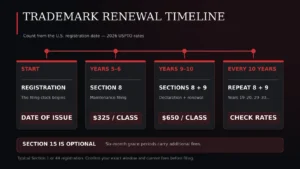
Years 5–6
File Section 8 Declaration of Use or Excusable Nonuse. It is maintenance, not a Section 9 renewal. Eligible owners may also file optional Section 15.
Years 9–10
File combined Sections 8 and 9. Section 8 addresses continued use or qualifying excusable nonuse; Section 9 requests renewal.
Every 10 Years After That
Repeat combined Sections 8 and 9 in years 19–20, 29–30, and later ten-year windows. Six-month grace periods carry extra fees. The owner remains responsible even without a USPTO reminder.
Year 5–6 Trademark Maintenance Cost
The Section 8 trademark fee is $325 per class for a timely electronic filing. The owner normally declares that the mark is still used in commerce for the retained goods or services and submits a specimen for each class. The USPTO examines the filing and may request more information. Limited excusable-nonuse provisions exist for special circumstances; ordinary plans to resume selling are not automatically enough. USPTO: Keeping your registration alive
Section 8 Cost by Number of Classes
| Number of classes | Timely Section 8 government fee |
|---|---|
| 1 | $325 |
| 2 | $650 |
| 3 | $975 |
| 4 | $1,300 |
Totals assume all listed classes remain and no extra charges apply. Section 8 does not replace renewal.
Is Section 15 Required?
No. Section 15 is optional. A Principal Register registration may qualify after five years of continuous qualifying use and other conditions. Incontestability has limited legal effects; it is not immunity from challenge or a substitute for Sections 8 and 9. USPTO guidance
Section 15 Filing Fee
The current electronic Section 15 government fee is $250 per class. It is a separate optional cost, not part of the minimum required year 5–6 maintenance fee.
Section 8 + Section 15 Cost
If eligible, combined Sections 8 and 15 cost $575 per class: $575 for one class or $1,150 for two. Required Section 8 alone costs $325 or $650, respectively. USPTO schedule
10-Year Trademark Renewal Cost
The normal combined Sections 8 and 9 fee is $650 per class. Section 8 confirms continued use or eligible excusable nonuse; Section 9 renews the registration. The combined amount consists of a $325 Section 8 fee and a $325 Section 9 fee per class. It is due in years 9–10 after registration and again in each later ten-year window. USPTO fee schedule
Combined Sections 8 + 9 Cost by Number of Classes
| Classes | Timely combined 8 + 9 government fee |
|---|---|
| 1 | $650 |
| 2 | $1,300 |
| 3 | $1,950 |
| 4 | $2,600 |
A properly retained two-class registration costs $1,300 at this milestone. Review current use before filing.
Why Trademark Classes Change the Renewal Cost

USPTO maintenance and renewal charges are generally per class. A clothing brand registered only for clothing in Class 25 might owe $325 at years 5–6 and $650 at years 9–10. If that brand also has handbags in Class 18, the two-class totals become $650 and $1,300, assuming both classes remain properly covered.
Downloadable software in Class 9 and SaaS in Class 42 can likewise make two classes. Verify the actual registration; consult the Trademark Class Finder, 45-class guide,
How Much Does It Cost to Renew During the Grace Period?
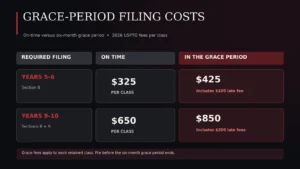
A six-month grace period follows each normal window, with extra per-class fees. USPTO maintenance guidance; fee schedule.
Year 5–6 Grace Period
One-class Section 8: $325 on time, $425 in grace. Two classes: $650 or $850. Optional Section 15 adds its own fee.
Year 9–10 Grace Period
One-class combined Sections 8 and 9: $650 on time, $850 in grace. Two classes: $1,300 or $1,700. Check anniversary dates, not just the calendar year.
What Happens If You Miss the Trademark Renewal Deadline?
The sequence is normal filing window → six-month grace period with added fees → cancellation or expiration if the required filing is still missing. Once the grace period ends, the owner generally cannot pay the ordinary renewal fee whenever convenient and restore the old registration. A new application may be necessary, and it does not automatically recover the former registration’s position. USPTO: Keeping your registration alive
A timely but defective filing differs from never filing. Check the reason and dates in the record before considering a petition; see our future Trademark Expiration and Cancellation guide.
Do You Need a Specimen to Renew a Trademark?
Generally, yes. A Section 8 or 71 continued-use filing normally includes one specimen for each class retained, plus the signed declaration identifying the goods or services on which the mark is used. A specimen is a real example of how customers encounter the mark in commerce: for example, appropriate packaging or a product page for goods, or a service advertisement that connects the mark to the services. It must support the actual claimed use, not merely show a designed logo in isolation. USPTO specimen guidance
One specimen per class does not excuse unsupported listed items. The USPTO may audit and request more proof. See Trademark Specimen Explained: USPTO Requirements & Examples.
What If You No Longer Use the Trademark for Every Good or Service?

Review every item in the registration before declaring continued use. Do not claim use for goods or services on which the mark is no longer used. Items that no longer qualify generally should be deleted, unless a valid excusable-nonuse claim applies. This may reduce retained classes and future per-class maintenance costs if an entire class is removed.
Timing matters. The USPTO says you can delete unused items between required maintenance filings through an appropriate Section 7 request without a deletion fee, or identify them for deletion when initially filing the maintenance declaration without a deletion fee. Deleting after submitting a Section 8 or 71 declaration but before its acceptance currently costs $250 per affected class, and a deficiency surcharge may also apply in some circumstances. USPTO maintenance guidance; post-registration audit guidance. Deleting items is a substantive decision; verify the record and actual use first.
How to Renew a Trademark Through USPTO Trademark Center
As of 2026, the USPTO offers the common maintenance and renewal forms in Trademark Center; the corresponding legacy TEAS forms were scheduled for retirement in September 2026. Use the USPTO’s Trademark Center announcement and current system guidance rather than an old TEAS-only walkthrough.
- Sign in to Trademark Center.
- Choose the filing: Section 8 or combined Sections 8 and 9. Verify date and status in TSDR.
- Review owner details and the registration record.
- Check listed goods, services, and classes against actual use or qualifying nonuse.
- Provide a specimen for each retained class when claiming use.
- Complete declarations accurately, including any deletions.
- Review and pay the USPTO fee.
- Submit on time, save confirmation, and monitor for correspondence.
Follow the live form instructions. Madrid-based records, ownership changes, and stopped use need extra care.
Can You Renew a Trademark Yourself?
Many U.S.-domiciled owners can file themselves. They must still check ownership, listed items, specimens, and deadlines. Foreign-domiciled owners require a U.S.-licensed attorney. USPTO guidance
Professional help may be useful for complex records, audits, or uncertain specimens; USPTO fees remain the same.
USPTO Renewal Fees vs Attorney or Service Fees
| Cost type | Mandatory? | Paid to |
|---|---|---|
| Section 8 or combined Sections 8 and 9 government fee | Yes, for the applicable required filing | USPTO |
| Grace-period charge | Only if filing in the permitted late window | USPTO |
| Attorney or service fee | Optional for many U.S.-domiciled owners; attorney representation required for foreign-domiciled owners | The professional or provider |
Ask whether a professional quote includes specimens, responses, audits, and USPTO fees. Prices vary. Our Trademark Cost guide covers initial applications.
Real Trademark Renewal Cost Examples
Examples assume a typical domestic registration, properly retained classes, current electronic fees, and no professional charges.
Scenario 1 — One-Class Clothing Trademark
Class 25: $325 at years 5–6 and $650 at years 9–10, totaling $975 in required government fees through the first renewal at current rates. Optional eligible Section 15 adds $250.
Scenario 2 — Two-Class Software Trademark
Classes 9 and 42: $650 at years 5–6 and $1,300 at years 9–10, totaling $1,950 in required government fees. Both classes must remain supported.
Scenario 3 — Three-Class Registration
Three classes: $975 for timely Section 8 and $1,950 for timely combined Sections 8 and 9. The $2,925 total spans two milestones, not one bill.
Scenario 4 — Late Filing During Grace Period
Two classes filing combined Sections 8 and 9 in grace pay $1,700 instead of $1,300—a $400 difference.
How to Avoid Unnecessary Trademark Renewal Costs
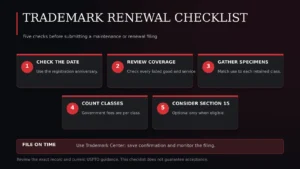
- File in the normal window. The extra grace fees are predictable and avoidable if you can file on time.
- Review the registration early. Match each class and listed item to actual current use; investigate excusable nonuse only when facts support it.
- Delete unsupported items appropriately. Doing this between filings or in the initial maintenance declaration can avoid the later $250-per-affected-class deletion charge.
- Organize specimens and proof of use. Keep dated examples that connect the mark to the relevant goods or services, and be prepared for a possible audit.
- Track future deadlines. Calendar both the statutory window and the end of the grace period from the registration date.
- Treat Section 15 as a choice. Add its $250-per-class fee only if the registration qualifies and the optional filing fits your circumstances.
Can an Expired Trademark Registration Be Restored?
Do not assume it can. If no statutory Section 8 or 9 filing was made by the end of the grace period, the USPTO says a petition cannot simply reinstate a registration canceled for that omission. Different, narrow procedures may apply if the USPTO made an error or if an owner timely filed but missed a later response to a maintenance Office Action. The facts matter. USPTO petition guidance
A new application may be needed and does not revive the old registration. Check TSDR promptly.
Section 71 vs Section 8 — What About Madrid-Based U.S. Registrations?
A U.S. registration obtained through the Madrid Protocol generally uses Section 71 declarations at the U.S. maintenance milestones instead of Section 8. The underlying international registration is renewed through WIPO, not through a USPTO Section 9 filing. The U.S. Section 71 fee is currently $325 per class for a timely electronic declaration, but the overall international-renewal costs and timing require a separate review. USPTO Madrid maintenance guidance
Frequently Asked Questions About Trademark Renewal Fees
How much does it cost to renew a trademark?
A timely combined Sections 8 and 9 renewal of a typical U.S. federal registration costs $650 per class in current USPTO electronic fees. Before the first renewal, a separate required Section 8 filing in years 5–6 costs $325 per class. Grace-period and professional charges may add to these amounts.
What are the current USPTO trademark renewal fees?
As of October 2026, the government fee is $325 per class for a timely Section 8 declaration and $650 per class for a timely combined Sections 8 and 9 renewal. Section 15 is optional and costs $250 per class. Confirm the USPTO fee schedule before paying.
How often do you renew a U.S. trademark?
For a typical domestic federal registration, file Section 8 between years 5 and 6, then renew with the combined Sections 8 and 9 filing between years 9 and 10 and every ten years afterward. A six-month grace period follows each normal window for an added fee.
What is the trademark filing required in years 5–6?
It is generally a Section 8 Declaration of Use or Excusable Nonuse, costing $325 per class when timely filed. It confirms qualifying continued use or a supportable exception. This first maintenance filing is not a Section 9 renewal.
Is Section 15 required?
No. Section 15 is an optional Declaration of Incontestability for eligible Principal Register registrations. Its current fee is $250 per class. Filing it does not replace the mandatory Section 8 declaration or the later Sections 8 and 9 renewal.
How much is the 10-year trademark renewal?
The timely combined Sections 8 and 9 filing costs $650 per class: $650 for one class, $1,300 for two, and $1,950 for three. During the six-month grace period, the combined total rises to $850 per class.
Are trademark renewal fees charged per class?
Yes. Required Section 8 and combined Sections 8 and 9 fees are assessed per class in the registration. Review which goods, services, and classes remain properly supported before filing; retaining an unused class solely to preserve the registration can create problems.
What happens if I miss the renewal deadline?
You can generally still file within the six-month grace period by paying extra fees. If that period ends without the required filing, the registration will be canceled or expire. A late ordinary payment after that point does not simply renew it.
Is there a grace period for trademark renewal?
Yes. The USPTO generally provides six months after the normal Section 8 or combined Sections 8 and 9 window. Section 8 alone costs an extra $100 per class; a combined Sections 8 and 9 filing costs an extra $200 per class because both components have grace charges.
Do I need a specimen when renewing a trademark?
When claiming continued use, a maintenance declaration generally requires one appropriate specimen per class. The specimen must show the mark used with the relevant goods or services. The USPTO can request further proof, especially if it audits the registration. Excusable-nonuse claims have separate requirements.
Can I remove unused goods or services during maintenance?
Yes, and the registration should accurately reflect current use or a valid exception. You can identify goods or services for deletion in the initial maintenance declaration without a deletion fee. Deleting them after submitting the declaration but before acceptance currently triggers a $250 fee per affected class.
Can I renew a trademark myself?
Many U.S.-domiciled owners may file their own maintenance forms through Trademark Center. Check the correct form, classes, current use, specimen, owner details, and deadline. Foreign-domiciled owners generally must have a U.S.-licensed attorney represent them before the USPTO.
Can an expired trademark registration be renewed?
If the six-month grace period remains open, you may be able to file with the required late fees. If it has ended without the statutory filing, ordinary renewal is no longer available. Narrow remedies depend on the reason for cancellation; a new application may be necessary.
Conclusion
The required Section 8 filing costs $325 per class in years 5–6; the combined Sections 8 and 9 renewal costs $650 per class in years 9–10 and every ten years thereafter, at current rates. Section 15 is optional, and grace-period filing costs more.
Review retained classes, current use, specimens, ownership, and deadlines before filing. The Trademark Class Finder and Trademark Specimen Explained guide can help.
Need Help With Your Trademark Renewal?
Contact EagleMarkUSA for help reviewing deadlines, classes, specimens, and maintenance options. Explore EagleMarkUSA Trademark Registration Services for related support. Acceptance and continued registration cannot be guaranteed. Check out our detailed guide on intent-to-use trademark
This article is general educational information, not legal advice. USPTO fees and procedures can change; check current official guidance for your registration.
Also Read:
How Long Does It Take to Get a Trademark? Complete USPTO Timeline
