
There is no single answer to how long it takes to get a trademark registered in the United States. As of October 1, 2026, the USPTO reports an average of 4.3 months from filing to a first examining action and 10.4 months from filing to either registration or abandonment. Those are agency-wide processing benchmarks, not a promise that your mark will register in 10.4 months. USPTO processing wait times
A straightforward application based on an already-used mark can move through examination and publication without an extra use filing. An Office Action, opposition, or intent-to-use application can follow a longer path. How quickly you respond and when you actually start using the mark also matter.
This guide walks through every stage, explains the current figures, and shows which delays you can realistically avoid.
How Long Does It Take to Get a Trademark?
A U.S. trademark application moves from filing to examination, publication, and then either registration or another required step. Current USPTO averages are useful for planning, but your registration date depends on the filing basis and what happens in your particular case.
| Application Path | Relative Timeline | Main Reason |
|---|---|---|
| Smooth Section 1(a) use-based application | Often the shortest ordinary path | The mark is already in qualifying use; no later Statement of Use is required. |
| Application with an Office Action | Longer and variable | Applicant response and additional USPTO review are needed. |
| Section 1(b) intent-to-use application | May be much longer | After publication, the applicant must establish use and file an acceptable Statement of Use. |
| Opposed or complex application | Highly variable | A third-party challenge, appeal, suspension, or multiple unresolved issues can interrupt the usual path. |
A filing is not a registration; examination, publication, and any later requirements still follow. USPTO trademark process
Current USPTO Trademark Processing Time
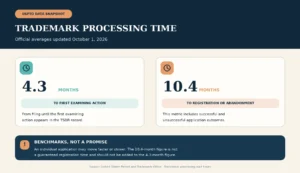
USPTO Processing Update — October 2026
The USPTO’s figures below were updated October 1, 2026. They describe averages across cases, with separate agency targets. USPTO processing wait times
| Measure | USPTO Average | USPTO Target | What It Measures |
|---|---|---|---|
| Filing to first examining action in the TSDR record | 4.3 months | 5.0 months | Time until the first examination event appears in the application record. |
| Filing to registration or abandonment | 10.4 months | 11.0 months | Time until the application reaches either of those two outcomes. |
“Registration or abandonment” is not the same as guaranteed registration time. The 10.4-month figure includes unsuccessful applications. It is not a forecast for every successful application, and it should not be added mechanically to the 4.3-month figure. An individual case can take less or more time than either average.
First-action timing indicates when examination begins, not approval. Check the live USPTO processing page for updates.
Complete USPTO Trademark Registration Timeline
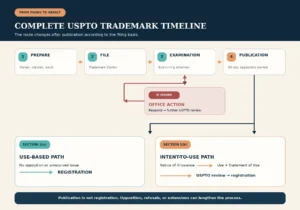
The shared path looks like this:
Prepare application → File with USPTO → Wait for examination → Examining attorney review → Resolve any Office Action → Approval for publication → Publication in the Trademark Official Gazette → 30-day opposition period
After publication, the paths split:
| Filing Basis | Next Steps if No Opposition Prevents Progress |
|---|---|
| Section 1(a): use in commerce | USPTO proceeds toward registration and issues an electronic registration certificate. |
| Section 1(b): intent to use | USPTO issues a Notice of Allowance → applicant establishes qualifying use → files a Statement of Use (or requests permitted extensions) → USPTO reviews that filing → registration if requirements are met. |
An Office Action creates a response and review loop before approval. An opposition or request to extend the time to oppose can pause the post-publication path. Publication alone never means the mark is registered. USPTO process · USPTO publication guidance
Stage 1 — How Long Does It Take to Prepare and File a Trademark Application?
Preparation time is separate from USPTO processing time. A business with clear ownership, a completed clearance review, and accurate goods or services may be ready sooner than one still deciding what it sells or who owns the mark. The agency averages above start at filing; they do not include your prefiling work.
Before submitting in Trademark Center, check the legal owner, mark format, filing basis, classes, and specific goods or services wording. A Section 1(a) filing also needs use dates and a specimen. Clearance research can reveal conflicts before you pay to file.
Research classes with the Trademark Class Finder and Trademark Classes Explained. Downloadable apps, clothing, retail services, and SaaS need distinct identifications; see the Trademark Class 9, Trademark Class 25, Trademark Class 35, and Trademark Class 42 guides where available. Check wording in the USPTO ID Manual and see Trademark Cost for fees.
Stage 2 — How Long Until USPTO Reviews the Application?
After filing, the application enters the examination queue and eventually reaches a trademark examining attorney. In the October 1, 2026 USPTO update, the average time to a first examining action was 4.3 months, against a 5.0-month target. Your application may move sooner or later. USPTO processing wait times
The examiner checks formal filing information and legal registrability. That may include ownership, the goods or services identification, conflicts with earlier marks, descriptiveness, filing basis, and whether a submitted specimen shows proper use. The initial review can lead to approval for publication or an Office Action that needs attention. USPTO examination guidance
Stage 3 — What Happens During USPTO Trademark Examination?
Application approved
In the situation where no problem is identified with the application during the examination process, the application becomes approved for publication. This will never lead to the registration process in any manner.
Office Action issued
An Office Action identifies a refusal or requirement: perhaps likelihood of confusion, descriptiveness, unclear goods or services, a disclaimer, an unacceptable specimen, or an owner problem. The response may need a correction, evidence, or legal analysis.
Most Section 1 and 44 pre-registration actions allow three months, with one eligible paid three-month extension. Section 66(a) Madrid actions generally allow six months without extension. Check your actual letter; some notices differ. See Trademark Office Action Response. USPTO guidance
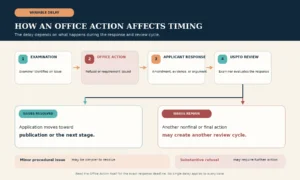
To What Extent Does an Office Action Affect a Trademark?
There is no fixed number of months that every Office Action adds. Time depends on the issue, when the applicant responds, whether an extension is requested, how quickly the USPTO reviews the response, and whether another or final Office Action follows.
Minor procedural issue
A goods or services clarification or disclaimer may need a focused amendment. Address every issue and allow for USPTO review.
Substantive refusal
A confusion or descriptiveness refusal may require evidence, legal arguments, further examination, or a TTAB appeal. An incomplete resolution can produce a final or new nonfinal action. USPTO Office Action guidance
Stage 4 — How Long Does Trademark Publication Take?
Once approved, the mark is published in the USPTO’s weekly Trademark Official Gazette. Publication starts a standard 30-day opposition period. A party that believes registration would harm it may oppose or request more time to oppose. A contested case can substantially change the timeline. USPTO approval for publication
Publication is not registration. If no challenge blocks progress, the application moves to the next stage. The USPTO says it can take three to four months from publication to receive official notice that the mark has registered or moved to the next stage; treat that as guidance, not an individual deadline. The next stage depends especially on whether the application is use-based or intent-to-use. USPTO publication guidance
How Long After Publication Is a Trademark Registered?
\
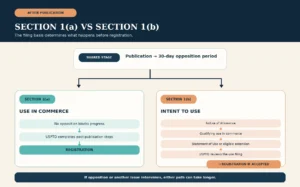
Section 1(a) use-based application
If the mark was properly in use when filed and no opposition or other issue prevents registration, the USPTO proceeds toward registration after the opposition period. The electronic certificate becomes available in TSDR when registration issues. Do not assume the 30th day after publication is the certificate date. USPTO trademark process · Receiving registration
Section 1(b) intent-to-use application
The mark does not register merely because it passed the opposition period. The USPTO issues a Notice of Allowance (NOA). The applicant then needs qualifying use in commerce and a timely, acceptable Statement of Use (SOU), or a permitted extension while preparing to use the mark. Only after the use filing is accepted can the application proceed to registration. USPTO intent-to-use guidance
How Long Does an Intent-to-Use Trademark Take?
A Section 1(b) application can complete its initial examination and publication while the business is still preparing to launch. After the NOA, it has six months to file an acceptable SOU or request the first six-month extension. Up to five consecutive six-month extensions may be available; if all are granted, the SOU must be filed within 36 months of the NOA issue date. Extensions require timely requests and fees, and later requests require a showing of good cause. USPTO ITU forms and timing
A SaaS startup may clear publication but wait to launch. A planned service is not actual use; launch time and SOU review extend its timeline. See Trademark Statement of Use and Trademark Specimen Explained.
Three Realistic Trademark Registration Timeline Examples
These are illustrative paths, not promised schedules.
Example 1 — Smooth use-based application
A shirt seller files under Section 1(a) with real use and a suitable specimen. After examination and publication, no one opposes, so the application proceeds to registration. The 4.3-month first-action average covers only the queue to examination; publication and issuance come later. USPTO data
Example 2 — Application receives an Office Action
A marketing agency receives a requirement to clarify its services. It responds with a narrower identification, then waits for another examination. If unresolved issues remain, another action may follow. The extra cycle adds time, but no fixed number of months.
Example 3 — Intent-to-use startup
A software startup files before launch. After examination and publication, it receives an NOA and requests an extension. Once the service is in qualifying use, it files an SOU and specimen. Registration awaits acceptance; the startup’s own launch time remains part of the timeline. USPTO Section 1(b) timeline
What Causes Trademark Registration Delays?
| Delay | Why It Adds Time | Can Applicant Reduce It? |
|---|---|---|
| Office Action | Response and another review cycle | Often: respond completely and promptly. |
| Likelihood-of-confusion refusal | Conflict analysis and possible argument | Sometimes: clearance research before filing. |
| Descriptiveness refusal | Registrability must be addressed | Sometimes: evaluate the mark before filing. |
| Incorrect goods or services | Clarification or narrowing | Yes: use precise USPTO ID Manual wording. |
| Specimen problem | Evidence fails to show relevant real use | Often: verify evidence before filing. |
| Slow applicant response | Time spent within response period | Yes: calendar deadlines and act early. |
| Opposition or extension to oppose | Third-party proceeding interrupts progress | Not fully: research may flag conflicts. |
| Intent-to-use extensions | Use, and acceptable SOU still needed | Partly: plan launch and track NOA dates. |
| Wrong owner or entity | Correction can be limited | Often: confirm the legal owner first. |
For scope changes, see Can You Add a Trademark Class After Filing? USPTO common application problems
What Is the Fastest Way to Get a Trademark?
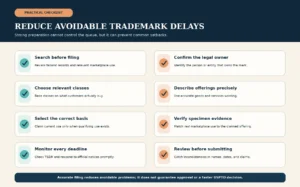
There is no legitimate method that guarantees fast USPTO approval. The practical way to save time is to reduce avoidable filing and response problems, without making inaccurate claims about use.
Before filing, research conflicting marks, confirm the actual owner, identify appropriate classes, and write accurate goods or services. Choose Section 1(a) only if the required use already exists; choose the correct basis if it does not. Prepare a valid specimen when required. After filing, monitor TSDR, respond to notices promptly, and meet any SOU deadlines. These steps can reduce avoidable delay, but they cannot control the examination queue or a third party’s opposition. USPTO tips for avoiding delays
Can You Expedite a Trademark Application?
There is generally no standard paid USPTO fast-track option that lets ordinary applicants pay extra to jump the queue. The USPTO does allow a Petition to Director requesting advancement of initial examination out of its regular order in limited circumstances. The current form asks the petitioner to select that specific request and provide the required fee and supporting evidence. USPTO petition guidance
The USPTO describes situations involving possible loss of substantial trademark rights, such as actual infringement or pending litigation. A planned advertising campaign and desire for a quick certificate do not qualify merely because the business feels urgency. The discontinued “Petition to Make Special” form should not be promoted as a current filing route. Even a granted request to advance initial examination does not guarantee registration or eliminate publication, opposition, or use requirements. USPTO petition guidance
What Can You Control vs What Can’t You Control?
| Mostly Outside Your Control | Things You Can Influence |
|---|---|
| USPTO queue, workload, and processing times | Completeness and accuracy of the application |
| Whether a third party seeks opposition | Clearance research before filing |
| Some examiner decisions and review intervals | Correct owner, classes, and goods/services wording |
| Time needed for an opposition or appeal | Specimen quality, response speed, and SOU deadlines |
These are influences, not guarantees: even an excellent application receives an independent legal review.
Does Filing More Trademark Classes Make Registration Take Longer?
More classes do not automatically add a fixed number of months. But each class can introduce additional goods or services wording, evidence needs, and possible examination issues. Filing unnecessary classes also raises per-class costs. If an application claims both downloadable software and SaaS, for example, the Class 9 and Class 42 descriptions and use evidence must each be examined on their own facts.
Start with the actual offerings, then consult Trademark Classes Explained and the Trademark Class Finder. You can also review Can You Add a Trademark Class After Filing? before assuming that a missing offering can simply be added later.
Does a Trademark Search Make Registration Faster?
A search does not move your application ahead of others in the USPTO queue. It may reveal an obvious earlier mark, making it possible to reassess a proposed name or the scope of an application before filing. It cannot predict every refusal, prove availability, or prevent an opposition. Its value is better decision-making before you incur filing costs and wait for examination.
How Do You Check Your Trademark Application Timeline?
Find your application’s serial number, then use the USPTO’s Trademark Status and Document Retrieval system (TSDR). The Status view shows the current stage; the Documents view includes correspondence such as Office Actions and publication or allowance notices. Check the record rather than relying only on an inbox alert, and keep your contact information current. After registration, the electronic certificate is available through TSDR. USPTO status guidance
How Long Does Trademark Protection Last Once Registered?
Federal registration can continue for many years if the owner continues to satisfy applicable use and timely maintenance requirements. Registration is not a one-time filing that stays active regardless of later use or deadlines. See Trademark Renewal Fees for the post-registration schedule and costs. USPTO maintenance guidance
Common Trademark Timeline Mistakes
- Filing = registration. A receipt is only a filing record.
- One timeline fits all. Filing bases, refusals, and challenges change the path.
- Old statistics still apply. Recheck the USPTO’s dated figures.
- Office Action responses can wait. Late responses risk abandonment.
- Publication = registration. The opposition opportunity comes first.
- Section 1(b) registers after publication. An NOA and SOU are still needed.
- Any specimen will do. Mockups or mismatched evidence can be refused.
- A paid fast track is routine. Petition relief requires special grounds.
- Status checks are optional. TSDR and notices reveal needed action.
Frequently Asked Questions About Trademark Processing Time
How long does it take to get a trademark?
There is no universal time. As of October 1, 2026, the USPTO averages 4.3 months to first examination and 10.4 months to registration or abandonment. Neither figure promises registration. Your filing basis, Office Actions, publication, and opposition determine your path. USPTO wait times
How long does a trademark application take?
Preparing the application depends on ownership, clearance research, classes, goods or services wording, filing basis, and any use evidence. After submission, the USPTO’s separate examination and publication processes begin. A filing receipt confirms that you submitted the application; it does not mean it has passed review.
How long does USPTO take to review a trademark application?
The October 1, 2026 USPTO average to a first examining action is 4.3 months. Some cases move sooner and others later. The first action may approve the mark for publication or identify issues requiring a response. It is not the date of registration. USPTO wait times
How long does it take to register a trademark?
Registration comes after examination and, if approved, publication with a 30-day opposition opportunity. A Section 1(a) use-based application can proceed toward registration after that. A Section 1(b) intent-to-use application needs an acceptable Statement of Use. Refusals or opposition may extend either route.
How long does an Office Action delay a trademark?
No fixed period applies. Time depends on the issue, applicant response, USPTO review, and whether another action follows. Most Section 1 or 44 pre-registration actions have a three-month response period with an eligible paid three-month extension; check your specific letter. USPTO response guidance
How long after publication is a trademark registered?
The opposition period lasts 30 days. The USPTO says official notice of registration or the next stage can take three to four months from publication. Section 1(a) may register; Section 1(b) receives an NOA and still needs an acceptable SOU. USPTO publication guidance
How long does an intent-to-use trademark take?
It depends on when qualifying use begins. After publication, Section 1(b) receives an NOA. The applicant initially has six months for an SOU or extension, and up to five consecutive six-month extensions may be available. Use and SOU review can substantially lengthen the process. USPTO ITU guidance
Can you expedite a trademark application?
Limited cases may support a Petition to Director to advance initial examination, with a fee and evidence of special circumstances risking substantial rights. A planned advertising campaign alone does not qualify. An accepted petition cannot guarantee registration or remove the ordinary legal stages. USPTO petition guidance
Is there a fast-track USPTO trademark process?
There is no generally available paid fast track for ordinary business filings. Exceptional grounds may support a petition to advance initial examination, but the USPTO decides whether to grant it. The application still needs examination, publication, and any relevant proof of use.
What is the fastest way to get a trademark?
File accurately for the proper owner, use a suitable basis, research conflicts, identify the actual offerings, and supply valid use evidence when required. Then monitor notices and respond promptly. These steps reduce avoidable delays; they do not move your application ahead of the ordinary USPTO queue.
Does filing more trademark classes slow down registration?
Not by a set number of months. Additional classes can require more precise descriptions and specimens, increasing the chance of an issue that needs correction. Choose classes based on the actual goods or services linked to the mark. Per-class fees also increase the filing cost.
Can a trademark be registered in only a few months?
An individual case may move faster than the averages, but it still needs examination and, if approved, publication with an opposition opportunity. No service can responsibly promise a particular short registration date. Use the latest USPTO data and TSDR status to plan.
How do I check my USPTO trademark application status?
Enter your application serial number in TSDR and review Status and Documents. Look for examination correspondence, Office Actions, publication and allowance notices, and any registration record. Calendar deadlines from the official notices rather than guessing from a general timeline. USPTO status guidance
Conclusion
The current USPTO averages provide a useful starting point, but there is no universal trademark-registration timeline. A Section 1(a) application already supported by real use can follow a shorter path than a Section 1(b) application waiting for launch and an acceptable Statement of Use. Office Actions and opposition can add further stages. Filing quality, accurate use evidence, prompt responses, and careful deadline tracking can reduce avoidable delays; the USPTO queue and third-party decisions remain outside your control.
Use the October 2026 processing figures as benchmarks, then check the live USPTO page and your own TSDR record for updates. This article is general educational information, not advice about a particular application’s legal outcome.
Ready to Start Your Trademark Application?
Contact EagleMarkUSA Trademark Registration Services for assistance with application preparation, class selection, goods and services wording, filing support, Office Action responses, and Statement of Use filings. No service can guarantee a USPTO approval date or registration.
