
You have chosen a brand, product, or service name and genuinely plan to launch it—but you are not yet using the mark in commerce. In this case, an intent-to-use trademark application may allow you to apply for U.S. federal registration before launch.
Filing basis is based on Section 1(b) of the Trademark Act. It does not mean the mark is registered, and it is not a way to reserve a name indefinitely. You must have a bona fide, good-faith plan to use the mark when you file. Before registration can issue, you must begin qualifying use in commerce and submit proof to the United States Patent and Trademark Office (USPTO).
This guide explains when Section 1(b) may make sense, how the process works, what the current 2026 government fees are, how extensions affect cost, and what you must prove after receiving a Notice of Allowance.
What Is an Intent-to-Use Trademark?
An intent-to-use trademark application allows a person or business with a genuine plan to use a mark in commerce to apply before qualifying commercial use has begun. The applicant selects Section 1(b) as the filing basis, completes the normal examination process, and later proves actual use before the USPTO can issue a registration.
What Is a Section 1(b) Trademark Application?
Section 1(b) is the U.S. filing basis for an applicant with a bona fide intention but no current qualifying use. The sequence is:
Intent first → actual qualifying use later → proof of use → registration
The USPTO examines conflicts and legal requirements without an initial specimen. Registration requires a later Amendment to Allege Use or Statement of Use.
Who Should Consider an Intent-to-Use Application?
Section 1(b) may fit a real launch that has not reached qualifying use, including:
- a startup preparing to launch after choosing its name;
- a physical product still in prototype or manufacturing development;
- a consumer brand arranging packaging, suppliers, or distribution;
- a restaurant or service business preparing to open;
- a software company building an app or SaaS platform; or
- an established brand making a documented expansion into a new product line.
It does not fit speculative name-holding and may be unnecessary for items already in Section 1(a) use. Never falsely claim current use to avoid ITU filings or fees.
What Does “Bona Fide Intent to Use” Mean?

Bona fide intent is a real, good-faith plan to use the mark for the identified goods or services—not a speculative wish.
The application includes a sworn statement. USPTO examination generally accepts it unless the record contradicts it, but intent may be challenged. Useful records include:
- business or launch plans;
- product development notes and prototypes;
- supplier or manufacturer communications;
- packaging and label development;
- website or software development records;
- market research and marketing preparation;
- distributor discussions; and
- applications for regulatory approval.
Records should relate to the listed goods and services and be consistent with the filing date. There is no universal checklist; the question is whether objective circumstances support a genuine use plan.
Intent to Use vs. Use in Commerce Trademark Applications
| Factor | Section 1(a) — Use in Commerce | Section 1(b) — Intent to Use |
|---|---|---|
| Current use at filing | Required | Not required |
| Bona fide intent | Not the basis | Required at filing |
| Initial specimen | Generally required | Generally not required |
| Later use filing | Usually unnecessary | AAU or SOU required |
| Extra ITU fees | None | Use filing and possible extensions |
| Timeline | May register after publication | Adds proof-of-use stage |
| Actual use | Already exists | Required before registration |
One application may use different bases for different items. Choose based on facts, not apparent cost or speed.
Can You Trademark a Name Before You Start Using It?
Yes. A qualifying applicant can file for a trademark before current commercial use by using Section 1(b), provided a bona fide intent to use the mark in commerce already exists.
Filing does not guarantee approval or create a registration. Refusals, opposition, and later proof of actual use still matter.
Does an Intent-to-Use Filing Give You Trademark Rights?
An ITU filing offers a conditional priority benefit. Under Section 7(c), filing on the Principal Register can constitute constructive use if the application matures into registration. The date may then support nationwide priority, subject to earlier use, applications, or qualifying foreign priority.
It is not immediate ownership. Senior rights may control, the USPTO may refuse, and third parties may oppose.
Complete Intent-to-Use Trademark Process
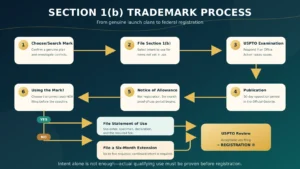
- Choose and search the mark; identify the planned goods or services.
- File a Section 1(b) application.
- An examining attorney reviews it and may issue an Office Action.
- If approved, the mark is published with a 30-day opposition period.
- If the application survives publication, the USPTO issues a Notice of Allowance.
- If use has begun, file an SOU; otherwise, request an extension of time.
- The USPTO reviews the use filing and, if all requirements are met, may register the mark.
How to File an Intent-to-Use Trademark Application
Step 1 — Confirm Bona Fide Intent
Confirm a real plan for every listed item and retain dated records.
Step 2 — Identify the Correct Applicant or Owner
Name the person or entity entitled to use the mark; some ownership errors cannot be corrected.
Step 3 — Search the Trademark
Search USPTO records and the marketplace for conflicts.
Step 4 — Identify the Goods and Services
Describe the offering precisely; vague wording may be rejected, and scope generally cannot be broadened later.
Step 5 — Select Appropriate Trademark Classes
Select classes for the exact offering; downloadable software and SaaS may differ. Review Trademark Class Finder, Trademark Classes Explained, and relevant class guides.
Step 6 — Select Section 1(b) Where Appropriate
Choose Section 1(b) for goods or services not yet in qualifying use. Different items in one application may need different bases.
Step 7 — Complete the Current USPTO Application
File new applications in Trademark Center. Because later forms are still moving from TEAS in 2026, check the current USPTO forms page when another filing becomes due.
Step 8 — Pay Government Fees
Pay the per-class fee. Extra fees may apply for certain missing information or free-form identification wording.
Step 9 — Monitor the Application
Save the serial number and monitor TSDR for documents and deadlines. See How Long Does It Take to Get a Trademark?
How Much Does an Intent-to-Use Trademark Cost?
2026 USPTO Government Fees
| Filing | Electronic fee |
|---|---|
| Base trademark application | $350 per class |
| Amendment to Allege Use | $150 per class |
| Statement of Use | $150 per class |
| Six-month Statement-of-Use extension request | $125 per class |
These October 2026 USPTO fees exclude professional and possible additional application fees. Recheck the fee schedule before filing.
One-Class ITU With No Extension
$350 application + $150 Statement of Use = $500 in base government fees.
One-Class ITU With One Extension
$350 application + $125 extension + $150 Statement of Use = $625.
One-Class ITU With Two Extensions
$350 application + $250 for two extensions + $150 Statement of Use = $750.
Examples assume one electronic class with no extra division, petition, opposition, or professional fees. See Trademark Cost.
Why Trademark Classes Affect Intent-to-Use Cost
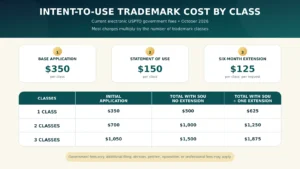
Application, AAU, SOU, and extension fees are charged per class.
| Classes | Initial application | SOU with no extension | One extension plus SOU | Base total with one extension |
|---|---|---|---|---|
| 1 | $350 | $150 | $275 | $625 |
| 2 | $700 | $300 | $550 | $1,250 |
| 3 | $1,050 | $450 | $825 | $1,875 |
Cover only items supported by a real plan. Use Trademark Class Finder and Trademark Classes Explained.
What Happens After You File a Section 1(b) Application?
USPTO Examination
An examining attorney reviews formal requirements, the goods and services, classification, conflicts, descriptiveness, specimens where relevant, and other registrability issues.
Possible Office Action
An Office Action states procedural requirements or legal refusals. Address every issue by its stated deadline. See Trademark Office Action Response.
Publication and Opposition
If approved, the mark is published in the Trademark Official Gazette for a 30-day opposition period.
Notice of Allowance
If no opposition blocks it, the USPTO issues an NOA and the proof-of-use stage begins.
What Is a Notice of Allowance?
A Notice of Allowance (NOA) means the application passed examination and publication. It is not registration.
The NOA starts a six-month period to file an SOU or extension. Calendar its issue date.
What Happens After the Notice of Allowance?
NOA issued → Are all covered goods or services in qualifying use?
- Yes: file a Statement of Use with the required declaration, use dates, specimen, goods or services, and per-class fee.
- No: file a timely six-month extension request for the goods or services not yet in use, or evaluate deletion or division where appropriate.
For a detailed filing guide, see Trademark Statement of Use: How to File, Fees, Deadline & Example.
How Long Do You Have to Prove Use?
Within six months of the NOA, file an SOU or extension request.
Up to five six-month extensions may be requested, creating a maximum 36-month SOU window from the NOA. Each timely request needs the required verified statement and per-class fee; extensions are not automatic.
How Do Intent-to-Use Extensions Work?
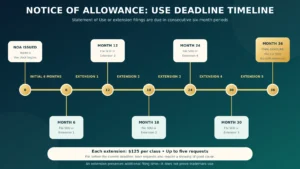
The timeline is:
NOA → first 6 months → Extension 1 → Extension 2 → Extension 3 → Extension 4 → Extension 5 → final deadline
The first extension requires verified continued bona fide intent. Four later requests also require good cause, such as ongoing research, manufacturing, promotion, distribution, or regulatory work.
At $125 per class, five extensions add $625 per class before the $150 SOU. Missing a deadline can cause abandonment.
What Is a Statement of Use?
An SOU is a verified claim that the mark is now used in commerce. It includes:
- a declaration of use;
- dates of first use anywhere and in commerce;
- the goods or services for which use is claimed;
- at least one acceptable specimen for each class; and
- the current per-class fee.
The USPTO reviews the SOU and may issue an Office Action; filing does not guarantee registration.
Do You Need a Trademark Specimen for an Intent-to-Use Application?
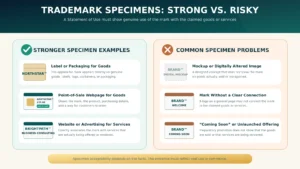
Initial Section 1(b) Filing
Generally, no current-use specimen is required because the application is based on intent rather than existing use.
Statement of Use Stage
A specimen becomes essential. Goods examples include labels, packaging, or a qualifying sales page; services may use advertising that directly associates the mark with rendered services. Mockups or altered images may be refused.
See Trademark Specimen Explained for examples and common specimen problems.
What If Only Some Goods or Services Are in Use?
If an application lists T-shirts, hats, and footwear but only T-shirts have launched, do not claim all three.
Options may include deletion, an extension, or division so portions proceed separately. Division adds procedure and fees. Review the facts before the deadline; see Can You Add a Trademark Class After Filing?
How Long Does an Intent-to-Use Trademark Take?
There is no universal timeline. Examination and publication are followed by the NOA and proof-of-use stage. Office Actions, opposition, extensions, or SOU problems add time.
Filing proof soon after the NOA is usually faster than using several extensions. See How Long Does It Take to Get a Trademark?
Can You Change From Intent to Use to Use in Commerce?
Yes, but the correct filing depends on timing.
Before Notice of Allowance
If qualifying use begins after filing but before the examining attorney approves the mark for publication, an Amendment to Allege Use may be filed. It requires use dates, specimens, a verified statement, and the $150-per-class electronic fee.
After Notice of Allowance
After the NOA issues, the applicant generally files a Statement of Use. An Amendment to Allege Use cannot be used after approval for publication merely because the NOA has not yet arrived; the applicant normally waits for the SOU stage.
Can You Transfer an Intent-to-Use Trademark Application?
Section 1(b) applications have a special restriction before an acceptable allegation of use is filed. They generally cannot be freely assigned at that stage, except to a successor to the applicant’s ongoing and existing business—or the relevant portion of that business—to which the mark pertains.
An improper pre-use assignment can threaten the application. Obtain fact-specific guidance before selling, transferring, reorganizing, or moving an ITU application between entities.
What Happens If You Never Start Using the Trademark?
An intent-to-use application cannot reserve a mark forever. If qualifying use never begins, or the applicant fails to file a timely SOU or extension request, the application can become abandoned. The applicant may have limited petition options in some circumstances, but revival is not automatic and does not replace a genuine use plan.
Advantages and Disadvantages of an Intent-to-Use Trademark Application
| Potential advantages | Potential disadvantages |
|---|---|
| Apply before launch | Registration cannot issue until use is proven |
| Potential priority benefit tied to filing date if registration issues | Additional filings and per-class fees |
| Supports early brand planning | Longer and more deadline-heavy process |
| Allows time for development after filing | Specimen and use requirements still apply |
| May help coordinate launch and brand investment | Risk of abandonment if use or deadlines fail |
Common Intent-to-Use Trademark Mistakes
| Mistake | Practical risk |
|---|---|
| No bona fide intent | Speculative filing leaves the application vulnerable; retain records for each item. |
| Wrong applicant | Some ownership errors cannot be corrected. |
| Treating filing as registration | A pending application is not a registration; constructive priority is conditional. |
| Ignoring an Office Action | Unresolved issues or a missed deadline can cause abandonment. |
| Missing the NOA deadline | The clock runs from the NOA issue date. |
| Assuming automatic extensions | Each needs a filing, declaration, and fee; later requests require good cause. |
| Premature SOU | A placeholder or token activity may not establish use. |
| Invalid specimen | Mockups or materials disconnected from real commerce can be refused. |
| Claiming unlaunched items | Claim only items in qualifying use; consider deletion, extension, or division. |
| Forgetting per-class fees | Costs multiply across classes. |
| Improper assignment | Pre-use transfers face statutory restrictions. |
Can You File an Intent-to-Use Trademark Yourself?
Yes. Applicants can file a Section 1(b) application themselves. The harder questions often involve the correct owner, goods and services wording, classes, clearance conflicts, mixed filing bases, Office Actions, specimens, partial use, and assignments.
A straightforward one-class application may be manageable for a careful applicant. A multi-class launch or ownership issue may justify professional review. Foreign-domiciled applicants must be represented by a U.S.-licensed attorney before the USPTO.
When Should You Consider Professional Help?
Consider assistance when:
- the application spans multiple classes;
- the filing basis or owner is unclear;
- a search reveals similar marks;
- the goods or services are complex;
- the USPTO issues a substantive Office Action;
- only part of the application is in use;
- an SOU deadline is approaching; or
- the application may be assigned or transferred.
Need Help Filing an Intent-to-Use Trademark?
EagleMarkUSA can assist with filing-basis review, application preparation, goods and services wording, trademark classes, Office Action support, and Statement of Use filings. No service can guarantee USPTO approval, but careful preparation can reduce avoidable errors.
Frequently Asked Questions About Intent-to-Use Trademarks
What is an intent-to-use trademark?
It is a Section 1(b) application filed before qualifying use begins. The applicant must genuinely intend to use the mark and later prove actual use before registration.
What is a Section 1(b) application?
It is the federal filing basis for an applicant who genuinely plans to use a mark but has not yet begun qualifying use for the listed goods or services.
Can I trademark a name before using it?
Yes, with a bona fide plan to use it in commerce. Filing is not registration; the USPTO requires proof of actual use before a Section 1(b) registration issues.
What does bona fide intent mean?
It means a real, good-faith commercial plan rather than a speculative name reservation. Dated development, supplier, packaging, marketing, or regulatory records may support it.
What is the difference between intent to use and use in commerce?
Section 1(a) requires current qualifying use and a specimen. Section 1(b) allows filing before use but later requires a use allegation, specimen, and fee.
Do I need a specimen when filing Section 1(b)?
Generally no. A specimen is required later with the Amendment to Allege Use or Statement of Use and must show real use with the relevant goods or services.
How much does an intent-to-use trademark cost?
As of October 2026: $350 per class to apply, $150 per class for an SOU or AAU, and $125 per class for each six-month extension. Other charges may apply.
How long does an intent-to-use trademark take?
Timing depends on USPTO processing, Office Actions, opposition, launch readiness, extensions, and SOU review. Waiting to establish use can substantially lengthen the process.
What is a Notice of Allowance?
An NOA means the application passed examination and publication. It is not registration; it starts the six-month period to file an SOU or extension.
How many Statement of Use extensions can I request?
Up to five consecutive six-month extensions may be requested, allowing a maximum of 36 months from the NOA date to file the SOU.
What happens if I am not using the mark after six months?
Timely file an extension with the verified statement and per-class fee. Later extensions also require good cause and continued bona fide intent.
What is a Statement of Use?
An SOU is a verified post-NOA claim of actual use, including use dates, covered goods or services, specimens, and the required fee.
Can I change from intent to use to actual use?
Yes. Before approval for publication, use an AAU where appropriate; after the NOA, generally use an SOU. Timing controls the route.
Can I transfer an intent-to-use application?
Possibly, but pre-use assignments are restricted and generally must involve a successor to the relevant ongoing and existing business. Review the facts before transferring.
What happens if I never use the trademark?
Intent alone cannot support registration. If use never begins and SOU or extension requirements are not met, the application can become abandoned.
Intent-to-Use Filing: The Bottom Line
Section 1(b) lets an eligible applicant pursue a federal trademark before current use begins, but it is not a permanent name reservation. A genuine bona fide intent must exist when the application is filed. The USPTO will still examine the mark, and actual use must later be proven through an acceptable Amendment to Allege Use or Statement of Use.
Budget for the $150-per-class use filing and any $125-per-class extensions, monitor every deadline, and claim use only for goods or services genuinely in commerce. The correct owner, identification, classes, specimen, and assignment decisions can materially affect the application.
Ready to File an Intent-to-Use Trademark?
Contact EagleMarkUSA for help with filing-basis selection, trademark classes, goods and services wording, application preparation, Office Action support, and Statement of Use assistance. Results depend on the facts, and USPTO approval cannot be guaranteed.
This article provides general educational information, not legal advice. Trademark requirements and fees can change; confirm current information with the USPTO or a qualified U.S. trademark attorney for your situation.
Primary Sources
- USPTO: Trademark applications—intent-to-use basis
- USPTO: Section 1(b) timeline
- USPTO: Intent-to-use forms
- USPTO: Current fee schedule
- TMEP Chapter 1100: Intent-to-Use Applications
- TMEP §201.02: Constructive Use Priority
- TMEP §501.01(a): Assignability of Intent-to-Use Applications

Pingback: How Much Does It Cost to Renew a Trademark in 2026?
Pingback: How Long Does It Take to Get a Trademark? USPTO Timeline