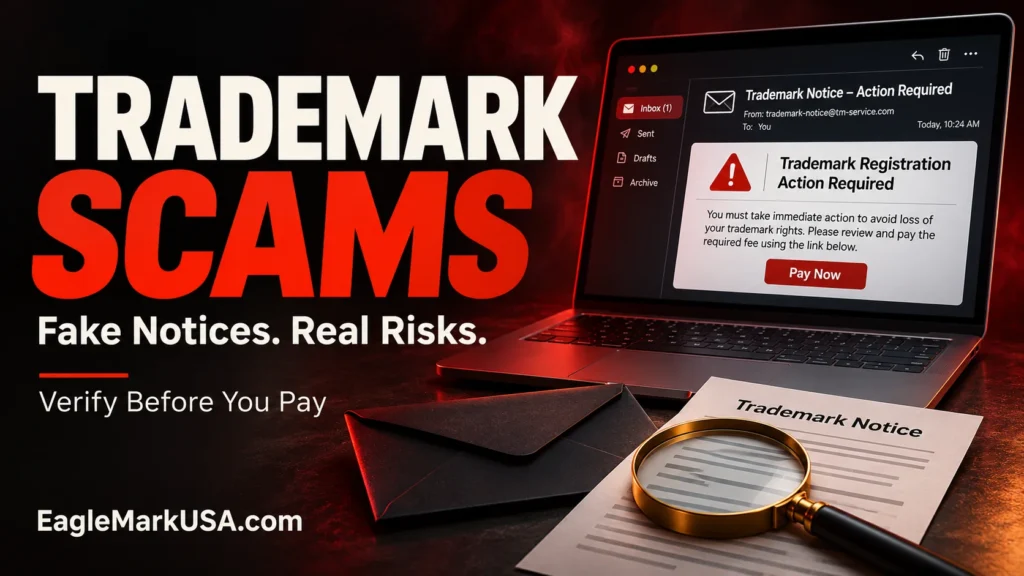
Trademark scams work because they often look authentic. The message may contain your trademark name, serial number, filing date, or owner information and still be fraudulent or misleading.
The vast majority of information contained in trademark applications and registrations is a matter of public record. Scammers can copy those details into emails, letters, invoices, phone scripts, and text messages that look convincing. They could also copy the agency’s branding, or even pose as a real employee.
Begin with independent validation. Don’t pay or share account credentials or click on an unsolicited payment link just because the sender knows your case number. At the same time, don’t dismiss a possible real deadline without checking it.
This guide is a repeatable checklist to help check trademark communications, private service offers, attorney claims, and payment requests. Also, it tells you what to do if you have already paid. The information is educational, not a finding a particular sender committed fraud or legal advice regarding your case.
Check your notice with our free Trademark Scam Checker.
What is a trademark rip-off?
A trademark scam is a scheme that seeks to fraudulently obtain money, information or access to an account by making claims related to trademarks. This could include pretending to be a government official, sending fake invoices, making up deadlines, suggesting unnecessary services as if they were needed, or providing false registration information.
Private companies can provide legitimate services. Confusing marketing does not prove fraud; look at specific claims and evidence.
Why Target Trademark Holders
Public records provide names, addresses, marks, dates, serial or registration numbers, and status – all information that personalizes a trademark scam email.
Correct information does not make the sender legitimate. They know the examiner’s name, but that doesn’t mean they have authority to collect money. See USPTO’s common scam warnings.
The Most Frequent Trademark Frauds
Identify the claim being made, then use the verification checklist below.
Phony USPTO Emails
Pretending to be an agency to ask for payments or data.
Fake USPTO Calls
Spoofed numbers and real case details.
Fake Office Actions
Invented trademark examination requirements.
Fake Renewal Letters
Misstated maintenance obligations or recipients
Trademark Publication and Directory Frauds
Optional listings presented as compulsory.
Invoices for Trademark Monitoring
Subscriptions not ordered, shown as debts.
Scams: “Someone Else Is Filing Your Trademark”
Claims about competing applicants used to pressure you into paying.
Misleading Filing Services
Hidden charges or unauthorized representation.
Assured Registration Claims
Guaranteed approval promises.
False claims by attorney or representative
The identities of professionals are faked or abused.
Fake websites and payment pages
Lookalike sites stealing money or credentials.
Emails on the “Someone Else Is Filing Your Trademark” Scam
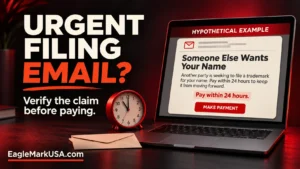
The sender claims that another company wants your name and asks you to pay within 24-72 hours to keep it. It may claim it held back the competing filing.
A marketer’s deadline is not necessarily a USPTO deadline. Check the allegation
- Open USPTO Trademark Search in a new window.
- If applicable, search the alleged conflicting mark and variations.
- Search the real application’s owner, filing date, goods or services, and status.
- Don’t trust the sender’s screenshot; open its full record.
- Assess real conflict separate from sales demand.
A real application does not authenticate the payment request. Finding no result does not rule out future filings or unregistered rights.
For more extensive research, see our Trademark Clearance Search guide. The USPTO specifically warns against competing-filing pressure tactics; paying the marketer is not a substitute for evaluating rights.
Fake USPTO Emails
A fake USPTO notice can copy seals, examiner names, government language, or email threads. Check the full sender and reply-to addresses, not just the display names.
The USPTO says emails directly from the agency will end in @uspto.gov. Looks aren’t everything. If in doubt, compare the claimed formal correspondence with the TSDR and contact the agency.
Do not respond with passwords, credit-card details, or Social Security numbers. The USPTO’s guidance on impersonation emails lays out those requests and the verification steps.
Received a message connected to OfficialUSPTONotices.com? Read our OfficialUSPTONotices.com verification review for the findings, evidence limits, and checks to complete before responding.
Bogus Phone Calls and Text Messages from the USPTO
Caller ID is no guarantee that the USPTO is calling. Spoofing can make a call appear as if it’s from a legitimate government number, name, and location.
An examiner may contact an applicant regarding a case, but USPTO employees do not collect personal or payment information by telephone, email, or text. Hang up and verify unexpected payment demands or cancelation threats yourself.
Use the number from an actual Office Action from TSDR or the official Trademark Assistance Center contact page. See USPTO’s warning about spoofed calls.
Fake Office Action
A fraudulent notice may be a rejection, a deadline for response, or a “verification fee.” It may request account information or payment via a link.
Go to the Documents tab of TSDR and get the actual Office Action and compare its issue date, requirements, and response instructions. If there is no match, check with the official. Separate documents may not be generated for routine interactions. Check the claimed requirement.
Meet any confirmed deadline. Refer to our guide, Trademark Office Action Response, to learn how to respond.
Trademark Renewal & Maintenance Fake Notices
Suspicious notices may arrive well in advance of any real deadline, look like government invoices, or combine a large service charge with an unexplained “official” fee.
Independently verify the date of registration, any maintenance requirements, and official correspondence. Compare government fee with USPTO fee information. Request separate service-fee breakdown.
Private providers may charge service fees, but disclosure alone does not establish that a service or charge is legitimate. The problem is misrepresentation of sender, obligation, or price. See Fees for Trademark Renewal. A threatening e-mail, by itself, does not create grounds for Trademark Cancelation.
Trademark Publication and Directory – Scams
Trademark scam publications may be a private registry, international directory, unofficial database or a paid listing presented as required protection.
The USPTO does not officially require a fee for a private publication or directory. Publication in the USPTO’s Trademark Official Gazette is not the same as purchasing an entry in a private directory.
Review the operator, deliverable, and optional service disclosures. An official-sounding directory name does not create a government filing requirement or make its fee mandatory. Check out current examples of warnings on USPTO’s scam resources.
Fake Trademark Monitoring Bills
Monitoring can be a legitimate optional service. A misleading invoice may falsely imply that you ordered it or must pay to maintain your registration.
Check purchase history, contracts, renewals of subscription, and provider identity. Ask for proof of authority; an “invoice” alone does not establish a debt.
Misleading “Official” Trademark Company Names
Words such as United States, Federal, Trademark, Office, Bureau, Registry, or Agency may appear in private business names. A government-sounding name does not mean a government agency.
Check the business identity, private-service disclosures, and actual role. The flags, seals, and formal typography are not indications of any affiliation with the USPTO.
Low-Cost Trademark Filing Scams and Deceptive Services
A low price alone does not establish a trademark filing scam. Review the total cost and scope, including government fees, searches, classes, representation, responses, subscriptions, refund terms, and extras.
Beware of hidden upsells, attorneys you can’t verify, unclear filing responsibility, surprise fees, and unexplainable requests for identity information.
Separate legal representation from administrative support. Non-attorney staff can’t just step in for your trademark attorney. USPTO filing-firm guidance covers attorney involvement, signatures, and concerns about unauthorized practice. Check out Trademark Registration Cost review for fee comparison.
Trademark Registration Guaranteed Claims
No legitimate trademark service can promise USPTO registration. The examination will be based on the mark, existing rights, distinctiveness, filing basis, specimens, and other legal requirements. Third-party opposition can matter as well.
Guaranteed approval is not a refund policy or a promised deliverable. Get the terms in writing. Our guide on Trademark Opposition explains one way to challenge it after publication.
Claims by Fake Attorney or Representative
Get the lawyer’s name, jurisdiction, bar info, firm, and position. Check eligibility through official licensing records, then use independently obtained contact details to confirm the attorney’s involvement.
A copy of an attorney’s name or record is not evidence of authorization or representation.
“Legal team” is no license. Start with the practitioner guidance for licensing checks.
How to Tell if a USPTO Notice is Real
Before you pay or share any information:
- Look up the record. Open TSDR separately, and enter your serial or registration number.
- Compare correspondence. Open the Documents tab and match the claimed notice, issue date, requirement, and deadline.
- Check the domain. Start at uspto.gov. The address uspto.gov.example.com is a subdomain of example.com, not uspto.gov.
- Do not use provided payment links. Look up filings on the official website.
- Compare deadlines to actual correspondence.
- Check official correspondence or attorney license records to confirm identities.
- See the fees. Separate government charges from services; establish what is owed.
- Get contacts yourself, not through the dodgy message.
- If you get a letter you don’t recognize, contact the Trademark Assistance Center.
- Get qualified legal advice on disputed filings, rights, or time limits.
Act on known requirements. Do not pay without checking and clarifying. Reporting suspicion does not stop real deadlines.
Legitimate USPTO Correspondence vs. Dubious Correspondence
| Legitimate or verifiable independently | Indicators Under Further Verification |
|---|---|
| The stated need is consistent with the official record. | No matching official requirement can be found. |
| Agency contact independently verified | Sender uses copied branding or lookalike domain. |
| Deadline matches official correspondence | Sales pressure for 24-72 hrs unexplained |
| Request reason is specific | Indistinct threats of immediate loss |
| Outcome remains subject to examination | 100% Approval Guaranteed |
| Official fees go the right USPTO filing route | Unsolicited request for crypto, gift cards, or transfer of funds |
| Contact information can be confirmed independently | Sender demands to use its link or number only |
Private providers normally use private domains. Check whether they falsely claim government affiliation; a private domain alone is not suspicious.
How to Know If a Trademark Company Is Legit
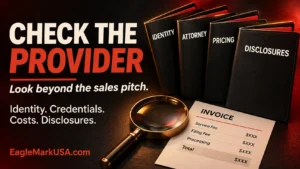
Look at indicators together. One website, one registered entity, or one review means little.
Company Identity
Determine the contracting legal entity.
Domain & Website
Review disclosures and contacts. HTTPS encrypts the connection; it does not establish that a business is trustworthy.
Participation of the Attorney
Confirm the named representative and actual participation.
Price Transparency
Ask for a detailed list of government fees, service charges, and extras.
Refunds Policy
Learn about refund eligibility, exclusions, and nonrefundable charges.
Revelation of Private Service
Look for clear disclosure that the company is a private provider.
USPTO Disciplinary or Sanction History
Utilize the USPTO’s protection resources and decisions. Look at the scope of the order. Find the exact entity. Not on a list does not mean it’s certified.
Unbiased Reviews
Look for specific, consistent stories; reviews don’t constitute a legal finding.
Warranties and Claims
Question claims of guaranteed approval, privileged access, or government partnership.
10 Trademark Scam Red Flags
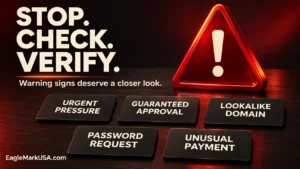
- Urgent pressure unsupported by the official record.
- A competing-filing threat is used to extract payment.
- Registration guaranteed.
- Unverified claims of USPTO affiliation
- A lookalike domain presented as an official government address.
- A compulsory requirement that can not be checked.
- Unusual payment requests.
- Login codes or password requests.
- An attorney who is an unidentified or unconfirmed participant.
- Optional services disguised as mandatory.
These indicators need to be checked, not automatically assumed to be fraud.
Payment Methods That Should Draw Your Attention
Be especially cautious of unsolicited requests for wires, gift cards, cryptocurrency, payment-app transfers, urgent telephone payments, or unfamiliar payment links.
A payment method alone does not prove fraud by a private business. The USPTO does not require gift cards or transfers to third parties. If the relevant filing is available in Trademark Center, please use that; otherwise, independently reach official electronic filing services.
Do not tell anyone your USPTO.gov password. Your attorney uses his/her own account (not your own). See USPTO’s guidance on protecting an account.
What To Do If You Have Already Paid A Suspected Trademark Scammer
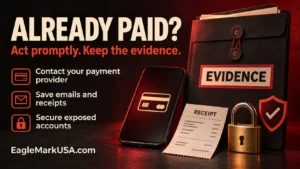
- Stop further payments. Do not pay a second demand just to get the first payment released.
- Contact the payment provider right away. Explain the circumstances and inquire about cancellation/reversal/dispute options.
- Preserve evidence. Retain original emails, envelopes, invoices, receipts, transaction details, and screenshots
- Lock down exposed accounts. Change any passwords that may have been compromised, including those that are reused, and protect your authentication methods.
- Review USPTO access and records. Check correspondence details, representatives, and unexpected filings. Contact USPTO support about suspected misuse.
- Verify actual trademark requirements. That someone was paid does not mean a filing was made.
- Report fraud. Use the appropriate official channels below.
- Seek legal advice as appropriate. For large payments, unauthorized filings, or disputed representation, a professional review may be required.
The recovery is uncertain. The FTC’s recovery guidance includes steps specific to payments, while the USPTO’s response checklist includes trademark records and reporting.
How to Report a Trademark Scam 101
- USPTO: Email TMScams@uspto.gov. The agency asks for the original email as an attachment for suspicious emails so technical details are preserved.
- FTC: Report it at ReportFraud.ftc.gov.
- Payment provider: Report the transaction directly via independently verified channels.
- Other relevant authorities: Depending on the alleged conduct, the FCC for spoofed calls, USPIS for mail fraud, FBI IC3 for internet crime, or state consumer protection and attorney disciplinary authorities.
Find the channel on the USPTO reporting page. Reporting does not guarantee recovery or resolution of disputes.
Trademark Scams Examples
These are fictional examples.
Example 1: Competing Trademark Filing Urgently
You get an email demanding payment today to prevent another company from taking your name. Don’t take its sales deadline as a fact; check the alleged application and sender yourself.
Example 2: Renewal invoice (fraudulent)
A letter. Like a government letter. Requires a big payment to renew. Check registration dates, maintenance obligations, sender identity, and government/service fee split.
Example 3: Phony Office Action
You got an email saying that if you don’t pay in 48 hours using the link they gave you, they will cancel your trademark registration. Check the actual correspondence in TSDR and verify any requirement with official contacts.
Example 4. Publishing Directory Invoice
A private directory presents its paid listing as mandatory. Go read the disclosure and see if there’s any real USPTO requirement.
Example 5: Guaranteed Registration Service
Company says it will approve everyone. Ask for the written scope and attorney details; a refund policy doesn’t guarantee the agency’s decision.
FAQs on Trademark Scams
What is a trademark scam?
It’s a false demand or offer related to a trademark to obtain money, information, or access. Examples include fake government notices, bogus fees, fake attorneys, and optional services presented as required. A private solicitation isn’t automatically a fraud. Look at its claims and check out the sender.
How to know if a trademark email is a scam?
Verify the full sender and reply-to addresses, and then verify any claimed formal requirement in TSDR. Check the deadlines and contacts yourself. Copied seals, correct case details, or an apparently familiar sender are not authentication of the email. Don’t pay or give sensitive information until the uncertainty is cleared.
Does the USPTO send trademark owners emails?
Yes. There are real agency emails, so you cannot dismiss every trademark email. Emails from the USPTO will come directly from @uspto.gov. Verify suspicious requests independently; don’t assume based on appearance. Access formal notices through official systems. Contact the agency through any information other than what is in the message.
Does the USPTO call trademark owners?
Yes, there can be legitimate case-related calls. Caller ID can be spoofed, however, and USPTO employees do not collect personal or payment information over the phone. If you suspect a call, hang up and contact the agency or the examiner identified in legitimate correspondence on your own.
What if someone else is filing my trademark?
Check official records and review the owner, date, offerings, and status of any actual application. A competitive application is worth checking out, but it does not validate the marketer or its payment request. Don’t pay simply because a message imposes an unexplained short sales deadline.
How do I check a USPTO notice?
Open TSDR in a separate window and type in your serial or registration number and compare the formal notice claimed with the Documents tab. Confirm the date of issue, requirement, and deadline. If in doubt, contact the official agency’s contact details, not the phone number or payment link in the suspicious message.
Are trademark notices of publications valid?
Some are actual USPTO publications; some are advertisements for private listings. Check who sent the notice and if the service is optional. An international directory or private registry charge is not necessarily a USPTO requirement. Check the official record before treating an invoice as mandatory.
Is it legal to use private trademark filing companies?
Private companies can provide legitimate services, but the role they play and the authority they have matters. Administrative support is not the same thing as legal advocacy. If there is a claim of representation, verify the attorney responsible is licensed to practice in the U.S. and the real arrangement. A company’s branding may sound like a government, but it is not an agency, and it does not have the authority to practice law.
Can anyone guarantee trademark registration?
No provider can have control over the USPTO examination and any third-party challenge. Guaranteed registration is not the same as a clearly stated promise of refund or rework. Read the terms and exclusions, check for professional involvement, and ask questions about any claims that payment alone will guarantee approval no matter the mark and record.
Can my real trademark information be used by scammers?
Yes. Public records can provide names, filing dates, mark details, serial numbers, and registration information. These details can make a fake notice sound plausible. They do not establish the sender’s identity, their affiliation with the government, their authority to act on your behalf, or their right to payment.
How reliable is USPTO caller ID?
Caller ID cannot reliably authenticate the caller. Technology can show an incoming call from an actual agency number or employee identity. Verify the call independently before sharing information or taking action. Do not trust the number shown. Obtain the contact information from the USPTO website or from legitimate official correspondence.
What to do if you paid a trademark scammer?
Contact your payment provider immediately. Keep any evidence. Secure any accounts that may have been exposed. Find out what was actually filed. Report suspected fraud to the USPTO and the FTC. Consult your lawyer if filings or rights may be impacted. Payment disputes and claims of fraud do not guarantee recovery or extend deadlines.
How to Check a Trademark Attorney?
Ask for the full name and where they are licensed. Check the official state licensing directory to verify eligibility. Talk to the attorney directly to make sure they are connected with the business and your case. A website biography, copied bar number, or name on a record alone is not enough.
Where do I report a trademark fraud?
Report suspicious trademark communications to TMScams@uspto.gov and consumer fraud to ReportFraud.ftc.gov. If you sent the money, contact the payment provider too. Mail. Internet crime. Spoofed-call. State consumer-protection or disciplinary authorities. It is contingent upon the facts. Retain the original proof of communication and transaction.
Conclusion
Trademark scams can be slick and have accurate information. Appearance is a weak basis for trust, given public filing details, copied branding and spoofed caller ID. An urgent message should prompt verification, not an automatic payment or an automatic decision to disregard it.
See the official record. Look up the actual requirement and when it’s due. Get the contact info yourself. For private services, know who you are contracting with, know the price, and check any claims of attorney involvement. No service can guarantee registration, and a trust badge or customer review alone does not establish reliability.
If you’ve paid already, or shared access, act fast: contact the payment provider, preserve evidence, secure accounts, and review the trademark record. Reporting is useful for documenting suspected misconduct, but is not a substitute for meeting an actual filing deadline. Apply the same evidence-based checks to every provider, even one you know already.
Wondering if a Trademark Notice or Service is Legit?
Call EagleMarkUSA to help organize suspicious notices, check trademark status, correspondence, and filing-service claims. Legal questions or disputes should be reviewed with a qualified US licensed trademark attorney. EagleMarkUSA is a private service, not the USPTO. A review does not guarantee registration or determine that a third party committed fraud.

Pingback: Trademark Office Action Response: How to Respond to the USPTO
Pingback: How Much Does It Cost to Renew a Trademark in 2026?
Pingback: OfficialUSPTONotices.com Scam or Legit? What We Verified