
You pull up a USPTO Office Action and see “Section 2(e)(1): merely descriptive.” The examining attorney thinks your proposed mark immediately tells something about your goods or services to purchasers, not that the mark itself identifies the source of those goods or services. That is a refusal to register the mark on the Principal Register as filed. It is not necessarily the end of your application.
The answer depends on your actual mark, the goods or services listed in the application, and the evidence cited by the examiner. A term may characterise one offering, and may be unique for another. “Descriptive” is also not the same as “generic,” which is a simpler problem for registration.
This guide explains how the USPTO evaluates descriptiveness, how to understand the evidence in an Office Action, and when arguments about suggestiveness, a Section 2(f) claim, the Supplemental Register, or a different brand may be appropriate. These are educational choices, not a claim that any one answer will work.
What is a descriptive trade mark?
A descriptive mark, in contrast, directly describes an ingredient, quality, characteristic, feature, function, purpose or use of the goods or services mentioned in the application. For example, the label on paint marketed as drying fast would likely convey a product feature to buyers with little mental effort. This is a hypothetical example, not a decision on an actual application.
The USPTO considers the proposed mark as a whole and in context. It does not enquire whether the phrase sounds distinctive when divorced from the product. A descriptive mark may become registrable on the Principal Register with a showing of acquired distinctiveness, or may be registrable on the Supplemental Register in an eligible application. The Trademark Classes Explained guide and Trademark Class Finder can help you identify the offerings at issue; the words of the identification are more important than the class number. TMEP § 1209.01.
Section 2(e)(1) Trademark Refusal: What Does It Mean?
If the proposed mark is merely descriptive of the identified goods or services, the examining attorney will rely upon the legal basis outlined in Section 2(e)(1) of the Trademark Act. The provision also applies to deceptively misdescriptive language: language which reasonably describes a feature that the goods or services do not in fact have. The two grounds are distinguished in analysis. The article is concerned only with descriptiveness. TMEP § 1209.01(b).
Read the full Office Action. A descriptiveness refusal may be accompanied by a specimen, identification, disclaimer, or other problem. The response shall address all outstanding items. See the Trademark Office Action Response for the complete filing process.
Why Does the USPTO Reject Merely Descriptive Trademarks?
Businesses need common words for what they sell. If one applicant were permitted to obtain exclusive rights in a phrase that buyers understand primarily as a product description, competitors could be hamstrung in describing their own wares.
Thus, the USPTO enquires whether the proposed wording serves as a source identifier or merely informs about the goods or services. Descriptive language is not necessarily worthless as a brand. The registration route may be contingent on whether consumers have associated it with a particular source. A generic term, in contrast, names the category itself, and cannot be registered for that category just because of heavy advertising. USPTO: Trademarks with Strength.
How Does the USPTO Determine Whether a Trademark Is Merely Descriptive?
Mark is Used in Connection with Goods or Services
Application Identification: CLOUD STORAGE has a different implication for a hosted file-storage service than it does for unrelated physical goods. The relevant purchaser is the purchaser who would understand what the mark was in relation to the listed offering upon encountering the mark, not every possible interpretation of the words.
Does the Mark Transmit Instant Information?
The key question is whether buyers would quickly grasp a key attribute, feature, function, purpose, ingredient or quality. The examiner is not required to show that the proposed mark describes every aspect of the business.
Does the Consumer Need Imagination or Thinking?
A suggestive mark hints at a quality by an indirect idea or mental step. A purely descriptive mark is a more direct transmission of the information. The line is thin; a clever story of marketing developed after the fact does not mean that the consumer has to make that leap.
What Does the Relevant Consumer Understand?
Industry language may be understood differently by specialised buyers than by the general public. Technical terms, common usage, industry context, and the way the applicant describes its own offering may all be relevant. The analysis concerns the probable perception of the relevant purchasers.
A Mark Doesn’t Have to Describe Everything
To justify a refusal, you need only cite one important feature. So, if the examiner’s evidence shows that the wording immediately describes a meaningful feature, “but our product also does much more” is a weak answer on its own. TMEP §1209.01(b)
What evidence can the USPTO rely on to establish descriptiveness?
An examining attorney may rely on dictionary entries, industry articles, pages of competitors, advertising, product descriptions, trade publications, and other evidence of how buyers would understand the words. The applicant’s own website can be very informative.
Say an applicant describes its service as “instant invoice tracking” on its sales page and then applies for INSTANT INVOICE TRACKING for that service. The text on the page may help give an immediate descriptive meaning. The example is hypothetical, but the actual record and full mark still rule.
In reviewing an Office Action, open each item cited. Ask whether it is of the same goods, the same feature, and the meaning of the whole mark in context. A single dictionary definition may be less persuasive if it doesn’t match the offering. Consistent use in the industry may be strong evidence. TMEP §1209.03.
Descriptive Trademarks Examples Only
These are hypothetical teaching examples, not USPTO decisions or available-name checks.
| Suggested phrasing | Identified offer | Why descriptiveness might happen |
|---|---|---|
| FAST DRY | Paint that dries quickly | States a feature directly. |
| TAX FILING HELP | Tax-preparation help | Explains what the service does well. |
| EXTRA SOFT | Towels | Straightforward description of quality. |
| HARBORLIGHT | Online tax-preparation software | May refer to guidance, not software feature; treatment would depend on context and evidence. |
The last row is a possible suggestive contrast, not a promise of registration. Nonetheless, a separate likelihood-of-confusion search still must be made before adoption of any proposed name. See Trademark Clearance Search Guide.
Suggestive vs Descriptive Trademark
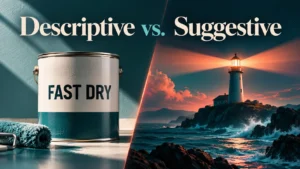
The real question is: does the buyer get product information immediately or do they have to make a meaningful mental connection?
| Question | Descriptive | Leading |
|---|---|---|
| What does the phrase mean? | Direct attribute, purpose, function, or use | An indirect hint about an attribute |
| Do you require imagination? | Little or no understanding of relevant feature | Some imagination, thought, or perception |
| Distinctive by nature? | No | Generally yes |
| Section 2(e)(1) risk | May be refused on the Principal Register | Usually not refused as merely descriptive, but other grounds might apply |
| Principal Register route | May require accepted Section 2(f) evidence | May qualify without Section 2(f) evidence, subject to other requirements |
There is no definite number of mental steps that makes a mark suggestive. The persuasive argument shows the real overall importance of the mark to purchasers and replies to the evidence presented by the examiner. TMEP § 1209.01(a)-(b).
Generic trademark vs Descriptive Trademark
Generic wording is the common name for the relevant goods or services, e.g., BICYCLE for bicycles. Descriptive wording makes a feature or quality clear, such as a phrase that states that particular bicycles are lightweight.
This distinction changes the answer at hand. A purely descriptive term may indeed acquire source-identifying significance over time; but the words cannot be registered for the goods or services they designate merely because they are genuinely generic because of extensive use or advertising by one seller. The full mark and the offerings identified matter. USPTO: Good trademarks.
Can a misspelling render a descriptive trademark registrable?
No, not automatically. The USPTO may treat this as an ordinary descriptive term if buyers hear or recognise the ordinary descriptive term in a slightly changed spelling. For instance, KWIK DRY for quick-drying paint would still raise a descriptiveness question. That is a hypothetical, not an evaluation of an actual score.
The change must be more than a disguise of an obvious description to create a different commercial impression; a truly different coined expression can do that. The present TMEP is limited to phonetic equivalents. TMEP § 1209.03(j).
Can Combining Descriptive Words Create a Trademark That Can Be Registered?
Sometimes. A combination can produce an unexpected overall meaning, an incongruity, or a real double entendre. But the fact that two descriptive words are simply combined with a space or hyphen or new font does not mean the entire mark is suggestive.
The question is about what consumers perceive from the total expression in relation to the offering. The intended second meaning should arise from the mark itself in context, not from a long explanation or outside advertising. TMEP §§1209.03(d)-(e).
How to Overcome a Trademark Refusal for Merely Descriptive Marks
First, find out what the examiner says the mark describes and the evidence for that conclusion. Then figure out which of these paths is legally permissible and commercially viable. Sometimes an answer may be argumentative or offer alternatives, but the filing must be specific to the application.

Make the Case the Mark Is Suggestive, Not Descriptive
Discuss why the complete text has a circuitous meaning. Discuss what buyers need to think mentally. Discuss why quoted materials do not constitute an instant description. Don’t say the word “creative” just to say it.
Contest the Examiner’s evidence
Is the dictionary meaning relevant to the goods or services? Are the cited websites for the same industry? Did the examiner reach a conclusion that is not supported by the record? Face the negative facts. Don’t pretend they don’t exist.
Double Entendre Discussion
If the term has two apparent meanings and the second one alters the overall commercial impression, discuss both and give support. Consumers’ discovery of the obscure meaning, after seeing a separate tagline, may not be very meaningful.
Disjunctive Argument
Why the combination gives the relevant purchasers an unexpected, nonliteral impression. It is unlikely that describing a normal feature in an unusual word order will be enough.
Distinctiveness Acquired by Use Under Section 2(f)
If consumers now associate the wording with your business, think about a properly supported Section 2(f) claim. The evidence is the strength of the mark descriptively, and the history of its use. Five years of isolation is not a magic cure.
Think about the Supplemental Register
For a qualifying mark and application, amendment may overcome a mere descriptive obstacle to registration on the Principal Register. There is no cure for all refusals, and an incapable or generic designation does not qualify. The basis of filing is important, especially for intent-to-use applicants. TMEP §§ 815–16.
For information on response mechanics, see Response to Trademark Office Action.
Distinctiveness is learned by the child.
Acquired distinctiveness, or secondary meaning, is when the pertinent consumers have come to understand a descriptive term as identifying a single commercial source, rather than just describing the goods or services. Buyers do not have to know the legal name of the company.
Long use can help, but the key question is consumer recognition. A business can be the first or only user of a descriptive phrase without showing that buyers regard the phrase as its brand. TMEP § 1212.
What Is Section 2(f)?
Section 2(f) is the legal means by which to show that a mark that is not inherently distinctive has acquired distinctiveness in connection with the applicant’s goods or services. The U.S. Patent and Trademark Office (USPTO) recognises three general types of support:
- Ownership of a qualifying active prior Principal Register registration for the same mark and for goods and/or services that are sufficiently related.
- Substantially exclusive and continuous use as a mark in commerce for the five years before the allegation.
- Other evidence of consumer recognition or an appropriate combination of evidence.
Five years of use is not a warranty in itself. The examiner might want more, especially if the wording is very descriptive or similar wording is used by others. The evidence must support the claim in relation to the particular mark and relevant goods or services. TMEP §1212.04-1212.06.
What Evidence Can Establish Acquired Distinctiveness?
| Evidence | What it might show |
|---|---|
| Length of time the wording has been used as a mark | Duration and consistency of use |
| Substantially exclusive use | Use of same or similar wording in the field by others |
| Advertising expenditures | Expenditures to promote the mark (particularly as a source identifier) |
| Sales figures | Commercial reach, with context on what the figures are |
| Customer or dealer declarations | Recognition of the wording as indicating one source |
| How to do a consumer survey right | Relevant consumer knowledge |
| Coverage by independent media | Marked attention from the public, not just the product |
| Eligible for Prior Registration | Potential Assistance under Relevant Section 2(f) Regulations |

Volume does not equal quality. A stack of invoices or impressions may demonstrate sales without demonstrating that consumers recognise the phrase as a mark. The more descriptive the language, the stronger the evidence of source identification may have to be. TMEP § 1212.06.
What Is the Supplemental Register?
The Supplemental Register is a second federal register for some designations capable of distinguishing goods or services, but which have not shown the distinctiveness required for the Principal Register. There is no objection to the registration of a merely descriptive mark if the other requirements are met.
It provides a federal registration, and may be used as a bar against later confusingly similar applications. It does not import all the legal presumptions of the Principal Register, nor does it render a generic term registrable. A Supplemental registration does not automatically convert into a Principal registration later. The owner may apply for a separate Principal Register registration if the mark qualifies. TMEP §§815–816; USPTO: Amendment to Register Guidance.
Principal Register and Supplemental Register
| Question | Main Register | Supplemental Register |
|---|---|---|
| Distinctiveness | Inherently distinctive mark or recognised acquired-distinctiveness claim | Mark that is capable but not yet eligible for Principal registration |
| Presumptions of ownership/exclusive right arising from registration | Generally available, subject to law | Such Principal Register presumptions do not apply |
| Publication and opposition | Published before registration with right to opposition | Not published for opposition before registration; may be challenged later by cancellation |
| Incontestability under Section 15 | Available if statutory conditions are met | Not available |
| Later conflicting USPTO applications | Registration can be cited | Registration can also be cited |
| Future Principal registration | Already on Principal Register | Separate qualifying application; no automatic upgrade |

Both routes still require that the mark and application meet their respective requirements. USPTO: Definitions of Office Actions; TMEP Chapter 800
Can an Intent-to-Use Application be Transferred to the Supplemental Register?
A single Section 1(b) intent-to-use application generally cannot advance to the Supplemental Register until use is commenced and a satisfactory allegation of use is submitted. That allegation may be an amendment to allege use or a Statement of Use depending upon the status of the application. A Section 66(a) Madrid application may not be amended to the Supplemental Register.
If a sole Section 1(b) application later amends to the Supplemental Register, the effective filing date is the date the allegation of use met the minimum filing requirements. That can affect priority analysis. The examiner does a new search for conflicts. Applications using both Section 1(b) and Section 44 bases might receive different filing-date treatment. Please consider this consequence before you ask for an amendment. TMEP §§ 815.02, 816.02.
See Intent-to-Use Trademark Application, Trademark Use in Commerce, and Trademark Statement of Use for the individual use-filing stages.
Always the Best Answer? Supplemental Register
Nope. If the examiner’s case is weak, a fact-based suggestiveness argument may keep a path open to the Principal Register. An established mark may be evidence of Section 2(f). A newer brand that is eligible may want to take out Supplemental registration while it builds recognition. If a startup has very descriptive wording, changing its name might be more valuable in the long term.
Compare the examiner evidence, your use history, marketing investment, future enforcement need, and switching cost. Do not choose the Supplemental Register just because the form asks you to. It does not overcome all refusals and does not provide all of the benefits of the Principal Register.
When is rebranding smarter than fighting a descriptiveness denial?
If it is in the early days of the business, the wording directly describes a core feature, the use of similar terms is common in the industry, and little evidence exists of source recognition, then rebranding should be seriously considered. Lawsuits can consume a lot of time and money, and leave you with a comparatively flimsy name.
That’s a business decision, not a law.” Ask the same question if the brand is well known and has a proven track record. Do a Trademark Clearance Search before you go to a replacement name. A more creative name can still conflict with a prior mark.
What Happens After You Reply to a Descriptiveness Office Action?

The examining attorney will review the complete response and any new evidence. A refusal may be withdrawn, the examiner may raise or sustain issues, or a final Office Action may result. If the answer is no, a timely Request for Reconsideration and/or a TTAB appeal may be relevant.
Calendar the deadline in the actual notice. Many Section 1 and 44 examining-attorney actions have a normal response period of three months, with one three-month extension available to be requested prior to expiration of the response period. Normally, six months for section 66(a) applications without the extension. Filing a Request for Reconsideration does not extend the time for filing an appeal. USPTO TTAB appeal guidance. USPTO response forms.
A refusal that is only descriptive v. a refusal on likelihood of confusion
| Question | Section 2(e)(1) Mere Descriptiveness | Section 2(d) Likelihood of Confusion |
|---|---|---|
| core issue | Does your offer come across instantly in the copy? | Could purchasers mistake your mark for an earlier qualifying mark? |
| Main comparison | Marks, goods/services and consumer perception | Identified goods/services and other relevant factors of confusion |
| Common response themes | Suggestiveness, evidence, Section 2(f), eligible Supplemental amendment | Differences in marks or offerings, relevant evidence, case-specific amendments |
| Can the two co-exist? | Yes | Yes |
A descriptiveness refusal is not addressed by an argument that “nobody has my exact name.” However, registration in the Supplemental Register does not automatically eliminate a conflict with an earlier mark. Read USPTO Trademark Likelihood of Confusion for Section 2(d) analysis.
How to React to a Descriptiveness Refusal: Common Mistakes
- “No one else uses my exact mark.” Owning the mark doesn’t help with what your wording means to buyers.
- Listing off-topic dictionary definitions. Relevant meaning is the meaning that buyers associate with your goods or services.
- Assuming it corrects a spelling mistake. A recognisable phonetic equivalent may be descriptive.
- Five years of automatic Section 2(f) evidence use. The claim is correct and might need some more evidence.
- Supplemental Register amendment without balancing the trade-offs. Review eligibility, other refusals, and any effective filing date effect.
- Confusing description with generality. Selling more does not make a generic term a qualifier.
- Ignore the examiner’s exhibits. A reply must show why the evidence cited does or does not establish the refusal.
- Boilerplate use. Without analysis, generic assertions of imagination do little to bolster this mark.
- Not meeting the deadline. Verify the issue date, the basis for filing, eligibility for extension, and confirmation of filing.
Can You Respond To An Office Action That Is Simply Descriptive By Yourself?
Yes, if you have the right to appear pro se before the USPTO. An individual applicant domiciled in the U.S. may normally respond on his or her own behalf. A company domiciled in the U.S. acts through an authorised person where permitted by the USPTO rules. Foreign domiciliaries must be represented by a U.S. licensed attorney before the USPTO.
How hard it is depends on the facts. It may be easier to explain a clear evidentiary defect than a close descriptive-versus-suggestive line, a section 2(f) record, multiple refusals, or a final action. Please review signature and representation rules before filing. USPTO: Rules for trademark attorneys.
When to Seek Professional Help
Seek legal review if the mark is central to a valuable business, the examiner cites substantial evidence from the marketplace, you intend to make a Section 2(f) claim, the Supplemental Register will affect the effective filing date of a sole intent-to-use application, or the refusal is final. Also, a coordinated response is needed for the grounds of refusal.
Need Help With a Trademark Rejection That’s Purely Descriptive?
EagleMarkUSA can assist with scheduling the Office Action, reviewing the filing information, and discussing Office Action Assistance options. If you need legal analysis or representation, you should consult a qualified U.S. trademark attorney. There is no guarantee the USPTO will withdraw a refusal.
Frequently Asked Questions Regarding Descriptive Trademarks
What are descriptive trade marks?
It is wording that at once tells relevant buyers a significant ingredient, feature, quality, function, purpose or use of the goods or services. The USPTO determines this based on the particular goods or services identified in the application, not the words in the abstract.
What is the meaning of section 2(e)(1)?
The refusal grounds invoked are based on Section 2(e)(1) of the Trademark Act for marks that are merely descriptive or deceptively misdescriptive. The examiner finds that, for a mere descriptiveness refusal, the proposed mark immediately describes a feature of the goods or services identified. Read the Office Action as to what aspect and what evidence is cited.
Can a descriptive trade mark be registered?
Maybe. A descriptive mark can be registered on the Principal Register if there is proof of acquired distinctiveness under Section 2(f). An eligible mark may also be eligible for the Supplemental Register. Other refusals may still apply. A generic term cannot become registrable for what it names by use alone.
What is the difference between descriptive and suggestive marks?
The descriptive wording gives you an instant impression of the offering. Suggestive wording takes a little imagination or thought to make the connection. The USPTO looks at the mark as a whole in context, so a clever explanation alone does not make a plain description a suggestive mark.
Descriptive Trademarks vs Generic Trademarks: How are they different?
Generic wording is the name of the product or service category itself; descriptive wording describes something about the attributes of that category. Purely descriptive marks can acquire source-identifying significance. A truly generic word cannot serve as a trademark to identify the goods or services that it describes.
So what do you do with a simple descriptive refusal?
Read the Office Action for each issue and the Examiner’s evidence. Depending on the record, an applicant can argue suggestiveness, challenge evidence, show acquired distinctiveness under Section 2(f), or seek an allowable amendment to the Supplemental Register. Rebranding can also be a good business move. There is no single way for every mark.
What is acquired distinctiveness?
This is to say that relevant consumers have come to see language that was not inherently distinctive as pointing to one commercial source. It’s based on how the mark is used and evidence of how consumers see it—not simply the owner’s belief that the brand is known.
What is secondary meaning?
Acquired distinctiveness is also called secondary meaning. It means that buyers understand a descriptive designation as a brand, or a brand and its ordinary descriptive meaning. Such recognition must be tied to the mark and the goods/services.
What is 2(f)?
Section 2(f) provides a way for a mark to acquire distinctiveness even if it is not inherently distinctive. Support may depend on the case on having a qualifying prior registration, substantially exclusive and continuous use for the last five years, evidence of actual consumer recognition, or some combination.
Is five years of use enough to achieve acquired distinctiveness?
Not without saying. The claim is for substantially exclusive and continuous use as a mark in commerce for the five years immediately preceding the claim. The USPTO may require more convincing evidence, especially in the case of highly descriptive wording, or where others use similar wording in the marketplace.
Evidence for acquired distinctiveness:
Relevant evidence may include length and exclusivity of use, source advertising, contextual sales figures, customer or dealer statements, independent coverage and properly designed consumer surveys. The question is not the size of the business, but whether the evidence shows that the consumers recognise the wording as a mark.
A descriptive mark can be registered on the Supplemental Register.
Sometimes. If the mark can distinguish the goods or services and the application meets the applicable filing-basis and use rules. You can’t just move a generic or otherwise incapable designation there. A Supplemental amendment won’t solve all the other refusals.
Can you register an intent-to-use application on the Supplemental Register?
A single Section 1(b) application normally must begin with qualifying use and an acceptable allegation of use. If it is then amended to the Supplemental Register, the effective filing date is the allegation-of-use filing date of the applicable rule. Handling of combined Section 1(b)/44 applications is different.
Fight a descriptiveness rejection or rebrand?
Compare the examiner’s evidence with your own evidence of consumer recognition. Likely strength of an argument Cost of response Cost of switching names An early-stage business that uses heavily descriptive language may benefit from a stronger mark. An established brand may have reasons to apply.
Conclusion
Whether a mark is simply descriptive is a question to be decided by the perception that the actual purchasers would have of the mark as to the goods or services identified. A suggestive mark suggests an idea to buyers. A descriptive mark tells them more directly. A generic term names the category. Those differences drive the available registration paths.
Read the examiner’s evidence before deciding on an answer. A supported suggestiveness argument, a Section 2(f) claim or an eligible Supplemental Register amendment may be appropriate, but none is automatic. Five years of use alone does not guarantee acquired distinctiveness, and sometimes an early business might be better served by a stronger name. Always respond to every issue by the deadline in your Office Action.
Need help with a refusal to be descriptive?
Contact EagleMarkUSA for help with its trademark filing and Office Action assistance services to review the cited evidence, the details of your application, and possible next steps. Legal advice concerning a particular refusal should be obtained from a qualified U.S. trademark attorney. No guarantee of USPTO approval.

Pingback: Trademark Office Action Response: How to Respond to the USPTO
Pingback: USPTO Likelihood of Confusion: Section 2(d) Trademark Guide
Pingback: Acquired Distinctiveness Trademark: Section 2(f) & Secondary Meaning
Pingback: Trademark Disclaimer: Meaning, USPTO Wording & Examples