
In this post, we explore what trademark counterfeiting means, how it works, the consequences of infringement, and a few examples.
Trademark counterfeiting is a subset of trademark infringement. It typically involves using a fake mark that is identical to or substantially indistinguishable from a registered trademark, often on goods made to look genuine. A different brand name can confuse and infringe without being counterfeit. Outside the brand’s network, a seller might be offering the genuine product.
In certain instances, a seizure order may be issued in a qualifying civil case, and, in some instances, damages may be increased. Federal criminal charges require proof of additional elements, including the intent and knowledge required by the statute. If something looks fishy, keep in mind that a copied photo and a low price aren’t much of an indicator as to what you’ve actually been sent.
This information sheet provides an overview of what constitutes a counterfeit and how it differs from infringement, the possible consequences of committing a counterfeit, and what trademark owners can do to prevent it.
What Is Trademark Counterfeiting?
Trademark counterfeiting typically involves using a fake mark that is identical to or substantially indistinguishable from a registered trademark in a way that is likely to cause confusion, mistake, or deception. The problem is that the false branding conveys information about the originator of, or authorization for, the goods to the buyer. See 15 U.S.C. § 1114 and § 1127.
What Is a Counterfeit Trademark?
Federal law defines fake branding as a “spurious mark,” a mark that falsely suggests the goods or services come from the trademark owner or an authorized source. A simple copy of a product’s shape or color is not sufficient to constitute counterfeiting.
If any of the common federal remedies for counterfeiting described herein are applicable, see whether the genuine mark is registered on the USPTO Principal Register; whether the mark is in use; and whether the mark has been registered for the goods/services involved. Both the civil and criminal statutes have their own requirements. In a criminal case, the government must prove more than a mere similarity between the marks. See 15 U.S.C. § 1116(d) and 18 U.S.C. § 2320(f).
Trademark Counterfeiting vs Trademark Infringement.
The table shows where counterfeiting fits within the broader category of trademark infringement.
| Issue | Trademark Counterfeiting | Ordinary Trademark Infringement |
|---|---|---|
| Mark similarity | Marks which are identical or substantially indistinguishable | Marks which are not identical but which are confusingly similar |
| Common examples | Fake branded goods, labels, packaging or services | Confusion over source, sponsorship or affiliation in the marketplace |
| Federal registration | The special remedies discussed here generally require a Principal Register registration in use for the relevant goods or services. | Some federal infringement claims can protect qualifying unregistered marks. |
| Civil remedies | Injunctions and possibly special damages and/or seizure of goods or property | Injunctions and possibly, under the rules of the court, monetary damages |
| Criminal exposure | If the government proves a statutory offence, there is a possibility of criminal exposure. | Ordinary trademark infringement, on its own, is generally a civil matter. |
| Fake product required? | No. The fake mark can be found on packaging, labels, or be associated with services. | Both parties have the option to sell their products. |
Understanding the marketplace confusion through USPTO’s overview of trademark infringement. The likelihood of confusion question is a separate question, which is explained in our USPTO likelihood of confusion guide. For unregistered marks, see 15 U.S.C. § 1125(a).
Trademark Counterfeiting Examples
The examples are illustrative only.
1. Fake branded shoes
A factory prints a registered sportswear logo on shoes for which it is not licensed to produce. A seller then offers them as the brand’s genuine sneakers. The duplicated logo and the identical products are indicative of counterfeiting.
2. Counterfeit luxury bag
An imitation handbag has a replica of the registered emblem of a brand almost identical to it. The listing does not alter the meaning of the emblem when viewed or resold, as it is called a “replica.”
3. Falsified Electronic and Packaging Products
A seller puts generic chargers in boxes bearing a copied logo registered for chargers. Even if the chargers themselves are unmarked, the box can falsely suggest that the brand made or approved them.
4. Counterfeit pharmaceutical packaging
The pills arrive in boxes displaying a copy of a mark registered for that medication. The branding may create a counterfeiting problem, irrespective of the ingredients of the pills. Any suspected medication that is counterfeit should also be reported via the FDA’s reporting procedures.
5. Other brand name, but similar.
There are two companies producing jackets with different names outdoors, with a prominent word in common and their names sound alike. Customers often think that the newer brand is somehow connected to the older brand. That may provide a basis for an infringement action, but the same word and the same sound will not be sufficient to create a counterfeit mark.
What is the Trademark Counterfeiting Act, 1984?
In 1984, legislation was enacted to provide federal authorities with a specific criminal remedy against counterfeit trafficking, as well as enhanced civil remedies for trademark owners under the Trademark Counterfeiting Act of 1984. It adopted 18 U.S.C. § 2320 and modified the Lanham Act’s injunction and seizure provisions, monetary damages provisions, and destruction of infringing material provisions. The law was later amended; see the current statutes.
Civil or Criminal – Trademark Counterfeiting?
It can be both. The trademark owner can pursue a private lawsuit against the seller, and the federal government can bring a criminal case.
Civil trademark counterfeiting
Under the Lanham Act, a trademark owner can file a lawsuit and seek damages, including an injunction to cease selling the products or to obtain reasonable monetary damages, or to have the infringing products destroyed. The knowledge needed to obtain treble damages is a separate question from whether the use infringes. See 15 U.S.C. § 1114 and § 1118.
Criminal trademark counterfeiting
If the evidence supports the offense, then federal prosecutors can file charges under 18 U.S.C. § 2320. A takedown or a civil complaint doesn’t prove that someone is guilty of a crime.
What Do Prosecutors Have to Prove in a Criminal Counterfeiting Case?
In an ordinary completed goods-or-services offense, the government must establish the defendant’s intentional trafficking in the goods or services and his or her knowledge of the use of a counterfeit mark in connection with those goods or services. In the typical “registered mark” scenario, the mark should satisfy the statutory requirements, such as being connected with the goods/services for which it is registered and used in a way that is likely to cause confusion, mistake, or deception.
The government does not have to prove that the defendant knew the genuine mark was registered. Accidentally reselling a fake does not by itself establish the ordinary offense. The statute also covers specified marking and packaging materials, qualifying military goods and services, and drugs bearing counterfeit marks. It reaches attempts and conspiracies to commit the listed offenses. See § 2320(a) and (f).
Trademark Counterfeiting Penalties
The figures below are statutory maximums under 18 U.S.C. § 2320(b). They are neither automatic nor a prediction of what a particular defendant will receive.
| Federal offense category | Individual maximum under § 2320 | Organization maximum fine under § 2320 |
|---|---|---|
| General offense, first offense | Up to $2 million, up to 10 years in prison, or both | $5 million |
| General offense, second or subsequent offense | Up to $5 million, up to 20 years in prison, or both | $15 million |
| Qualifying military goods or services, or drugs bearing counterfeit marks, first offense | Up to $5 million, up to 20 years in prison, or both | $15 million |
| Same special category, second or subsequent offense | Up to $15 million, up to 30 years in prison, or both | $30 million |
Separate provisions apply if someone knowingly or recklessly causes or attempts to cause serious bodily injury or death through the prohibited conduct. These provisions allow up to 20 years in prison for the serious injury category and up to life for the death category. Forfeiture, destruction, and restitution are also covered in the statute under 18 U.S.C. § 2323.
Civil Damages for Trademark Counterfeiting
Civil awards go through a different analysis. A prevailing plaintiff under 15 U.S.C. § 1117 may recover the defendant’s profits, as well as the plaintiff’s actual damages and costs, subject to the provisions of the rules. Attorney fees may be awarded to the prevailing party in such exceptional cases as may be reasonably deemed to have been caused by such action.
§ 1117(b) generally requires three times the profits or damages (whichever is greater) plus reasonable attorney fees for qualifying knowing, intentional use of a counterfeit mark, unless the court finds extenuating circumstances. The subsection also covers certain intentional assistance.
Before final judgment at trial, the plaintiff has the choice to seek statutory damages (which are damages other than actual damages and profits) instead of actual damages and profits, when eligible. The civil statutory damages range under § 1117(c) is $1,000 to $200,000 for each counterfeit mark for each type of goods or services sold, offered, or distributed. If willful use is detected, the top increases to $2,000,000 per mark per type. Just compensation is determined by the court. The unit is the mark and product type, not every item sold.
Do courts have the authority to take control of bogus goods?
Yes. In 15 U.S.C. § 1116(d), the federal court has the power to enter an ex parte seizure order, which means that it can enter it without giving the person being seized advance notice. The order may cover counterfeit goods and marks, the means of making the marks, and relevant records.
This is an extraordinary remedy. The applicant is required to offer security and specific facts establishing the likelihood of success, that immediate irreparable injury would result, that a less drastic remedy would be futile, and that a risk of rendering the material unavailable would exist if advance notice was given, among other things. The law also mandates reasonable notice to the U.S. Attorney and a prompt hearing after the notice is issued. A trademark owner cannot seize the seller’s stock on their own.
Counterfeit Labels, Packaging, Hangtags and Boxes

Labels, stickers, patches, hangtags, containers, and documentation are specifically addressed in Section 2320(a)(2). The provisions of its knowledge and requirements for counterfeit marks remain in effect. Keep inserts and cartons: They reflect the origin’s presentation by the seller.
The difference between counterfeit goods, knockoffs, and replicas.
- Counterfeit: generally refers to goods or services presented with fake branding identical to or substantially indistinguishable from a registered mark.
- Knockoff: Usually refers to a good that is made to look like another good. It could be a new legal question without any counterfeit mark.
- Replica: A reproduced facsimile or likeness of something. The label is no justification for the use of fake branding or for it being illegal.
- Imitation: a broad term which might refer to similarities in design, packaging, or branding.
Are Gray-Market Goods Counterfeit?
Genuine products do not become counterfeit simply because they are sold outside a brand’s authorized channels. Gray-market goods can typically be genuine products that are manufactured for one market but sold in another without the permission of the brand owner. Not all conflicts are solved by authenticity. Material differences between the U.S. version and the imported version may affect an infringement analysis, such as a U.S. warranty that does not exist in the imported version. Read SKF USA Inc. v. International Trade Commission.
Can Counterfeit Goods Appear for Sale Online?
Yes. Fake offers might come across Amazon, eBay, Facebook, and stand-alone stores and social accounts. The test remains the same regardless of the sales channel. A duplicate listing photo does not prove the seller shipped falsely labeled items.
A marketplace may remove a reported listing under its policies. Customs, courts, and criminal investigators ask different questions. A takedown is no basis for liability.
If you found a suspected counterfeit listing on Amazon, here’s how to report counterfeit products on Amazon and what evidence to save before filing.
What Can a Trademark Owner Do About Counterfeit Goods?
- Verify your rights. Examine owner, registration, precise mark, covered goods/services, and any license/authorization that might account for the sale.
- Take the offer before reaching out to the seller. Keep all listings, seller description, links, and times intact. Remember the seller’s word for authenticity.
- Authenticate the product wherever possible. A documented test purchase will demonstrate whether the product shipped matches the listing for an ordinary consumer item. Compare to a real unit of the same model and market. If you are buying goods that are safety-sensitive, please refer to the advice received.
- Select an answer that is supported by the evidence. A platform report can be made for a specific listing. If the demand letter or litigation might be warranted because the repeller is a repeat seller, a larger distribution problem, or there is doubt about the source of the drugs, counsel may be requested to evaluate it.
- Take into account customs or law enforcement if applicable. If there are any concerns about imports, trafficking, or credible safety reasons, a report may be directed to the appropriate authorities. Explain what you can prove and what you can’t prove.
Once you’ve saved the evidence, here’s how to report counterfeit products to online marketplaces and U.S. agencies.
What are the best ways to preserve evidence of counterfeiting?
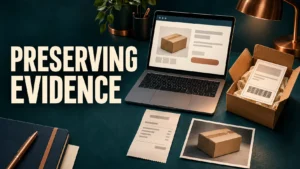
Store full-page screenshots of each seller/each order with URLs, Timestamps, Seller ID, Listing ID, Product photos, Price, Description, and Claim of authenticity. Maintain order confirmations, receipts, payment records, messages, shipment tracking, and shipping labels. Leave original files and notes with annotated copies.
If acquired for a test purchase, keep the outer carton, retail packaging, inserts, and tags. Take a picture of how it is, and give it a reference number that relates to the specific listing and sale. Record the person who received it, opened it, read it, or transferred it, and the date. Write down any discrepancies from the actual object and any serial number checks. If you lose your records, someone else should be able to recreate what has occurred.
Is the U.S. Customs Service able to prevent counterfeit imports?
Yes. U.S. Customs and Border Protection (CBP) may detain imports suspected of bearing a counterfeit version of a trademark recorded with CBP. It may seize goods in qualifying cases. Owners of eligible USPTO Principal Register marks can record them with CBP through its e-Recordation system. Recordation does not constitute obtaining the USPTO registration. Additionally, CBP receives suspected trade violations via e-Allegations. Refer to CBP’s guidance on intellectual property, and 19 C.F.R. § 133.21.
May Buyers get into trouble for purchasing counterfeit goods?
Possession and/or purchase of an item for personal use does not necessarily constitute a federal counterfeiting offence. Section 2320 addresses trafficking and specified knowing conduct, and extends the definition of trafficking to include certain conduct with the intention to transfer or to dispose of goods for commercial purposes or for private financial gain.
There’s another question to consider when importing an item. Goods can be detained at the border even if the buyer wanted to retain the goods. The limited traveler exemption is only for specific circumstances. Don’t assume its coverage will apply to an online purchase with an overseas delivery or goods that have been imported for sale.
Trademark Counterfeiting Cases
- Tiffany & Co. v. Costco Wholesale Corp. (2d Cir. Appeals court overturns judgment, due to factual disputes about confusion and Costco’s alleged use of the term “Tiffany” descriptively on ring signs (2020). Such a record could not support the counterfeiting ruling. Even the same words should be considered in their context.
- This case is Coach, Inc. v. Goodfellow (6th Cir.). In 2013, the court reaffirmed liability for a flea-market operator who, he knew or should have known, had been continuing to rent booths to infringing vendors. Statutory damages were awarded, and willfulness was found. Specific notices and the operator’s behaviour were important.
- In 2024, DOJ reported a guilty plea for a counterfeit trafficking and fraud conspiracy with a prison sentence of 78 months, against Onur Aksoy (D.N.J.). It was labeled and packaged fraudulently as Cisco products and sold online from storefronts. This was a sentence for a particular scheme and charges.
Here are some common trademark counterfeiting errors to steer clear of:
- Considering similarity as a copy. Use the mark as it is used. Make sure to save the specific logo, text, and packaging, not just a quick first look at the listing.
- Associating an unauthorized seller with fake inventory. Check for signatures and labels. “Seller authorization” is a different question from “product authenticity”.
- Accepting “replica” on its own terms. Check out what is being delivered to the buyer and what the mark stands for.
- Assuming criminal intent or anticipating the maximum sentence. Outline the behavior that you can record. Mental state and sentencing are distinct issues in the criminal process.
- Reputation before the evidence is gathered and/or the availability of proof of goods’ authenticity. If there is no listing, it may complicate the investigation. Don’t accuse if evidence is preliminary.
What is a business to do when accused of selling counterfeit goods?
Read the notice and look for the specific products, listings, marks, registration numbers, and any response dates. Separate the at-issue stock and consider a temporary sales freeze while you work on the investigations. Keep stock as delivered and keep accompanying documentation such as invoices, supplier contacts, payment records, shipping records, etc., as well as authorisation paperwork. Before considering evidence preservation, do not relabel, destroy, or return stock.
Follow up on every disputed unit or batch to source. Determine if the products are genuine, for another market, modified after production, or produced without permission. An invoice is merely identification of the supplier and not authentication of the goods. When court papers, customs notifications or law enforcement inquiries are received, hire U.S. trademark counsel immediately. The information contained in this article is general and does not offer legal advice for a specific dispute.
Find answers to common questions regarding trademark counterfeiting.
What is Trademark Counterfeiting?
It typically involves using a fake mark that is identical to or substantially indistinguishable from a registered trademark in a way likely to cause confusion, mistake, or deception. An example is a brand that has an imitated brand logo and puts it on shoes that are not made by the brand itself.
What constitutes a Counterfeit Trademark?
Just the fake mark, e.g., a copy of the logo on a carton, not the product. The typical federal remedies are to review the registration of the genuine mark, its ongoing use, and the goods/services covered, along with the manner of use of the mark.
Is trademark counterfeiting a trademark infringement?
Yes. Counterfeiting is a narrower form of trademark infringement. For instance, a new cosmetics company may come up with a name that is similar enough to an existing company’s name to give people the impression that there is a connection. That may constitute an infringement even if the name is sufficiently different for the newer brand to be using a different mark.
What does the Trademark Counterfeiting Act say?
It is the law that was enacted in 1984 to establish a federal criminal counterfeiting statute and enhance civil enforcement tools. If it’s a contemporary issue, go to the current U.S. Code; subsequent changes to the law have occurred since Congress initially passed it.
Is trademark counterfeiting a federal crime?
It can be. The ordinary federal offense under 18 U.S.C. § 2320 requires intentional trafficking, knowing use of a counterfeit mark, and proof of the other statutory elements. The burden of proof for the charge is on the government. A private lawsuit or marketplace suspension is not punishment equivalent to a criminal conviction.
May you be jailed for selling counterfeit merchandise?
Yes, you can go to prison for a federal conviction. The degree of prosecution and severity of punishment imposed by a court will depend on the case. The knowledge requirement cannot be met by the receipt of suspect inventory when that is done without knowledge.
What do you think is the punishment for trademark infringers?
The criminal penalties may involve forfeiture, restitution, payment of fines and/or imprisonment. In a civil case, an injunction, damages, and, if applicable, enhanced damages and attorney fees may be awarded. The separate limits are explained in the criminal penalty table and in the civil damages above.
Is it possible for a person who owns a trademark to sue the counterfeiter?
Yes, a rights holder can bring an appropriate civil claim and seek relief such as an injunction and money damages. The owner must first determine who is the registrant of the registration, the scope of the registration and whether the evidence shows a use of a fake mark.
Is it possible to trace and confiscate fake products?
Yes, under certain circumstances. The seizure may be made under strict statutory conditions in a civil court and CBP may conduct an independent seizure of qualifying imports. A marketplace takedown is merely a process of removing an offer from the platform, per its rules, rather than taking the goods themselves.
Do copies necessarily look fake?
No. There may be other legal issues arising from a reproduction of the item if it is not fake-branded, but the term “replica” does not constitute trademark counterfeiting. On the other hand, by naming the product as a replica, the seller is not able to render a copied mark legal.
Is gray-marketing a form of counterfeit?
Not just about the channel of distribution! Authentic products can get to the U.S. beyond the brand’s official distribution system. Examine the authenticity and alteration of the goods and whether the differences from the authorized version are relevant to the purchaser.
Is there a need to register trademarks for the remedies of counterfeiting?
In general, the special federal counterfeiting remedies discussed here will depend on having registered the mark on the Principal Register, keeping it in use, and having registration coverage for the relevant goods or services. If other requirements are satisfied, an unregistered mark can be the basis of other infringement or false designation actions.
Do online counterfeit products get taken down?
It is possible for a platform to remove certain listings based on a supported complaint. Keep the listing and submit registration and evidence as requested. The removal of a listing does not necessarily result in the end of the listing process or the end of the dispute.
What can I do if my trademark is being used as a trademark by someone else?
Save the listing and seller information, verify your registration, and collect reliable evidence of what is being sold. Then select a response for the magnitude of the evidence and the magnitude of the problem. If you have a more complex dispute, you should talk to qualified trademark counsel.
What to Do Next
The first step is to determine which items were copied and which were actually included or delivered by the seller. A fake logo on the same products can create a counterfeiting problem with repercussions that go beyond normal infringement. If the sale is by another name, if it’s an imitation product or if it’s a sale of another person’s product, it’s a different analysis. Keep as much evidence as possible and check the registration prior to response.
Please consult EagleMarkUSA if you need assistance with federal registration records or other registration filing questions. If there is an active dispute, a seizure request, or a criminal accusation, seek the advice of legal counsel with expertise in U.S. trademark law. When changing your name due to a trademark dispute, make sure to search for possible trademark conflicts prior to the change.

Pingback: How to Report Counterfeit Products on Amazon