If you are being sold counterfeit items of your brand on Amazon, use the reporting tool that is available to you. If your brand is registered in Amazon Brand Registry and your account is authorized to use Report a Violation, you can use it. If your brand is not enrolled, you can report suspected infringement as the rights owner or its authorised agent via the Amazon Report Infringement form.
Before filing, determine if your evidence is of the product, one seller’s offer, or both the product page and the offer of one seller. An unauthorized seller may have legitimate inventory, and a copied photo isn’t an indicator of the type of inventory that this seller will provide.
This guide will tell you which reporting path to take, what evidence to gather, and what to do if the complaint is rejected by Amazon.
What to do if the item is a Counterfeit on Amazon?
If your brand is enrolled in Amazon Brand Registry
Sign in to Amazon Brand Registry and open Report a Violation. To report IP infringement through this tool, you need the Rights Owner or Registered Agent role for the brand.
If your brand is not enrolled
Log in to your Amazon account and go to the Report Infringement form on Amazon.com. Rights owners and their authorized agents only are invited to fill out the form. For regular buyers with an issue with an order, they should utilize Amazon’s order and customer support systems. Read Amazon’s guidelines on reporting counterfeit items.
What is Amazon’s definition of a counterfeit product?
In U.S. trademark law, a counterfeit mark is a fake mark that is identical to or substantially indistinguishable from a registered mark. One example is a charger created by a different factory that comes in a bag containing a duplicate of your registered logo. See 15 U.S.C. § 1127 and § 1114. See our guide on Trademark Counterfeiting for examples and a discussion of the difference between trademark counterfeiting and ordinary trademark infringement.
Amazon will also consider the context and the manner in which the mark is used. It refers to counterfeit branding, as it is used to misrepresent a product as legitimate, in its Project Zero guidance. Just because a photo has been copied doesn’t mean the physical items are, too. If you have the copyright for the picture, report that specific content of the page as a separate item.
What evidence should you have before reporting?
Create the report around two inquiries: What right do you have, and exactly where or how is it being challenged? Amazon provides guidance for rights owners on why they require both.
- Product and offer identifiers: Note the ASIN, exact listing URL, seller or store name, and seller ID, if applicable. An ASIN is used to identify the catalog product, and multiple sellers could be offering an ASIN.
- Show trademark information: U.S. Registration Number, registered mark, and Trademark Owner’s name. If representing the owner, have proof of authority on hand.
- Dated screenshots: Keep screenshots of the listing from when it was made, if they exist. Demonstrate the particular misuse and a bit of the page so that the context will be understood.
- If applicable: Save the order or test-buy ID, receipt, shipping label, and pictures of the item, logo, and packaging. Provide images of a genuine unit and identify key variations.
- Brief explanation: Give a brief description of the seller or the contents of the page that you are reporting, which is, where the mark is placed, and what is wrong with the way the page or person describes the origin of the product. If you have already checked out the offer of one seller, mention this.
Sample focused report: We ordered from the named seller on this ASIN, this unit arrived in a carton with our registered logo, the model with its serial number combination is not in our production records, pictures 1-3 are the received unit with the corresponding real model.
Is there a need for Amazon Brand Registry to report Amazon counterfeits?
No. The public form is still available to rights owners and authorized agents. If abuse is happening repeatedly, Brand Registry can assist you to monitor across cases and utilize the automated safeguards provided by Amazon. Check out Amazon Brand Registry.
How to Report a Counterfeit Through Report a Violation
The current Report a Violation guidance page for Amazon provides a single point of contact for IP, store policy, and regulatory reports. Use the IP reporting path for a trademark counterfeiting claim.
- Log in to Brand Registry and select Report a Violation. Confirm you’re reporting in the U.S. store and have the Rights Owner or Registered Agent role for the brand.
- Search by ASIN or listing information. Double-check the product variant and the seller you will report.
- Choose the scope. If your evidence only applies to that seller, then address their offer. Use page-content reporting for issues with the title, images, or other detail-page content. If there is any evidence supporting a product-wide claim, then consider the entire ASIN.
- Choose the trademark counterfeiting category and the matching right. Use the correct mark in dispute in the registration. Select the other violation category if the evidence shows only evidence of a different violation.
- Provide reasons for the claim and supporting evidence. If there is an Order ID, enter it, describe the feature that illustrates the problem, and attach documents or images in the fields provided on the form.
- Submit the report and save its reference number. Track the status and outcome using Submission History.
For instance, if you have a true ASIN and an order from one seller ships a fake, then the order goes to the particular seller’s offer. A whole page report may even be able to impact lawful offers. See Amazon’s scope guidance.
What to do about counterfeit products when no brand registry is involved.
Use the public Report Infringement form. Log in to your Amazon account and be the owner or their representative. Submit the relevant U.S. trademark registration and designate the content of the offer, ASIN, and/or page. For the description, link the right with the reported behavior, and fill in the required content for the form.
If you are an agent, find out the owner and be ready to provide proof of permission. Keep a copy of the confirmation and a case reference.
Would You Do a Test Purchase?
Sometimes. When there is a real product, and the query is what one seller actually ships, an order may link the physical product to the seller’s offer. It also provides you with an Order ID and a comparison of the product and packaging. Be sure to choose the seller you are researching and double-check the seller on the order confirmation.
If the evidence is already visible on the page, a test purchase may add little. Complete the requirements listed for your report type. Amazon has guidance for reporting test buys in Seller Central that says to report a test buy within 90 days of the order date. Amazon recommends test buys on its Project Zero page for suspected counterfeits. Write the date and submit on time; don’t assume that the older order will be considered.
The way to properly record a test buy.
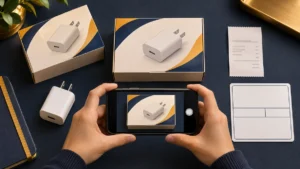
Create a link between the received unit and Seller and Order ID—and Order Date. Shoot the item as it arrives in the package and record any batch or serial numbers in the picture. Compare it to a true model and version. Note how you established a difference – whether an internal production record eliminated a serial number or just different boxes.
Be brief and to the point when comparing. Packaging may vary from batch to batch or place to place. If you can’t think of a plausible explanation, state that the difference is a lead – not proof.
What if the seller isn’t authorized but the product is still authentic?
Unauthorized resale doesn’t necessarily mean counterfeiting. A reseller may have acquired the authentic products from another reseller. Gray-market goods can be genuine goods that were manufactured for a different country. Material differences like the warranty coverage or the labeling can warrant its own legal review, and the item was not necessarily fabricated.
An IP complaint cannot be based on a dispute over either an exclusive distribution agreement or a minimum advertised price agreement. If the page inaccurately describes the item, rate that item based on its own facts. A report that is deliberately falsified can defeat any subsequent complaints and could jeopardize access to a reporting tool. Please see Amazon’s rights owner reporting policy.
What is done after the Report is submitted?
Amazon reviews it and could remove the targeted offer/content, ask for more information, or take no action. If you used Brand Registry, open Submission History to see the status and outcome. Public-form users should adhere to the confirmation or decision notice.
Offers may be removed while the shared product page is up. Track the reported seller – do not consider a failed removal until you have confirmed it. The consequences for different accounts will be different, and Amazon does not guarantee suspension due to notice acceptance.
What If Amazon Drops Your Report of a Counterfeit?

Don’t re-send the same complaint without any change to it. Begin with a decision message and the original report reference. If Amazon couldn’t find the right information, look at the registration and account permissions; if they couldn’t verify the product to the seller, correct the offer and order details.
If the item you received is genuine, drop the counterfeit allegation for that unit. Report a separate violation only if there is evidence to support it. If there is an escalation option for an earlier submitted issue, reference the previous issue in the report and provide the details of the change. This is described in Amazon’s Seller Central guidance. If the public form is used, follow the case-specific instructions in the Amazon response, if applicable.
Common causes of Amazon counterfeit report failures are:
- The right cannot be verified: The registration is pending, the registration covers a different mark, the registration is owned by another entity, or the reporter does not have permission.
- Explanation and evidence refer to different things: There may be a physical fake, and it’s the only attachment that’s a screenshot of a normal catalog image.
- The report is targeted too much or too little: The order was placed by another seller, the variant is incorrect, or the report is aimed at an ASIN due to one offer.
- No supported counterfeit claim: Product is not obviously fake, and the complaint is regarding price or seller authorization.
- There’s a second submission which is the same as the first except that it doesn’t address why Amazon rejected it: The follow-up simply restates the allegation without answering why Amazon rejected it.
The difference between Report a Violation and Report Infringement.
| Issue | Report a Violation | Report Infringement |
|---|---|---|
| Brand Registry | Available through Brand Registry | Available without enrolling the brand |
| Who can file an IP report | Brand Registry user with the Rights Owner or Registered Agent role | Rights owner or authorized agent |
| Workflow | Guided forms for the selected violation | Public infringement form, with Amazon sign-in |
| Follow-up | Track status and outcomes in Submission History | Keep the confirmation and follow the case instructions |
| Best use | Manage infringement reports for an enrolled brand | File an infringement report without enrolling the brand |
What Amazon Brand Registry is?
Amazon’s brand protection program is called Brand Registry. Enrollment can be offered as a result of an eligible pending or registered trademark. Provides automatic protection and reporting to eligible accounts. An eligible pending application may support Brand Registry enrollment, but it does not replace a U.S. trademark registration for a trademark counterfeiting report on Amazon.com. Before you submit, be sure to test the right you are going to use.
What is the Amazon Project Zero?
Project Zero is an optional tool for eligible Brand Registry users. It has a self-service system that enables brands to remove verified offers or listings directly if they were confirmed to be counterfeit. Access to a store will be controlled by an active registered trademark linked to the brand’s account at the store. The brand’s report acceptance history is just one of the factors Amazon will look at, and a 90% acceptance rate alone does not guarantee access. Amazon requires training at enrollment and at least 99% removal accuracy to keep access to the tool. If you don’t have Project Zero access, use normal reporting first.
What is Amazon Transparency?
By making things transparent, you can stop suspect units from getting to the buyer. It employs special codes for each product unit enrolled to be checked in Amazon’s processes. Protection is provided once the product is reviewed for operation. It’s helpful if a brand can apply codes to every individual unit that it ships.
When choosing an Amazon Brand Protection Tool, how do you know which one to pick?
| Situation | Best starting point |
|---|---|
| A suspected counterfeit offer/listing already exists. | Report a Violation if enrolled with the correct role; otherwise, Report Infringement: |
| If your brand is experiencing repeated IP abuse, | think about taking advantage of Brand Registry for regular reporting and automated protections. |
| Your eligible brand wants to remove confirmed counterfeit offers directly | Project Zero, if your brand has access |
| Your brand needs to be authenticating individual units | Transparency |
What Evidence to Keep on Hand for Amazon?
Preserve the records within your own case folder until the listing changes or goes away. Keep originals apart from annotated copies, and attach the date of the listing and the name of the seller to the order, all communications, and the unit and package received. Keep shipment documentation and track the individual who handled the sample in case it is passed on to a different person. See our Trademark Counterfeiting guide for more information about preserving evidence beyond the platform.
When is it time to venture off of Amazon?
If sellers are seen repeatedly, there is activity across several platforms, losses are significant, or there is evidence of a greater supply chain, seek the counsel of qualified U.S. trademark counsel. Determining the seller or importer may help determine the next steps, such as litigation and/or border enforcement actions if applicable. A Platform removal will not recover losses or prevent sales through other platforms.
If you find the same product on another marketplace, see how to report suspected counterfeits on eBay and Facebook or send a tip to a U.S. agency.
Common Brand-Owner Mistakes
- Taking the absence of a reseller agreement as evidence. Utilize evidence of false branding or another clearly identified violation.
- Waiting to preserve a listing. Take a screenshot of it before you let the Seller know, and record the Seller ID and display name.
- Registering the wrong trademark or on the incorrect terms. Guide the reviewer to the specific mark and conduct.
- Not following a test purchase when authenticity is questioned. When the evidence merely demonstrates a suspicious offer, think about what would constitute evidence of a shipment.
- Refusing to take a declined notice as it is or to consider Project Zero as a normal report. Take the next step in that case and account.
Frequently Asked Questions
How do you report Amazon counterfeit?
If you have the correct permissions, report a Violation via Brand Registry. If not, as the rights owner or the rights owner’s authorized agent, fill out Amazon’s Report Infringement form. Make sure you know the offer or page you’re reporting.
Is it required for me to report a counterfeit with Amazon Brand Registry?
Amazon’s public form for infringement is available for rights owners and approved agents without the need to sign up for the brand.
Is a trademark necessary?
Use the appropriate U.S. trademark registration for a trademark counterfeiting report on the Amazon.com website. An eligible pending application does not replace a registration in a counterfeit claim, but rather it can be used to enlist the Brand.
Is it possible to report a counterfeit seller without purchasing the product?
Sometimes. If the evidence is shown on the product page, record what it is and the category to which it belongs. Amazon might require more supporting data for any specific seller’s shipments.
Should I make a test buy?
If the authenticity of the product is the issue that is not discussed in the listing, think about one. Choose the specific Seller and keep a record of the purchase.
What is done after reporting a counterfeit?
Amazon will accept the report, request further information, or refuse it. Determine if the action was taken against the reported offer or the shared listing.
What is the reason behind Amazon rejecting my fake report?
Typical errors are a lack of a verifiable seller, offer, or proof of a fake product. Determine what needs to be changed based on the actual case decision.
What is Amazon Project Zero?
It enables qualified brands to delete the verified counterfeit offers or listings themselves via a self-service tool.
What is Amazon Transparency?
It is a programme that employs special codes to ensure that each unit of the product that is enrolled is verified and to ensure that noncompliant units do not end up in the hands of customers.
Does Amazon have any permanent power to ban a counterfeit seller?
Amazon’s anti-counterfeiting policy gives them the right to suspend or cancel a selling account if it is selling products that are not authentic. A report does not ensure either of both scenarios.
If the product is authentic but the seller is not authorized?
Selling genuine goods outside an authorized channel does not, by itself, establish counterfeiting. Assess any isolated problem, such as unauthorized use of your photographs, or materially different imports, on its merits.
What can I do if Amazon removes the listing?
Possibly. A removal is not a way to settle a legal claim. Consult with counsel if the activity is to be continued or if business damage warrants additional action.
What to Do Next
Specifically address the precise offer or content the proof backs. If Amazon refuses the report, correct the identified gap(s) and then follow up. The public form is available outside the program, and help for ongoing enforcement is provided by Brand Registry.

Pingback: Trademark Counterfeiting: Meaning, Penalties & Infringement