You ordered a brand-name product, but what arrived looks like an imitation. Or you own the brand and found someone selling products with a copy of your logo. Where you report it depends on where you found the item, whether you own the rights, and what you want to happen next.
Reporting counterfeit products in the United States: Flag the listing as suspected counterfeit on the marketplace. Trademark owners and their authorized representatives can use the platform’s intellectual property reporting tools. Report deceptive sales to FTC ReportFraud; suspected intellectual property crimes to the National IPR Center; and suspected counterfeit imports to U.S. Customs and Border Protection.
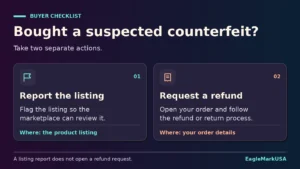
If you already paid and want a refund, start a separate request through your order. Reporting the listing alerts the marketplace, but it does not open a refund request.
Where Do You Report Counterfeit Products?
Choose the reporting route that matches what you can document. If you own the trademark, you can use the platform’s formal complaint process to report suspected infringement.
| Situation | Where to report it: |
|---|---|
| You notice a possible counterfeit eBay listing | eBay’s listing reporting process |
| You own the rights or are authorized to report suspected infringement on eBay | eBay Verified Rights Owner (VeRO) |
| You notice a suspected counterfeit item on Facebook Marketplace | Use the report option on the listing |
| You own the rights or are authorized to report suspected trademark infringement on Facebook or Instagram | Meta’s trademark reporting forms or Brand Rights Protection if you have access |
| A seller is selling suspected counterfeits on Amazon | Amazon’s counterfeit reporting routes: Report a Violation or Report Infringement (if eligible) |
| A seller misrepresented what you bought | Report suspected deception to FTC ReportFraud. To seek a refund, contact the seller or marketplace separately, then ask your payment provider about dispute options if needed. |
| You have evidence of suspected commercial counterfeiting or trafficking | National IPR Center referral form |
| You have information about suspected counterfeit imports into the U.S. | CBP e-Allegations |
A marketplace can audit its listings and accounts. The FTC does not conduct takedowns in the marketplace, and filing a complaint to any government agency doesn’t mean an investigation or a refund.
What information should be taken before reporting?
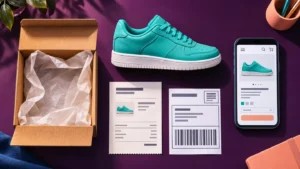
Be sure to save as much as possible before the listing changes or goes away. If you could only see the listing, make a report of what you saw. If bought from the seller, please retain the original item and packaging for reference as to what was received.
- Listing Details: URL, seller username (or store name), and listing ID or Amazon ASIN (if available). If several sellers share the product page, record which seller made the offer you’re reporting.
- Dated screenshots: Title, photos, price, and authenticity claims/seller information. Always make a copy of originals before adding annotations.
- Order records: Save order confirmation, receipt, transaction number, tracking and shipping labels (if available).
- Product evidence: Take a picture of the product, its packaging, labels, and any model, batch, or serial number as appropriate. If you do have a genuine piece of the same version, make note of any differences.
- Seller communications: Keep records of authenticity, substitutions, returns, and where the seller got the goods.
- An explanation and (if applicable) evidence of rights: What did you notice and why is it a concern? If making an IP complaint, provide the mark, registration information if any, the owner, and authority to act on his/her behalf.
A low price can cause you to take a closer look. If a product’s serial number and the manufacturer’s record do not match, a reviewer will have something specific to look for. A difference should not be considered as definite proof of error if it is likely to be due to packaging or region.
What to Do When You See a Counterfeit Good on eBay
As a buyer or user, report a suspicious eBay listing
eBay prohibits counterfeit items and directs people who don’t own the rights to its ordinary content reporting process.
- Open the listing. On the current page, click on the question mark icon or the three dots on mobile.
- In the content reporting area, click Submit report. If prompted, sign in or continue as a guest.
- Choose the appropriate content type and reason, explain the suspected violation, and complete the form.
If you have already purchased the item, please also create an issue in your order. A listing report and the purchase conflict serve different purposes.
How rights owners use eBay VeRO
If the IP rights belong to you or you’re authorized to act on behalf of the IP rights owner, use the Verified Rights Owner program. Follow eBay’s instructions for submitting a Notice of Claimed Infringement (NOCI). State the particular listings, the right that you are claiming, and how the listing violates the right. A seller that isn’t part of your authorized distribution network does not necessarily infringe, as VeRO covers IP rights and not distribution or pricing arrangements.
What are the outcomes of an eBay report?
eBay will review the report and might delete the listing if it determines it violates the rules. Single reports do not automatically lead to a single removal or account suspension. Maintain the report reference for future reference.
How to Report Counterfeit Products on Facebook.
Reporting a Facebook Marketplace listing
Open the Marketplace listing and use its report option. Choose the reason that matches what you observed. The menu wording may vary by device or account. If you already bought the item, open a separate purchase issue to request a refund.
How to report trademark infringement to Meta
If you are the trademark owner or represent the trademark owner, go to the Facebook or Instagram trademark form found on Meta’s IP policy. Determine the trademark and specify the content URL. Describe how that content utilized the mark and why you think the use infringes. The ad, post or listing you wish to have reviewed may not be clearly identified by a link to the seller’s profile.
Using Meta Brand Rights Protection
Brand Rights Protection is a Meta tool that eligible rights holders can use to find and report suspected counterfeits or infringing content. If you own the rights or are authorized to act for the owner and don’t have access to the tool, use Meta’s trademark form.
Reporting fake ads and impersonating brands
Report the specific ad when suspected counterfeit items are being advertised. If the profile or Page is fake and is pretending to be your business, report the account as impersonation. Using your trademark may have different issues in an ad, faux business profile, and post. Determine exactly what content and exactly the violation you can explain. See Meta’s guidance on counterfeit activity.
How to Report Counterfeit Products on Amazon
Use Report a Violation to report a violation if your brand is registered in Amazon Brand Registry and you have the right to access the Report a Violation tool as a Rights Owner or Registered Agent. If the brand isn’t enrolled, the rights owner or an authorized agent can use Amazon’s Report Infringement form. If you’re in the process of having to solve your purchase, you should begin with the order and Amazon customer support.
To report trademark counterfeiting on Amazon.com, specify the U.S. registration(s) involved and indicate if your evidence pertains to the offer by one seller or to the entire ASIN. A shared listing can have legitimate offers from other sellers. If you placed a test order, include the order number and describe the order you received from the seller you are tagging. Amazon’s counterfeit reporting support provides information on what to do and what information to collect.
How to Report Counterfeit Products to U.S. Government Agencies
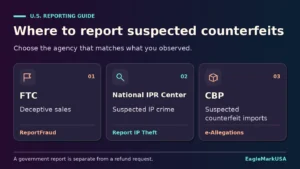
If you’ve been a victim of consumer fraud, report it to the FTC
If a seller appears to have passed off a fake as genuine or used deceptive sales practices, report it to FTC ReportFraud. Explain what the seller promised, what happened, and what you can document. Reports help the FTC and other enforcement agencies identify patterns. To seek a refund, start with the seller or marketplace and ask your payment provider about dispute options if needed. See the FTC’s online shopping tips.
Report suspected IP crime to the National IPR Center
For suspected criminal counterfeiting, such as multiple shipments of falsely labeled merchandise, submit the Report IP Theft referral form. The center accepts tips from the public and from businesses. Describe what happened and include names, locations, dates, and transaction numbers you can verify. A referral can help law enforcement assess the activity, but it does not guarantee prosecution.
Reporting of counterfeit imports to CBP.
If you have information that suggests a U.S. trade violation with imports that are counterfeit, submit an e-Allegation to CBP. Give whatever information you have about the importer or shipper, origin, carrier, tracking/shipment reference, and why you think the goods are counterfeit. If the package is just delayed or lost, go to the seller/shipper.
Owners of eligible federal trademark registrations can apply to record their registrations with CBP. Recordation helps CBP enforce existing trademark rights at the border.
What If You already bought a fake product?
- Document what arrived. Maintain the product, packaging, and order record. Take pictures of what is different before returning anything.
- Open a purchase issue. Contact the seller or marketplace, explain what arrived, and ask for a refund or another resolution. Check the return instructions and deadlines.
- Contact your payment provider promptly if needed. If you approved the purchase, explain that the item you received appears counterfeit or differs from what the seller promised. If you never approved the charge, report it as unauthorized. Ask what dispute options and deadlines apply to your payment method. See the FTC’s guide to credit card disputes.
- Report suspected fraud if appropriate. You can file a fraud report while pursuing a refund. Filing a report does not guarantee reimbursement.
- Discontinue use of a potentially unsafe object. If suspected to be a counterfeit medicine, seek immediate advice from a pharmacist or healthcare provider.
What happens after you report a counterfeit product?
| Who receives the report | What may happen |
|---|---|
| Moderation team in the marketplaces | Review of a listing, ad, or account; possible removal or restriction |
| Marketplace IP team | Review asserted rights and identified offer/content; possible follow-up or action |
| FTC | Information for the identification of patterns and for enforcement purposes |
| National IPR Center | Evaluation of a referral and/or coordination with law enforcement to address it |
| CBP | Review of suspected import violation, potential action on the border if necessary |
When is it appropriate for the trademark owner to take legal action?
Talk to a qualified U.S. trademark attorney if a seller keeps relisting products after takedowns, multiple accounts appear to use the same supplier, or the activity spans several marketplaces and may involve imports. Save copies of the listings and reports so counsel can review the pattern. Ongoing sales or significant losses may justify looking at options beyond a marketplace report.
Whether a court can order a seller to stop or award damages depends on the trademark rights, the evidence, and the facts. Trademark infringement can occur even when the goods do not meet the legal definition of counterfeit. A genuine product sold outside an authorized network raises a separate question. A marketplace’s decision does not determine whether you have a civil claim. See 15 U.S.C. §§ 1114, 1116, and 1117.
Frequently Asked Questions
In the United States, where can I report counterfeit products?
Start by reporting the listing to the marketplace. Report deceptive sales to FTC ReportFraud, suspected IP crime to the National IPR Center, and suspected counterfeit imports to CBP. For a refund, start with the seller or marketplace.
Who can report suspected counterfeit products?
In general, consumers and others can flag suspicious listings. A formal trademark complaint must be submitted by the rights holder or someone authorized to represent the rights holder on a platform’s rights owner complaint mechanism.
Do I need a registered trademark to submit a report?
You don’t need a trademark registration to flag a suspicious listing as a shopper or report suspected consumer fraud. Formal complaints have different requirements. For example, Amazon requires a relevant U.S. trademark registration for a rights-owner counterfeit claim on Amazon.com.
What to do if a seller is selling stuff that’s fake on eBay?
Identify the seller and include links to the listings you think violate eBay’s policy. If you own the trademark or are authorized to act for the owner, use VeRO to report suspected infringement.
How to report fake products on Facebook Marketplace?
On the specific Marketplace listing, use the report option. You can also use the appropriate Meta trademark reporting channel if you are the rights owner (or its authorised representative) and there is evidence to back that up.
What do I do if I have a counterfeit seller that I don’t know?
Employ identifiers that can be confirmed: If purchased, use the account handle, listing URL, the item ID, and the transaction reference. Say that the seller’s legal name is unknown. Don’t take guesses on the name of the user.
Will reporting a counterfeit product get the seller banned?
A platform may remove a listing or restrict an account under its rules. Removing a listing does not necessarily mean the seller’s account will be suspended.
Can I get a refund if I bought a counterfeit product?
You may be eligible for a refund under the marketplace’s policies or your payment provider’s rules. Open a purchase issue promptly and follow the return instructions. A listing removal or a government report does not automatically trigger a refund.
Can the sale of counterfeit goods be a federal offence?
Yes, in some circumstances. Under 18 U.S.C. § 2320, intentionally trafficking in goods or services while knowingly using a counterfeit mark can be a federal offense when the other statutory requirements are met.
Can I hold someone liable for selling fake versions of my product?
A civil claim may arise for a rights owner. The amount of strength in the case is dependent on the evidences, the seller’s conduct, and the mark. A U.S. trademark attorney will be able to take a look at the facts and potential remedies.
What to Do Next
Document what you found and choose the route that fits: report the listing, seek a refund, or send an enforcement tip. You may need to do more than one. A low price or a seller outside the brand’s authorized network can be a reason to look closer. Describe the evidence you have and call the item a suspected counterfeit if you can’t confirm it is fake.
EagleMarkUSA can assist with any trademark document preparation or trademark registration needs if you need assistance to understand the U.S. trademark records and registration for your brand. This document offers general information; seek expert guidance on the subject of a dispute.
